 Economy


China’s Professional Hair Care Brand ISYUN Announces Victoria song as Global Brand Ambassador, Accelerating Global Expansion with Strategic Focus on Southeast Asia
1.
|
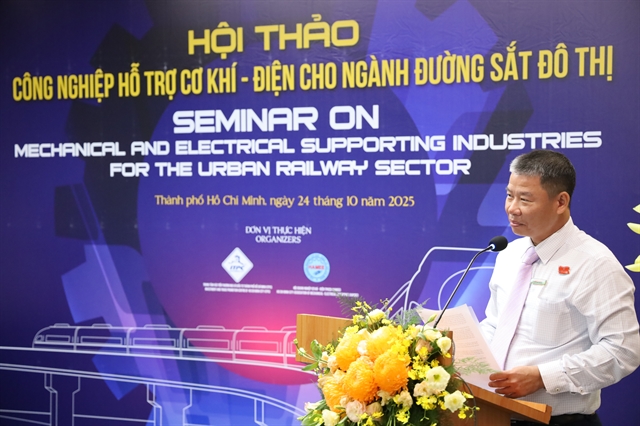
| Trần Thành Trọng, vice chairman of the HCM City Mechanical and Electrical Enterprises Association, speaks at the seminar. — Photo courtesy of ITPC |
HCM CITY — State management agencies, especially the HCM City Management Authority for Urban Railways (MAUR), should prioritise the use of locally made goods and services in metro projects to cut costs, enhance technological autonomy and foster Việt Nam’s urban railway industry, according to the HCM City Mechanical and Electrical Enterprises Association (HAMEE).
Speaking at a seminar on Mechanical and Electrical Supporting Industries for the Urban Railway Sector in HCM City on Friday, HAMEE vice chairman Trần Thành Trọng said urban railways are essential national infrastructure that help ease congestion, boost economic growth and symbolise the country’s industrial progress.
Under the Law on Bidding No 22/2023/QH15 and Decree No 24/2024/NĐ-CP, domestically produced goods are eligible for preferential policies based on localisation rates. Resolution No 188/2025/QH15 of the National Assembly, which pilots special mechanisms for developing urban railway networks in Hà Nội and HCM City, has also created opportunities for domestic manufacturers. It stipulates that contractors must prioritise the use of products and services that can be supplied locally.
Trọng affirmed that Vietnamese mechanical and electrical enterprises can fully undertake the installation of auxiliary systems such as power supply, backup generators, ventilation, fire prevention, automation and elevators. For components like rolling stock and tracks, enterprises need to start investing now.
He urged large enterprises to take the lead and support smaller firms to form domestic supply chains and prioritise local content wherever possible.
He also called on MAUR to further promote the use of domestic products to cut investment and maintenance costs and enhance industrial self-reliance. For components requiring imported equipment, Trọng proposed clear technology transfer roadmaps covering production, operation and maintenance.
Hồ Thị Quyên, deputy director of the Investment and Trade Promotion Centre of HCM City (ITPC), affirmed that the city’s metro investment plan is being developed in line with the Transit-Oriented Development (TOD) model, a transformative approach to urban development.
Metro systems can carry six to 10 times more passengers than buses and up to 100 times more than private cars. Operated with advanced electric technology, they are fast, safe, punctual and environmentally friendly. However, developing a metro network for a megacity like HCM City requires substantial financial and technical capacity, as well as efficient management and operational models, Quyên aded.
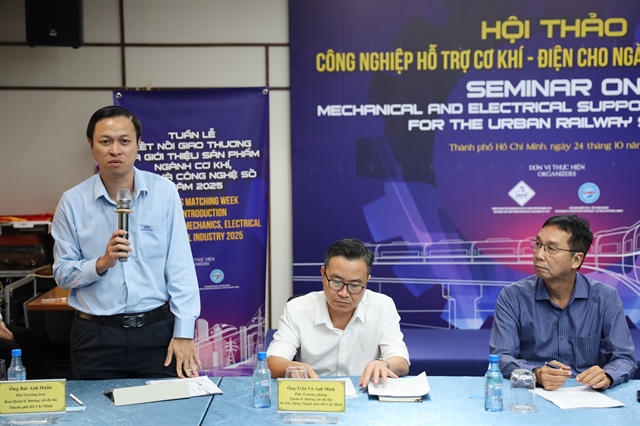
According to MAUR deputy head Bùi Anh Huấn, the Metro Line 2 (Bến Thành-Tham Lương) is scheduled to start construction in April 2026 and put into operations in December 2030.
Once completed, the line is expected to serve 227,000 passengers per day by 2030 and up to 1.5 million by 2060.
The project benefits from mechanisms under Resolution No 188, which allow the city to appoint EPC contractors, separate land clearance into independent projects and adopt Front-End Engineering Design (FEED) to shorten timelines, he said.
According to Trần Võ Anh Minh, deputy head of the Urban Railway Management Division under the HCM City Department of Construction, the city’s expanded urban railway network will exceed 1,000 kilometres, including 12 lines in the former HCM City area, 12 in Bình Dương and three in Bà Rịa–Vũng Tàu. By 2035, the city aims to complete 355 kilometres of metro lines, meeting 30–40 per cent of public transport demand, rising to 40–50 per cent after 2045.
|
| Bùi Anh Huấn, deputy head of the HCM City Management Authority for Urban Railways, answers questions from businesses at the seminar. — Photo courtesy of ITPC |
Minh said many private investors are showing strong interest in the city’s metro projects. The city has allowed investors to conduct feasibility studies and continues to guide them in completing necessary procedures.
He added that the city is reviewing its overall railway master plan and fully applying the mechanisms under Resolution No 188 to accelerate implementation and align with its new development vision.
Development of skilled workforce
The seminar also discussed the shortage of skilled labour, a major challenge for the sector’s development.
Dr Nguyễn Minh Khoa of the HCM City University of Technology estimated that between 2025 and 2030, the sector will need at least 35,000 workers, including 14,000 university graduates and 1,000 with postgraduate qualifications, mainly in engineering, signalling and infrastructure maintenance.
Việt Nam’s 3,300-kilometre railway network still relies on diesel technology and lacks electrification, resulting in low productivity. The planned transition to the 1,435-millimetre standard gauge by 2050 will require extensive manpower and upgraded training capacity.
Dr Tô Thanh Tuần, vice rector of LILAMA2 International Technology College, said closer cooperation between schools, enterprises and government bodies is essential. Training institutions should supply skilled workers and technology transfer; enterprises should define needs, support facilities and curricula; while government agencies should provide funding and quality assessments. Such collaboration would reduce retraining costs and ensure graduates are job-ready.
The workshop was jointly organised by ITPC and HAMEE as part of the 2025 Week of Trade Connection and Product Exhibition for Mechanical, Electrical and Digital Industries.” — VNS
Economy
 Economy
 Economy
 Economy
 Economy
 Economy
 Economy
 Economy
 Economy
 Economy
 Economy
 Economy
 Economy
 Economy
 Economy