 Sci-Tech
Vietnamese scientist wins ASEAN-US Science Prize for Women
1.
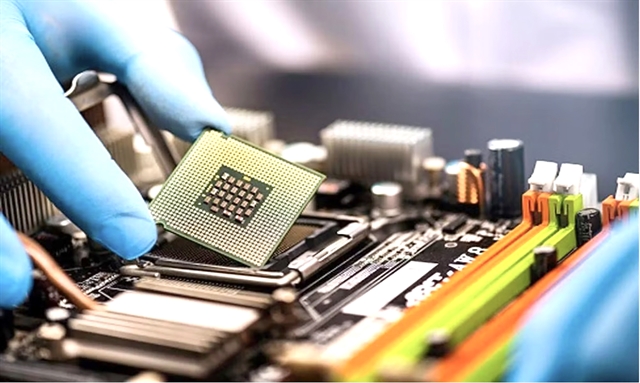 |
| A semiconductor chip. Hà Nội aims to become a leading centre for semiconductor industry development in the northern region of Việt Nam. Photo baochinhphu.vn |
HÀ NỘI – Hà Nội plans to introduce several preferential and support policies for the development of infrastructure and organisations operating in the fields of science, technology, innovation and digital transformation to concretise the Capital Law this year.
These policies are expected to serve as important foundational measures, helping Hà Nội become a centre of innovation in the next few years.
Hà Nội consistently ranks among the top localities in the Local Innovation Index, playing a crucial role in the national innovation ecosystem. Many large technology companies, research and development centres and high-quality training institutions are concentrated in the capital, creating a unique competitive advantage that few other localities possess.
However, alongside these positive results, practical development also shows that the city’s science, technology and innovation ecosystem has not yet fully realised its inherent potential.
The city People's Council recently passed a resolution on a number of preferential policies to support the development of science and technology infrastructure, innovation and digital infrastructure.
Under the resolution, Hà Nội will gain a mechanism to support investment, upgrading, renovation, repair and operation of scientific and technological infrastructure belonging to agencies and units in the area.
This is an important solution to gradually form a modern network of research and innovation infrastructure, serving the needs of research, testing and technology development.
The city will focus on research and development centres, key laboratories, technology incubators at universities, vocational education establishments, science and technology organisations and businesses.
Supporting these will help improve research capacity and promote technology transfer and commercialisation of research results, thus creating products and services with high added value.
Another policy will support the operation of the city's Technology Exchange, which is expected to help reduce initial investment costs, improve infrastructure exploitation and encourage the private sector to invest in high-tech fields.
The resolution provides many direct support policies for the business community and science and technology organisations.
Beneficiaries are numerous, including science and technology firms, science and technology organisations, innovation centres, intermediaries in the science and technology market and groups supporting creative start-ups.
One of the policies of interest to the business community is support for preferential loans through the City Development Investment Fund, an important resource to help businesses deploy new investment projects in science and technology, innovation and digital infrastructure.
Businesses also enjoy policies on exemption and reduction of land and property rent as well as tax incentives, according to the provisions of the Capital Law and related legal documents.
Chip industry development
The capital city of Hà Nội aims to become the leading northern hub for the semiconductor industry by 2030.
The target follows a five-year Plan 212/KH-UBND on developing the semiconductor industry in Hà Nội through 2030 which Vice Chairman of the Hà Nội People's Committee Trương Việt Dũng has signed.
Under the plan, the city will serve as a centre for research, design and manufacturing of semiconductor integrated circuits; a destination for leading Vietnamese and regional semiconductor enterprises; and a pioneer in piloting new training models, fostering public-private partnerships, strengthening cooperation among universities, research institutes and businesses, and effectively leveraging international integration opportunities to support Việt Nam’s chip development strategy.
The city will develop a skilled semiconductor workforce, focusing on improving the quantity and quality of trained personnel and gradually mastering key stages of semiconductor production.
It aims to train at least 22,000 workers with university degrees or higher to serve the industry.
Other targets include completing investment and development of the National Innovation Centre as well as a Semiconductor Research and Data Centre, both at Hòa Lạc Hi-Tech Park.
A semiconductor talent training system will also be built from secondary school to postgraduate level to meet the industry's development needs.
City authorities also aim to attract and help establish at least 20 enterprises specialising in integrated circuit design and semiconductor chip development for use in electronics manufacturing, electronic components and devices, telecommunications and information technology.
The city will also support semiconductor firms in using land resources, while striving to attract at least one strategic investor and promote investment and international cooperation in the semiconductor industry. VNS
Sci-Tech
 Sci-Tech
 Sci-Tech
 Sci-Tech
 Sci-Tech
 Sci-Tech
 Sci-Tech
 Sci-Tech
 Sci-Tech
 Sci-Tech
 Sci-Tech
 Sci-Tech
 Sci-Tech
 Sci-Tech
 Sci-Tech