 Society
Two women recognised for farming excellence, promotion of local specialties
1.
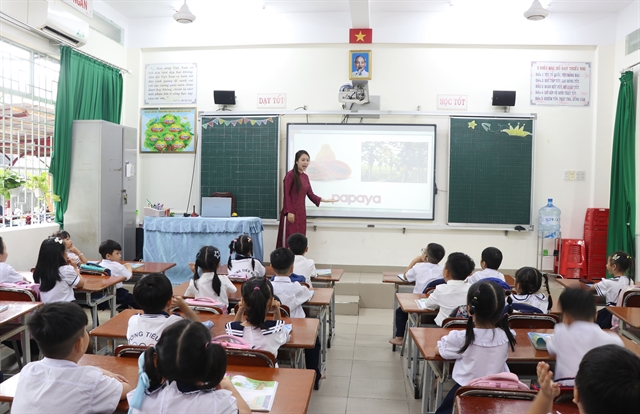 |
| Grade 1 pupils in an English lesson at the Nguyễn An Ninh Primary School, Đồng Nai City. — VNA/VNS Photo Lê Xuân |
ĐỒNG NAI — From laying the foundations of English learning in Grade 1 to creating an environment in which English is used regularly across schools, classes in Đồng Nai City are gradually helping pupils develop English-language reflexes and communication habits.
At the Nguyễn An Ninh Primary School, English has for many years been taught as an optional subject, giving pupils the opportunity to become familiar with a second language from an early age.
Cao Thị Hoài Thương, a Grade 1 teacher, said that to help pupils become familiar with English naturally, she uses it during English lesson and incorporates simple vocabulary into other subjects and experiential activities.
When introducing a new topic, she teaches pupils its English name, enabling them to learn subject knowledge while also memorising new words.
According to Thương, teachers regularly use simple English instructions and communication phrases in class, such as greetings, directions for activities and requests for pupils to respond with short sentences.
“For Grade 1 pupils, it is important to make English feel familiar and approachable. When they are exposed to and use English in everyday situations, they gradually become more confident and natural when communicating,” Thương said.
Hoàng Thị Ngọc, principal of the Nguyễn An Ninh Primary School, said the school had identified making English a second language within the school as one of the key objectives, and had prepared for it through a phased plan over previous academic years.
Ngọc said, to achieve this goal, the school regards its staff and teachers as a crucial foundation.
It has encouraged and supported teachers to proactively improve their English proficiency; some have pursued a second degree in English Language. The school has also established English clubs for teachers and students, creating opportunities for staff to use English regularly and gradually integrating it into teaching as well as school activities.
“I have found that pupils who become familiar with English from Grade 1 demonstrate greater confidence and quicker responses, and show more interest in the subject. Many are able to communicate with teachers, including foreign teachers,” said Ngọc.
The English clubs have also attracted pupils and provided them with additional opportunities to practise.
“This shows that early exposure to English is creating a favourable foundation for pupils to continue developing their foreign-language skills in the years ahead,” she said.
English steps outside classroom
While primary schools begin by building foundations through simple vocabulary and communication phrases, at secondary level English is being integrated into school life in a more accessible way.
At the Lê Quý Đôn – Tân Mai High School, every morning, as pupils pass through the school gate, they can hear and use English greetings with their teachers. Short English exchanges also appear in classrooms, corridors and everyday school activities.
Nguyễn Duy Khiêm, a pupil, said that from the moment he entered the school, he was encouraged to greet teachers in English and maintain simple English communication in class.
Using English regularly, he said, has helped him develop better language reflexes and greater confidence when communicating.
Timothy Luke Speake, a teacher, said that initially many students were hesitant about speaking English. But after using it every day and in every lesson, they became more confident and proactive in communicating.
Principal of the school, Vũ Thị Ni Na, said to better increase English, the school had been building an English-speaking environment, enabling pupils to listen, speak, practise and apply the language regularly and naturally in daily activities.
The school has developed English themes linked to learning activities and encourages students and teachers to use English from the simplest exchanges at the start of lessons. Vocabulary boards and English phrases are also displayed in corridors and stairwells, so they can “see English” and boost vocabulary every day.
“We encourage pupils to communicate more with foreign teachers in a variety of settings, both inside and outside the classroom. In this way, pupils gradually develop the habit of using English naturally and with greater confidence,” Na said.
The Đồng Nai City Department of Education and Training recently issued a document on expanding the environment for English communication, practice and use across subjects, educational activities and school life, with the aim of gradually making English a second language in schools.
Schools are encouraged to exercise initiative and creativity in developing communication environments, ensuring that pupils of different levels all have opportunities to use English. — VNS
Society
 Society
 Society
 Society
 Society
 Society
 Society
 Society
 Society
 Society
 Society
 Society
 Society
 Society
 Society