 Society
Sơn La applies science and technology to coffee production
1.
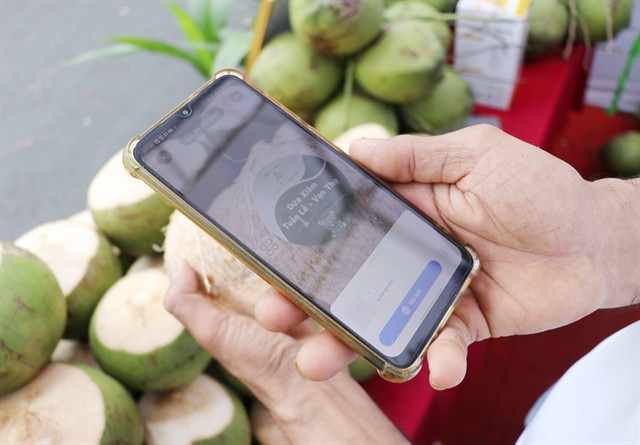 |
| A QR code application is used to trace the origin of Khánh Hòa’s farm produce. VNA/VNS Photo Nguyễn Thành |
KHÁNH HÒA — Khánh Hòa Province is stepping up digital transformation with a focus on serving residents, viewing it as a key driver of socio-economic development that can improve quality of life and the effectiveness of state management.
A wide range of tech solutions
The province has recently held a series of events showcasing digital ideas, solutions and services, giving residents the chance to try out digital products first-hand. New technologies such as artificial intelligence (AI), the Internet of Things (IoT), blockchain, mobile apps and augmented and virtual reality (AR/VR) have been introduced and applied in tourism, healthcare, transport and smart urban development.
Viettel Khánh Hòa has worked closely with the province, advising on and deploying new technology solutions. The company has focused on developing telecommunications infrastructure, rolling out 5G and upgrading shared databases and digital platforms, while also helping build digital government and promote digital transformation in tourism, transport, agriculture, e-commerce, healthcare and education.
Colonel Khổng Văn Kiên, deputy director of IT solutions at Viettel Khánh Hòa, said the company was introducing a range of modern technologies in the province, including Wi-Fi 7, surveillance cameras for security, traffic and high-altitude monitoring, and virtual reality products for tourism. It is also providing network security solutions, a Security Operations Centre (SOC) and smart city solutions.
Under its digital transformation scheme, Khánh Hòa is developing three pillars in parallel: digital government, digital economy and digital society.
In state management, the province has digitised administrative procedures, expanded full-process online public services and introduced the E-Office electronic document management system, which includes key performance indicator (KPI) tools to assess work performance. These measures have cut processing times for residents and businesses. Data sharing between provincial departments, sectors and localities has also been strengthened, making public administration more efficient and transparent.
Meanwhile, businesses are increasingly turning to e-commerce and cashless payments.
Digital transformation is also changing people’s daily habits, with digital apps becoming familiar tools for many residents. Nguyễn Thị Lành from Đông Hải Ward said that with just a smartphone, she could quickly and easily access online public services, pay electricity and water bills, school and hospital fees, and shop without cash.
Long-term goals
According to the provincial Department of Science and Technology, Khánh Hòa has made significant progress in implementing the Politburo’s Resolution 57-NQ/TW of December 22, 2024 on breakthroughs in science, technology, innovation and national digital transformation, particularly in building digital infrastructure and platforms.
The provincial data centre now operates at two sites, in Nha Trang and Phan Rang, with servers, storage and network equipment that meet safety and security standards. It runs the province’s shared platforms and information systems, backs up and restores data, and provides wide-area network connections for state agencies.
Khánh Hòa has also launched an Intelligent Operations Centre (IOC), which regularly receives data from government agencies and local systems and applications, allowing it to analyse information across multiple sectors. The centre helps provincial leaders spot problems early and respond promptly, while making government operations more efficient and transparent.
Phạm Quốc Hoàn, director of the department, said that in implementing Resolution 57, the province was developing science and technology, innovation and digital transformation together, with digital transformation taking the lead. The focus is on building infrastructure, data platforms and applications that serve residents, businesses and public agencies.
This year, Khánh Hòa is concentrating on telecommunications and internet infrastructure, expanding 5G coverage across the province with the aim of bringing the number of 5G base stations to at least 80 per cent of existing 4G stations. Average mobile download speeds are expected to double from 2025 levels to about 400 Mbps, while at least 30 per cent of users will have access to fixed broadband at speeds above 1 Gbps. The province expects to have 3,900 base stations in total, 80 per cent of them 5G-ready.
Khánh Hòa also aims to build 18,400km of fibre-optic cable, put fibre-optic cables underground along 3,900km of streets, extend 5G coverage to 80 per cent of the population and raise the share of internet subscribers using IPv6 to 90 per cent.
Alongside telecommunications, the province will continue to upgrade its data infrastructure, keep the IOC running, connect data from the provincial to the commune level, unify data across sectors and apply AI in database management.
To deliver on these goals, Khánh Hòa has set out five groups of tasks and 10 groups of solutions, with the Department of Science and Technology taking the lead.
Priorities include reviewing and improving policies to encourage telecommunications and IT companies to develop cloud computing and safe, modern digital infrastructure. The province will also accelerate investment in 5G base stations to cover every village, starting with urban centres, industrial parks, tourist areas and state agencies, and switch all information systems to the next-generation IPv6 protocol.
By 2030, Khánh Hòa aims for the digital economy to account for about 35 per cent of its gross regional domestic product (GRDP) and to rank among the top 10 localities nationwide in both the Provincial Innovation Index (PII) and the Digital Transformation Index (DTI).
With these measures, the province is steadily establishing itself as a leader in digital transformation and innovation, laying the groundwork for sustainable growth through 2030. — VNS
Society
 Society
 Society
 Society
 Society
 Society
 Society
 Society
 Society
 Society
 Society
 Society
 Society
 Society
 Society