 Society

Việt Nam, Denmark issue joint statement on establishment of Comprehensive Strategic Partnership
1.
|
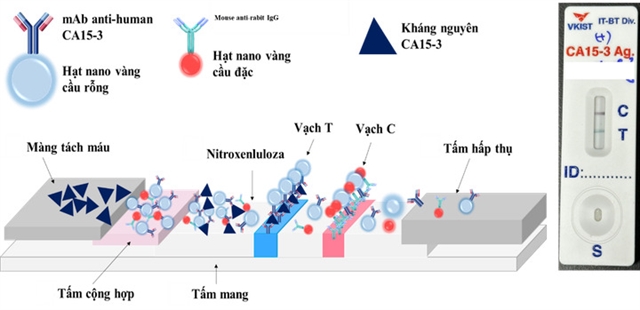
| Simulation of a multicolour test-strip design intended to verify test reliability. — Photos courtesy of research team |
HÀ NỘI — Vietnamese scientists are developing a technology platform for rapid diagnostic tests that could detect viruses, bacteria and cancer biomarkers, as the country seeks to build domestic capacity in a sector still heavily reliant on imports.
The platform is being developed by researchers at the Vietnam-Korea Institute of Science and Technology (VKIST) using lateral flow immunoassay (LFIA) technology, which is commonly used in rapid test strips.
The team is developing a flexible platform rather than individual kits for each disease. This would allow researchers to adapt the system to new pathogens or testing requirements by changing the relevant antibodies and selected technical parameters, while retaining much of the existing manufacturing process.
The platform includes technologies for producing functional nanomaterials, binding nanoparticles to antibodies, designing and manufacturing LFIA strips, evaluating their performance and controlling quality.
Building domestic capacity
Demand for point-of-care testing has increased in Việt Nam in areas including healthcare, veterinary medicine and food safety. Yet many high-quality diagnostic products are still imported.
The VKIST researchers say their objective is to master the core technologies needed to develop locally produced kits that meet quality standards and are appropriate for use in Việt Nam.
The key technical challenges are sensitivity, specificity and stability, all of which depend on precise control of the production process. Researchers must optimise everything from nanoparticle synthesis and surface chemistry to antibody binding and capillary flow through the nitrocellulose membrane.
A member of the research team said the main benefit would be the ability to develop new products quickly when demand emerges, rather than the creation of a single diagnostic kit.
The platform comprises five main areas: functional nanomaterials; surface chemistry and covalent conjugation; LFIA strip production; performance testing and quality control; and product development, intellectual property protection and commercialisation.
The team’s covalent-conjugation technology, which creates a stable link between nanoparticles and antibodies, is protected by Vietnamese Utility Solution Patent No. 4603.
Researchers have also developed a label based on hollow spherical gold nanoparticles. They say the material produces a stronger optical signal than the solid gold nanoparticles commonly used in conventional strips, potentially allowing the detection of lower concentrations of target substances.
The production technology for the strip is protected under Utility Solution Patent No. 4711.
A further development is a two-colour test strip protected under Utility Solution Patent No. 4859, granted in March 2026.
|
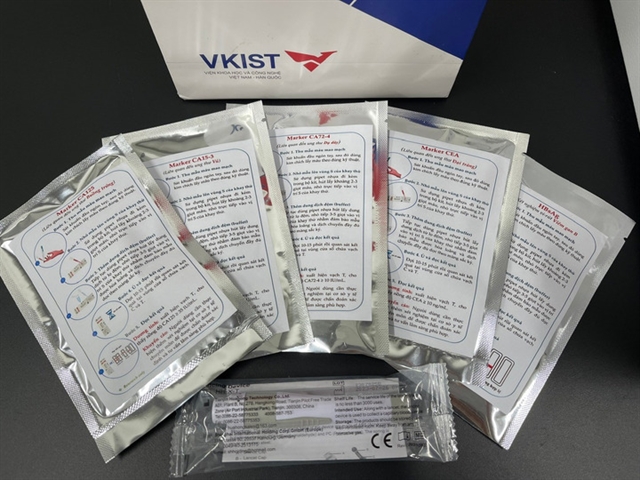
| Prototype test strips for detecting viruses, bacteria, and cancer biomarkers developed using the new platform. |
The strip uses hollow spherical gold nanoparticles to produce a blue signal at the test line. At the control line, the combined capture of solid and hollow particles produces a purple signal.
The researchers say the colour combination provides users with more information than a conventional control line. A purple control line indicates that the sample has flowed correctly through the strip and that the biological activity of the antibody-nanoparticle conjugate has been maintained during storage and use.
The design is intended to help identify tests that have not functioned correctly, but the prototypes will require further testing and regulatory approval before they can be used as commercial diagnostic products.
From prototypes to commercial products
The team has produced prototypes targeting a range of applications, including H5N1 influenza and hepatitis B, as well as bacteria such as E. coli, Pseudomonas and Klebsiella.
Other prototypes target cancer biomarkers including carcinoembryonic antigen, or CEA, alpha-fetoprotein, or AFP, prostate-specific antigen, or PSA, and CA15-3.
The next phase will involve collaboration with hospitals, healthcare providers and companies to carry out larger clinical evaluations.
The researchers also plan to complete a quality-management system, standardise production procedures and apply for regulatory approval.
VKIST said the project was intended to establish a full development chain, from core research and testing to manufacturing and commercialisation, and ultimately support the launch of rapid diagnostic products made in Việt Nam. — VNS
Society
 Society
 Society
 Society
 Society
 Society
 Society
 Society
 Society
 Society
 Society
 Society
 Society
 Society
 Society