 Society
Vietnamese scientist wins ASEAN-US Science Prize for Women
1.
|
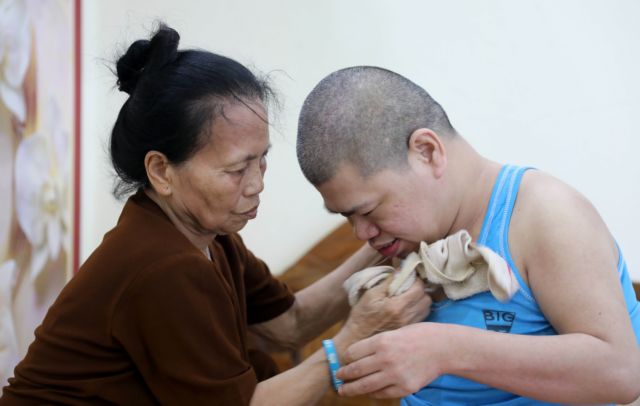
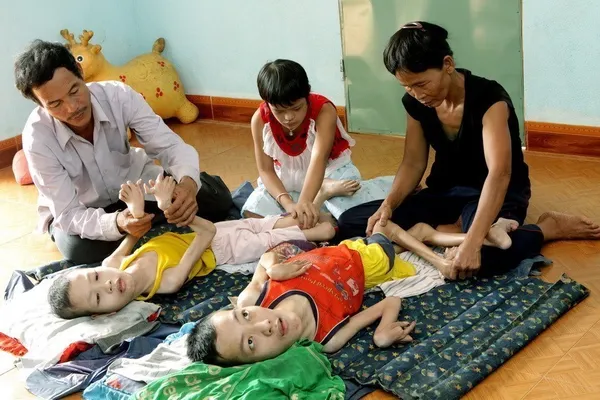
| Although elderly, Phạm Thị Lán, from Diên Hà Commune, Hưng Yên Province, still has to care daily for her son, who has been bedridden for 41 years due to the effects of Agent Orange. — VNA/VNS Photo Thế Duyệt |
HÀ NỘI — Sixty-five years have passed since August 10, 1961, when the US military began carrying out large-scale chemical toxin spraying operations in Việt Nam.
The consequences of their actions still persist today, causing severe damage to the environment, human health and future generations.
In the journey to care for and assist victims of Agent Orange (AO)/Dioxin, the Party and the State have always said this is an issue of profound political, social and humanitarian significance.
It is a long-term responsibility of the entire political system and the whole society.
Deep concern
On March 1, 1999, then Prime Minister Phan Văn Khải issued Decision No. 33/1999/QĐ-TTg establishing the National Steering Committee for Overcoming the Consequences of Chemical Toxics Used by the US in the War in Việt Nam.
The committee’s functions and tasks are to formulate long-term plans and annual plans and to conduct programmes to overcome the consequences of chemical toxins from central to grassroots level.
On July 5, 2004, then PM Khải promulgated Decision No. 120/2004/QĐ-TTg on certain regimes for people who participated in the resistance war and their biological children who suffered due to exposure to chemical toxins.
Later, on December 18, 2009, the Party Central Committee’s Secretariat issued Conclusion No. 292-TB/TW on resolving the consequences of chemical toxins and on the work of caring for and assisting AO victims, and on organising the activities of the Việt Nam Association for Victims of AO/Dioxin.
The notification clearly stated: “Party committees and authorities at all levels need to focus their leadership and direction and adopt specific measures to effectively resolve this task.”
In particular, Directive No. 43-CT/TW dated May 14, 2015 of the Secretariat on strengthening the Party’s leadership in resolving the problems created an important basis for mobilising the strength of the entire political system to participate in the work.
After more than 10 years, awareness and actions of all sectors have seen many changes. Work on victim care, dioxin contamination remediation, scientific research and international cooperation has achieved many positive results.
Preferential allowances, healthcare, rehabilitation, vocational training, employment and livelihood assistance have gradually been expanded to help affected families overcome hardship and stabilise their lives.
These efforts reached a new milestone in 2026, when a nationwide programme was launched for the first time to replace temporary and dilapidated homes belonging to the children of resistance war veterans exposed to toxic chemicals.
In March, the Prime Minister issued Official Dispatch No 270/TTg-KGVX, approving the use of unspent money from the Central Fund for the Poor to support the programme.
By the end of last month, more than 2,000 houses had started construction, nearly 900 houses had been completed, and more than 44,000 worker-days of officers and soldiers had been mobilised to participate in building and repairing houses for the beneficiaries.
The campaign 'Actions for victims of AO', launched by the Việt Nam Fatherland Front Central Committee in June 2011, has spread widely, attracting the attention and active response of the community, organisations and individuals both domestic and abroad.
In addition, from its establishment until the end of last year, the Việt Nam Association for Victims of AO/Dioxin at all levels have called for VNĐ5 trillion (US$191.1 million) to support and care for victims.
Among this, they have supported the construction and repair of 15,266 houses; and regularly cared for more than 6,100 victims at social protection centres and within the community.
International friends’ compassion
|
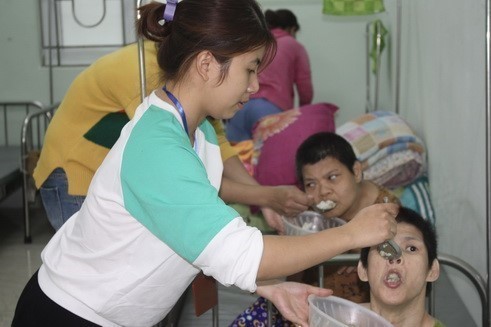
| Staff at the Hà Nội Centre for Care, Nurturing and Treatment of Victims of Agent Orange/Dioxin always devote themselves wholeheartedly to caring for the victims. — VNA/VNS Photo Hồng Kỳ |
A project by the Green Cross International (Switzerland) supported a programme to assist AO victims in Đà Nẵng City during the 2023–24 period, with total funding of over VNĐ1 billion ($38,200).
The United Nations Children’s Fund (UNICEF) supported a child-friendly project for the 2023–26 period with $50,000.
In 2023, the Chamber of Representatives (Belgium) adopted a resolution supporting Vietnamese AO victims with absolute consensus. After the resolution, many contents of cooperation were implemented.
The Việt Nam Association for Victims of AO/Dioxin and the Brussels-Capital Region authorities exchanged a framework agreement on supporting efforts to overcome the consequences of AO in Việt Nam.
Alongside this, the Aquitara Impact Fund 1 (AIF1) has conducted livelihood support programmes oriented towards creating jobs and increasing income for victims.
The 'An Vui Mart' convenience store model in Đồng Nai has initially brought effectiveness, with participating households all maintaining profitable business operations. The fund plans to expand the model to Hà Nội and Hưng Yên with more than 130 stores, with total funding of around VNĐ25 billion ($955,800).
In addition, the Project to Support Persons with Disabilities in localities heavily sprayed with AO was jointly implemented by the Government of Việt Nam and the US Agency for International Development (USAID) in Quảng Trị, Thừa Thiên-Huế, Đà Nẵng, Đồng Nai and Tây Ninh, with a committed total budget of $65 million.
To date, more than 32,000 persons with disabilities and AO victims have accessed healthcare services, rehabilitation, livelihood support and community reintegration. The US Government has enhanced cooperation on dioxin contamination remediation at hotspots in Việt Nam.
Following the completion of an environmental remediation project at Đà Nẵng Airport, approximately 32.4ha of contaminated land was cleaned and handed over for defence, security and socio-economic development purposes.
At Biên Hòa Airport, the country’s largest ongoing dioxin remediation project continues to make progress. According to the implementing agency, the excavation of contaminated soil has reached about 48 per cent across the project’s total area of 62ha. Surveying, sampling and treatment work is continuing as scheduled.
Gratitude
During recent days, ceremonies to mark 65 years of the AO disaster have been organised in numerous provinces and cities across Việt Nam.
Speaking at one ceremony, Phạm Văn Nghiêm, deputy chairman of the Hưng Yên Province People's Committee, promised to strengthen education work, raise awareness and responsibility across the entire society; promptly resolve policies on health insurance allowances, convalescent care and rehabilitation for the AO victims.
The province will effectively mobilise social resources to support livelihoods and improve living conditions for families of AO victims, with a focus on removing temporary and dilapidated houses, further promote the role of AO victim associations at all levels, spreading humanitarian values within the community.
In Thái Nguyên Province, Nông Quang Nhất, deputy chairman of the provincial People's Committee, expressed his deep gratitude to war invalids, sick soldiers, resistance fighters exposed to chemical toxins and families of AO victims in the province.
He urged agencies, departments, sectors, enterprises, organisations and individuals to continue joining hands and accompanying AO victims, so that they do not feel alone in life and their pain is eased.
The consequences of AO remain very heavy and long-lasting. There are still victims who need to be cared for, families who need to be supported, areas of land that need continued contamination remediation and affected generations who need to be accompanied.
The work of overcoming the consequences of AO remains a long-term task, requiring persistence, resources, and joint efforts of the entire society and international friends. — VNS
Society
 Society
 Society
 Society
 Society
 Society
 Society
 Society
 Society
 Society
 Society
 Society
 Society
 Society
 Society