 Sci-Tech
Digital transformation makes construction supervision green, smart
1.
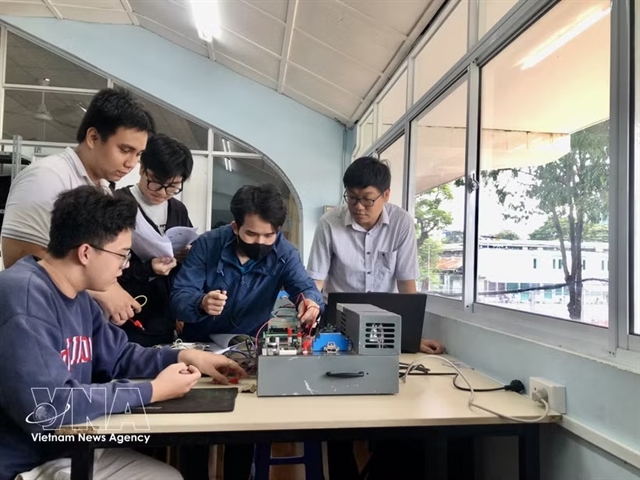 |
| Students at the Hồ Chí Minh City University of Technology – Việt Nam National University, Hồ Chí Minh City, practise applying advanced technologies. VNA/VNS Photo |
HÀ NỘI — Việt Nam is stepping up efforts to build a high-quality artificial intelligence (AI) workforce, from connecting Vietnamese AI experts worldwide to expanding domestic training and research, in line with the Political Bureau's Resolution No. 57-NQ/TW on breakthroughs in science, technology, innovation and national digital transformation.
Tapping global Vietnamese expertise
The Ministry of Science and Technology has recently established the global network of Vietnamese AI experts under Decision No. 3335/QD-BKHCN, bringing together Vietnamese scientists, experts and entrepreneurs at home and abroad, as well as international experts interested in contributing to Việt Nam's AI development.
The network aims to attract global Vietnamese AI talents, strengthen links among research institutions, businesses and experts to form strong research teams and promote commercialisation, while mobilising experts to advise on policies and key national AI programmes and projects.
Operating as an open, flexible and voluntary platform rather than an administrative organisation, the network will focus on practical challenges facing Việt Nam and encourage international and public-private cooperation. It is expected to support the development of strategic AI models, platforms and products in prioritised areas such as healthcare, education, smart cities, cybersecurity and national data.
At a consultation with key network members, Minister of Science and Technology Vũ Hải Quân stressed the need to bring AI into schools and businesses, train and connect global AI experts, and involve them in policymaking. He said the knowledge and contributions of Vietnamese AI experts at home and abroad serve as a core driving force and a prerequisite for substantive and effective AI development.
Identifying training and research as two key pillars of the network, Quân said leading experts should engage in teaching, update knowledge and inspire younger generations, while connecting domestic and overseas resources to tackle major challenges, conduct research and master strategic AI technologies.
Bringing experts from universities, research institutes and major technology corporations closer to students would help build a future pool of AI specialists and chief architects, he added.
The ministry also plans to apply models such as Singapore's "100 Experiments", which connects businesses posing practical problems with universities and research institutions providing talent and research capacity, with the State supporting mechanisms and resources. Besides, a "Global Mentoring" model could also connect overseas Vietnamese experts with domestic educational institutions, research institutes and businesses.
The National Foundation for Science and Technology Development (NAFOSTED) will serve as the focal point for developing and implementing support programmes and funding key AI research projects and tasks, while the Posts and Telecommunications Institute of Technology will take the lead in professional activities, organising forums and workshops, and connecting experts.
The selection of research tasks will follow the principles of competition, transparency and fairness, towards connecting intellectual resources, creating value and working together to address major challenges, Quân said.
Giving organisations greater autonomy to attract talents
Quân has also called for greater autonomy for universities, research institutes and businesses in recruiting and retaining talents, noting that the "administrativisation" of talent recruitment has been a major bottleneck.
According to the minister, the experience of the VNU 350 programme at Việt Nam National University-HCM City, which has attracted nearly 100 PhDs from overseas and nearly 100 visiting professors, shows that competitive salaries alone are not enough. Scientists also need an environment with students, laboratories, projects and colleagues in which they can develop.
Alongside the AI experts network, Prime Minister Lê Minh Hưng on August 11 approved the National Programme on AI Human Resources Development through 2030, with a vision to 2035.
The programme aims to strengthen national technological autonomy and make AI use an essential skill for learners, workers and managers. By 2030, at least 80 per cent of general education students are expected to receive basic AI knowledge and skills, while all higher education students and at least 80 per cent of vocational education students will be equipped with basic AI, ethics and data security knowledge.
It also targets AI training for at least 90 per cent of public-sector officials and employees, at least 10 million labourers, and 100,000 teachers, lecturers and education managers through advanced programmes.
At the high-quality end, the programme seeks to train or upskill at least 50,000 university-level personnel capable of applying AI in key sectors and at least 10,000 highly qualified AI researchers, engineers and experts. Of these, at least 1,500 are expected to master core technologies and lead major AI tasks.
Together, the global network and national training programme are designed to create an AI workforce that is sufficiently large, highly skilled and adaptable, enabling Việt Nam to progressively strengthen its capacity to research, develop, master and apply strategic AI technologies. — VNA/VNS
Sci-Tech
 Sci-Tech
 Sci-Tech
 Sci-Tech
 Sci-Tech
 Sci-Tech
 Sci-Tech
 Sci-Tech
 Sci-Tech
 Sci-Tech
 Sci-Tech
 Sci-Tech
 Sci-Tech
 Sci-Tech
 Sci-Tech