 Sci-Tech
.jfif)
Investors look for new drivers after market upgrade
1.
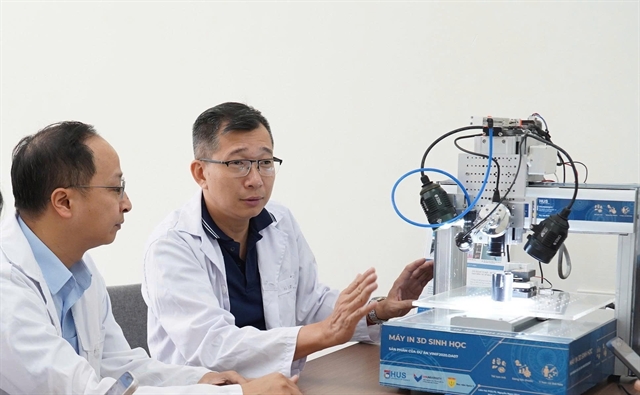 |
| Nguyễn Hoàng Nam (second, left), director of the Centre for Nano and Energy, vice dean of the Faculty of Physics, University of Science, under the Vietnam National University, Hanoi and his colleague. — VNA/VNS Illustrative Photo |
HÀ NỘI — A dedicated chapter on risk management in the funding and commissioning of science and technology projects has been introduced for the first time under a newly-issued Government decree.
The Decree No. 229/2026/NĐ-CP on the organisation and operation of the National Foundation for Science and Technology Development was issued on Thursday by the Government.
Associate Professor Đào Ngọc Chiến, director of the National Foundation for Science and Technology Development, said risk management is embedded from the very beginning of the project selection process.
Each proposed research project will undergo a risk assessment based on evaluations provided by scientific advisory councils.
The decree also clearly defines the risk management responsibilities of organisations and individuals undertaking science and technology projects funded or commissioned by the foundation, as well as the foundation's own risk management obligations.
Specifically, when the foundation receives reports from host organisations or project leaders regarding emerging risks in funded or commissioned projects, it is required to conduct ad hoc inspections and assessments to evaluate response capabilities, mitigate consequences, and determine the causes and extent of the risks involved.
If evidence of fraud or deliberate legal violations is detected during project implementation, the foundation will report the matter and recommend that the competent authorities take action in accordance with the law.
"Our guiding principle is to accept risks in a controlled manner," Chiến said.
Where a project fails to achieve its intended outcomes, organisations or individuals that have complied with professional procedures, management regulations and transparency requirements may be exempt from administrative liability, and funding will not be reclaimed under current regulations.
Chiến also added that one of the decree's key features is its clearer definition of the foundation's operating model as an independent science and technology funding body that functions transparently and competitively in line with international standards.
He said the foundation's operations have also been redesigned to enhance autonomy while linking decision-making authority with accountability.
Funding, commissioning and support activities will be carried out through independent expert evaluations, ensuring academic freedom, objectivity, openness and transparency, while upholding scientific integrity and professional ethics in research and technological development.
Another major reform introduced by the decree is a new financial mechanism that grants the foundation greater operational autonomy by shifting from input-based management to an output-oriented funding model.
The decree also sets out provisions to support initiatives aimed at strengthening the country's science and technology capacity.
Under the new regulations, the foundation will support the development of the national science and technology workforce through schemes for young scientists, postdoctoral researchers and doctoral candidates.
It will also fund overseas research placements and short-term academic exchanges, invite distinguished international scientists to Việt Nam for scholarly collaboration, and provide assistance to outstanding young scientists and talented young engineers.
Notably, the decree introduces support for research activities undertaken by leading scientists with outstanding achievements in scientific research and technological development, helping foster high-performing research groups and enhance national scientific and technological capabilities.
Another new provision, set out in Article 19 of Chapter IV on support for strengthening national science and technology capacity, stipulates that the foundation will finance technology validation activities for technologies derived from scientific research outcomes, patents, technical solutions, technology prototypes and transferred technologies requiring validation under Vietnamese conditions.
The objective is to assess their scientific and technical feasibility, complete validation data and ensure that technologies have reached the required level of readiness for further development or commercial transfer.
He said that technology validation support represents a crucial transitional stage for promising research ideas that have yet to become fully developed products.
“Assistance in refining technologies and evaluating their practical applications will enable research outcomes to reach the market more effectively and facilitate the establishment of technology-based start-ups,” he said. — VNS
Sci-Tech
 Sci-Tech
 Sci-Tech
 Sci-Tech
 Sci-Tech
 Sci-Tech
 Sci-Tech
 Sci-Tech
 Sci-Tech
 Sci-Tech
 Sci-Tech
 Sci-Tech
 Sci-Tech
 Sci-Tech
 Sci-Tech