 Society

HKSTP Partners with Leading Science and Technology Company Merck to Open a New Chapter in I&T Collaboration
1.
|
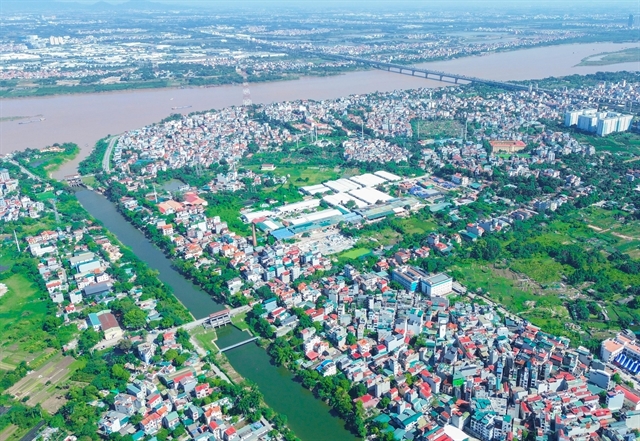
| Dense housing sits alongside vacant parcels in a corner of Hà Nội. — VNA/VNS Photo |
HÀ NỘI — Records for nearly two-thirds of its land parcels have been digitised in a sweeping push to build a national land database by the end of the year, but officials acknowledge that millions of parcels remain unregistered or fall short of quality standards.
As of June 15, the Ministry of Agriculture and Environment had compiled data for 64.4 million of the country's 102.5 million land parcels, roughly 63 per cent of the total.
Of those, only 28.8 million meet what officials describe as the 'accurate, complete, clean and live' standard, meaning records are verified, up to date and integrated into real-time systems.
Some 38.1 million parcels, or about 37 per cent of the national total, still have no digital record at all.
Mai Văn Phấn, deputy head of the ministry's Land Administration Department, said the ministry had completed five of its nine assigned priority tasks under Directive 05, an urgent, whole-of-government push to accelerate cadastral mapping along with land registration and database construction.
Key achievements include the issuance of Circular 19, which establishes unified technical standards for cadastral surveying and data construction nationwide, as well as the rollout of standardised software to manage the national land information system.
The ministry has also deployed nine inter-agency task forces to work directly with provincial authorities and launched an around-the-clock online support tool to help localities troubleshoot implementation problems.
Despite the progress, the road ahead remains steep.
Phấn said approximately 35.6 million land parcels have data on file but fail to meet current quality benchmarks, primarily because records were built in earlier phases under outdated technical standards and often lack verified owner information or do not reflect changes in land-use rights.
The largest unresolved backlogs are concentrated in provinces with large land areas, including Thanh Hóa, Phú Thọ, Nghệ An and Tuyên Quang.
Funding is emerging as another critical constraint. Eighteen of the country's 34 provinces and cities have formally requested central government budget support for their database construction efforts, with combined needs totaling nearly VNĐ15 trillion (about US$570 million).
Technical integration has also proven difficult. Although 28.8 million parcels now meet quality standards, only 1.06 million records have actually been synchronised to the National Data Centre because of data quality mismatches and server overloads when multiple provinces and cities attempt to upload simultaneously.
Administrative reform, a prerequisite for making the database useful in practice, is also lagging. While 28 of 34 provinces and cities have begun restructuring their land-related administrative procedures to reduce paperwork and rely more on digital data, the overall restructuring rate stands at just over 41 per cent nationwide.

|
| Two cadastral officers visits an elderly woman at her home in the south central province of Quảng Ngãi to help her complete her land registration paperwork. — VNA/VNS Photo |
Officials attribute the slow pace partly to the sweeping decentralisation of authority to provincial governments, which has left many localities uncertain about how to design their new procedures.
Some localities have moved aggressively to get ahead of the deadline. In the mountainous northern province of Lào Cai, authorities launched a '120 days and nights' campaign to compress what would have been a nine-month work plan into four months.
Every commune and ward in the province established its own ground-level task force to audit and standardise records, with accountability assigned to each unit under a five-point framework the province summarised as 'clear personnel, clear tasks, clear timelines, clear responsibilities, clear deliverables.'
Đồng Tháp Province in the Mekong Delta had synchronised 2.36 million parcels to the national system by the end of May, with 1.24 million meeting full quality standards.
Officials there distilled the experience into five lessons, including using data as the foundation for administrative reform, replacing paper documents with digital records and keeping the database in a continuously updated 'live' state.
Thanh Hóa, which ranked 33rd out of 34 provinces and cities on the ministry's progress ranking just one quarter ago, has climbed to 15th place, one of the steepest improvements in the country.
HCM City leads all localities in the number of parcels synchronised to the national system, with 4.2 million, followed by Thái Nguyên and Gia Lai.
Minister of Agriculture and Environment Trịnh Việt Hùng said the results from top-performing provinces and cities demonstrate that close coordination between land management agencies and the national police – who hold the population registry used to verify land-owner identities – is the decisive factor in building quality data.
Officials and provincial representatives agreed that cross-referencing land records against the national population database is essential for catching errors, reducing verification time and ensuring accuracy.
They also identified the completion of administrative procedure reforms as a necessary condition for the database to be operationally useful once construction is finished.
The ministry has called on all provinces and cities to accelerate administrative restructuring, strengthen inter-agency coordination and bring software vendors into the workflow design process from the outset, so that digital systems and administrative procedures are built in sync with each other.
In Hà Nội, the city government this week issued a directive ordering its Department of Agriculture and Environment to bring all surveyed parcels – approximately 3.25 million – up to the 'accurate, complete, clean and live' standard by June 30.
An additional 950,000 agricultural parcels currently being surveyed must be completed by August 30. — VNS
Society
 Society
 Society
 Society
 Society
 Society
 Society
.jpg) Society
Society
 Society
 Society
 Society
 Society
 Society
 Society
 Society