 Op-Ed
Op-Ed

Artists explore memory and change in Hà Nội exhibition
1.
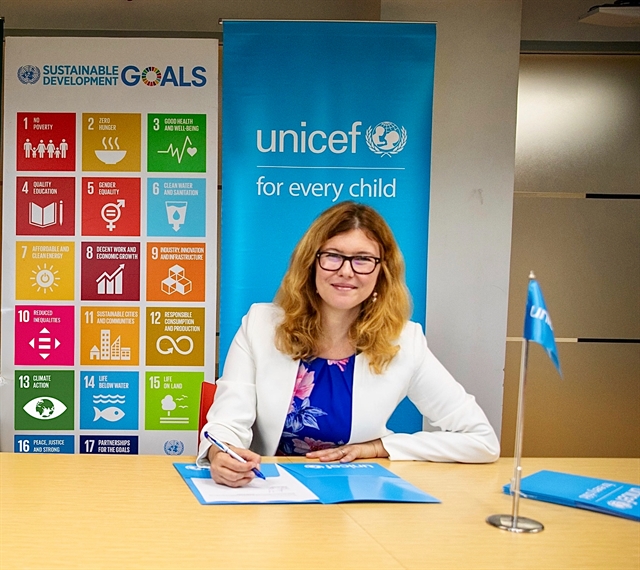 |
| Silvia Danailov, UNICEF Việt Nam Representative. — Photo from UNICEF Việt Nam |
I still remember a conversation with a young girl during a visit to a remote community. With quiet confidence, she told me she wanted to become an engineer. She had only just begun learning to use a computer – but already, the digital world had expanded what she believed was possible.
At home, I see that same sense of possibility in my own teenage children. Like many young people today, they spend a significant amount of time online – learning, researching issues that interest them and connecting with friends. Their experiences remind me every day of both the opportunities and the risks of growing up in a digital age.
For children across Việt Nam and around the globe, digital technologies represent an enormous promise. Artificial intelligence is rapidly transforming every aspect of our lives. For children and young people, these technologies offer extraordinary opportunities – to learn, develop, connect and build the skills they will need for the future.
But the same technologies are also creating new forms of harm – particularly in the area of child online sexual abuse and exploitation. Today, children no longer need to share an image to become victims. With generative AI, it is now possible to create highly realistic sexual images or videos of children without their knowledge or consent. This is not a future risk. It is happening now - quietly, rapidly, and at a scale that should concern us all.
A new and evolving threat
What makes this moment different is not just the nature of the harm and exploitation, but how easily it can occur.
Technologies that once required specialised expertise are now widely accessible. With just a few clicks, images can be manipulated, identities misused, and children targeted in ways that are difficult to detect or trace.
We are seeing a rise in AI-generated abuse material and 'deepfake' – images used to humiliate, threaten or control. A recent UNICEF, ECPAT and INTERPOL study across 11 countries found that at least 1.2 million children reported their images had been manipulated into sexually explicit deepfakes in the past year. In some cases, children themselves create or share such content without fully understanding the consequences. Increased accessibility of AI-powered image and video generation tools has led to a rise in the production and spread of child sexual abuse materials (CSAM).
This is what makes the challenge so complex: it is evolving faster than our systems can respond.
The harm is real and lasting
There can be a tendency to think that if an image is not 'real', then the harm is less serious. But that is not how children experience it. For a child, the fear, the shame, and the loss of trust are real. Digitally created images can follow them for years, affecting how they see themselves and how others see them.
Even more concerning is that children can now be harmed without ever interacting with a perpetrator, without sending a message, and without even knowing it is happening.
This fundamentally changes what protection means, not only for governments and systems, but also for families like mine navigating how to keep children safe online.
What this looks like on the ground
During visits to UNICEF-supported programmes, I have seen both the promise and the risks of the digital world.
In one innovation club, I met a group of girls learning to code. One 12-year-old from an ethnic minority community proudly showed me a game she had created - inspired by her village life. Technology gave her confidence and a voice.
But in another community, I met children with smartphones but no guidance. They navigated online spaces alone, unsure what was safe and where to turn for help. One boy told me that when something upset him online, he stayed quiet. He did not want to worry his parents. This silence worries me most, because the children most at risk are often those who are connected but not protected.
Implications for Việt Nam
Nearly nine in ten children aged 12-17 in Việt Nam are now online, many spending five to seven hours a day on the internet. Digital technology has become an integral part of childhood.
AI-driven risks add a new layer to existing challenges such as cyberbullying and online exploitation, while also exposing inequalities between children who are supported and those who are not.
This is not simply about technology. It is about how we protect children in a changing world.
Việt Nam has made important progress, with a strong legal and policy framework on child protection, cybersecurity and digital governance, increasingly focused on prevention and child-centred approaches.
This framework continues to evolve. A new government decree, effective 16 May 2026, strengthens children’s right to privacy by prohibiting the disclosure of a child’s personal information without the consent of the child (aged 7 or older) and their parents or caregivers - an important step as digital risks grow more complex.
Việt Nam has also demonstrated strong international leadership. As the second country in the world to ratify the United Nations Convention against Cybercrime, also known as the Hà Nội Convention, Việt Nam has sent a powerful message that the digital future must be safe, secure and protective of children.
Building on this, the Government has approved the National Programme on Child Online Protection and Support for Development, 2026–2030 to protect children and empower them as confident digital citizens through a stronger legal framework, improved systems, better education and coordinated action.
However, gaps remain in the legal framework, enforcement mechanisms need strengthening, and better alignment with the rapidly evolving digital environment is required. These challenges continue to affect the effectiveness of child protection.
These are critical steps – but they must be matched with action. Government institutions, civil society, international partners, and the private sector all have essential roles to play. Technology companies have a clear responsibility to respect and protect children’s rights in the digital environment. This means designing safer platforms and tools by default, conducting robust risk assessments, and taking proactive steps to prevent, detect and respond to harm.
A call for decisive action
The pace of change leaves no room for delay – we must act now.
Government must keep laws and enforcement aligned with rapidly evolving technologies and invest in strengthening child protection systems to prevent, detect and respond to harm in both online and offline spaces.
Technology companies must ensure children’s safety is built into the design of platforms.
Schools and families must be equipped – not overwhelmed – to support children online.
And we must build systems that children trust, so no child faces harm alone.
Above all, we must listen to children and work with them to create a safer online environment.
A shared responsibility for the future
Artificial intelligence has the potential to transform children’s lives for the better. I see that potential in classrooms, in communities, and at home – in the curiosity and creativity of my own children.
But technology does not shape itself. We shape it – through the choices we make, the protections we build, and the responsibility we take.
The question before us is: Will we allow innovation to outpace protection, or will we act now to ensure every child is safe?
The future we build must be one where children are not only connected—but also protected, respected and empowered.
And that is a responsibility we all share. — VNS
*Silvia Danailov is the UNICEF Việt Nam Representative
Op-Ed
 Op-Ed
Op-Ed
 Op-Ed
Op-Ed
 Op-Ed
Op-Ed
 Op-Ed
Op-Ed
 Op-Ed
Op-Ed
 Op-Ed
Op-Ed
 Op-Ed
Op-Ed
 Op-Ed
Op-Ed
 Op-Ed
Op-Ed
 Op-Ed
Op-Ed
 Op-Ed
Op-Ed
 Op-Ed
Op-Ed
 Op-Ed
Op-Ed
 Op-Ed
Op-Ed