 Society
Cambodian PM Hun Manet chairs welcome ceremony for Vietnamese counterpart Lê Minh Hưng in Phnom Penh
1.
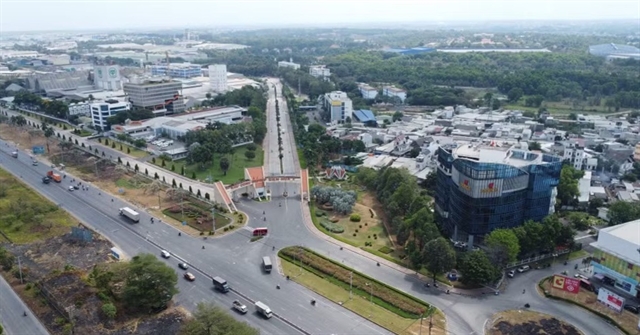 |
| A view of Biên Hòa 2 Industrial Park in Đồng Nai City. — VNA/VNS Photo Sỹ Tuyên |
HCM CITY — The elevation of Đồng Nai to a centrally-run city on April 30 marks a watershed moment for Việt Nam’s southern economic landscape.
By forming a "dual-engine" growth model with HCM City, the region is set to resolve long-standing infrastructure bottlenecks and pioneer a polycentric urban miracle in Southeast Asia.
For decades, the Southeast region – Việt Nam’s industrial heartland – has grappled with the "single-pole" trap, where HCM City acted as the sole magnet for investment, labour, and services.
This dominance led to inevitable overheating.
The birth of Đồng Nai as a centrally-governed municipality creates a strategic partnership to "share the heat," aligning with the Politburo’s Resolution No. 24 on regional development through 2030, with a vision to 2045.
Decompressing metropolis through strategic migration
HCM City, a sprawling metropolis of over 14 million people, has long reached its breaking point.
Traffic congestion, housing shortages, and environmental degradation have threatened its status as a global destination.
By elevating Đồng Nai, planners are effectively creating a "safety valve" for the nation’s largest economic hub.
Under the new regional master plan, heavy industrial functions, large-scale logistics, and satellite urban residential areas are being aggressively shifted eastward to Đồng Nai.
This strategic migration allows HCM City to "decompress," freeing up precious inner-city land to focus on high-value sectors: international finance, digital economy, and R&D.
Dr. Nguyễn Văn Sơn, a prominent economist, said the most immediate impact is the redistribution of the population.
"By developing modern urban areas in Đồng Nai that are seamlessly connected to the city centre, we can reduce the unbearable pressure on HCM City’s gateways, such as the HCM City-Long Thành-Dầu Giây Expressway and National Highway 1A."
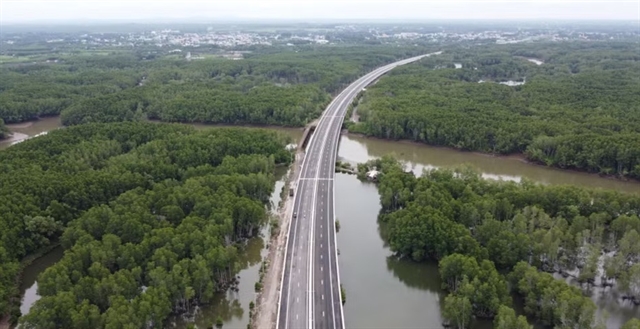 |
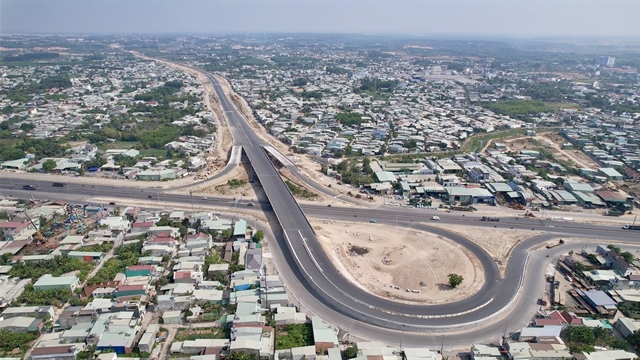
| A section of Bến Lức-Long Thành Expressway running through Đồng Nai City. — VNA/VNS Photo Sỹ Tuyên |
Infrastructure synergy
The synergy between the two cities is anchored by a massive overhaul of multi-modal transport.
At the heart of this transformation is the Long Thành International Airport in Đồng Nai.
Once fully operational, it will function as the primary international gateway, allowing HCM City’s Tân Sơn Nhất International Airport to pivot toward domestic services and high-end tourism.
Beyond the skies, ground connection is becoming seamless.
The extension of Metro Line No. 1 between Bến Thành Market and Suối Tiên Theme Park into Đồng Nai’s territory is a psychological and economic game-changer, turning the 30-kilometre distance into a mere 30-minute commute.
Combined with the Ring Road 3 and Ring Road 4 projects, the Cát Lái Bridge, and the Biên Hòa-Vũng Tàu Expressway, the two cities are merging into a single and fluid economic space.
Huỳnh Thị Vân Anh, general director of Việt Á Real Estate Investment JSC, said this connectivity creates a ripple effect.
When the 'hard' infrastructure is linked, the 'soft' economy follows, she said.
“We are seeing a surge in cross-border investments where businesses headquartered in HCM City but locate their massive production and logistics bases in Đồng Nai," she said.
A 'polycentric' economic powerhouse
The emergence of the HCM City-Biên Hòa-Long Thành urban chain is creating what experts call a "polycentric" (multi-centre) region.
This model is inspired by successful global clusters like the Greater Bay Area in China or the Tokyo Metropolitan Area.
Đồng Nai brings to the table a formidable industrial backbone with 89 planned industrial zones and over US$44 billion in FDI. Meanwhile, HCM City provides the "brainpower", the financial institutions, the tech talent, and the global trade links. Together, they create a complete value chain.
Sơn said the 'dual-pole' effect allows the Southeast region to compete head-to-head with major Asian economic hubs.
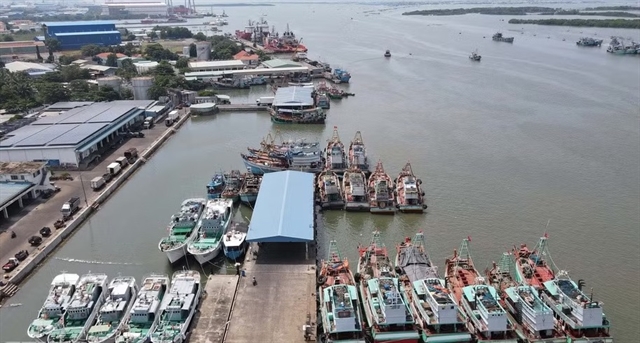 |
| Cát Lở Fishing Port in HCM City’s Phước Thắng Ward. — VNA/VNS Photo Đoàn Mạnh Dương |
"Đồng Nai’s strength in supporting industries and logistics complements HCM City’s role as a service and financial nucleus," he said.
This partnership is also redefining "living well" for millions of residents.
As Đồng Nai focuses on eco-friendly urban areas along the Đồng Nai River and Transit-Oriented Development (TOD) models, it offers a high-quality alternative for those priced out of HCM City’s real estate market.
Workers and experts can now choose to live in green, spacious environments in Đồng Nai while working in the high-tech zones of HCM City.
This "two-way flow" not only boosts consumption and services in both cities but also significantly improves the quality of life by reducing commute stress and environmental pollution.
Despite the physical connections, experts argue that the ultimate success of this "twin engine" model depends on administrative synchronisation.
According to Architect Ngô Viết Nam Sơn, specific mechanisms are the golden key.
"We are currently seeing unprecedented joint projects. However, we need a unified legal framework.”
It is impractical to implement major infrastructure projects like bridges or highways when one section operates under HCM City’s specific legal framework while the other is hindered by a different set of provincial regulations, he said.
As a centrally-run city, Đồng Nai now possesses the same degree of autonomy as Hà Nội or HCM City.
This allows for faster decision-making in planning and investment.
The challenge ahead lies in ensuring that both cities move in lockstep, governed by a shared regional vision rather than local interests.
With the dual engines of HCM City and Đồng Nai now firing in tandem, the Southeast region is no longer just a national leader; it is positioning itself as a top-tier engine of growth for the Asia-Pacific region, driving toward a modern, high-tech, and sustainable future by 2045. — VNS
Society
 Society
 Society
 Society
 Society
 Society
 Society
 Society
 Society
 Society
 Society
 Society
 Society
 Society
 Society