 Society

VN-Index ends lower despite liquidity hit over $1 billion
1.
|
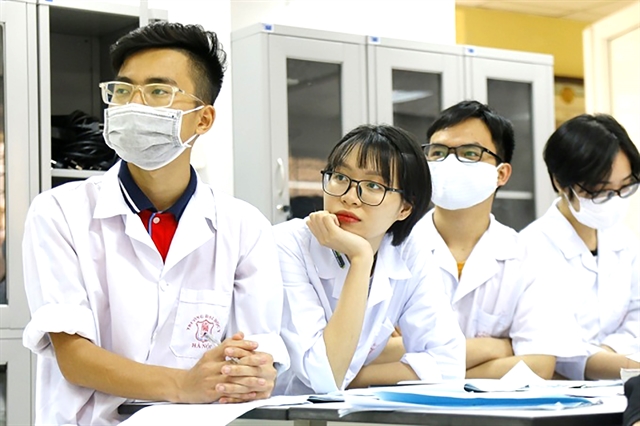
| Students at Hà Nội Medical University during a class. Photo vietnam.vn |
HÀ NỘI — The inclusion of literature, history, and economics and legal education in the admissions criteria for health science programmes at some training institutions has drawn considerable public attention.
Critics warn that dropping life sciences from entry requirements threatens the coherence of medical education.
Admitting students to health sciences programmes through social science subject combinations risks producing graduates with critical gaps in the scientific foundations required for medical practice, a senior Biology educator has said.
Nguyễn Duy Khánh, a lecturer in the Faculty of Biology at Hà Nội National University of Education with many years of experience teaching advanced Biology and preparing students for health sciences entry, told Suckhoedoisong.vn that medical training must be understood as a specialised scientific discipline, not a standard vocational pathway.
Khánh said students entering health sciences need not only humanitarian qualities but also the capacity to absorb and process life-science knowledge at a very high level of intensity. He cautioned that many voices are currently underestimating the role of secondary-school Biology when subject combinations used for admissions lack meaningful links to life sciences.
"When studying anatomy and physiology, students must understand the operational logic of the living body, mechanisms of homeostatic regulation, nerve impulse transmission, and cellular respiration. These concepts all have their foundations laid in secondary-school Biology," he said.
"When it comes to advanced subjects such as medical genetics or molecular biology, students without a basic foundation must almost relearn the underlying language before they can access university-level knowledge."
Khánh said observation showed that students with a solid biology background tended to adapt quickly and were not overwhelmed by the volume of terminology. Those with weak foundations, by contrast, frequently fell into forced rote learning and were unable to make meaningful conceptual connections – a pattern of academic shock that commonly leads to burnout along the demanding path of medical training.

|
| Nguyễn Duy Khánh (front row, second from left) with his students in a biology class. Photo suckhoedoisong.vn |
Irreplaceable scientific foundations
Responding to the view that including literature and history in admissions criteria would produce more humane doctors, Khánh argued that a clear distinction must be drawn between the humanitarian qualities of a physician and the empirical scientific competence required to train as one.
"Literature or history helps students develop emotional depth and social awareness, which is a positive thing. But training doctors demands systematic logical thinking and an extremely high degree of precision," he said.
"A person may write beautifully yet not necessarily be capable of understanding the mechanism of anaphylactic shock, interpreting arterial blood gas results or analysing drug interactions.
"If social science subject combinations are used for admissions to health sciences programmes without a sufficiently robust mechanism to compensate for the absence of natural science foundations, that is a hazardous trade-off in terms of cognitive capacity."
"The greatest danger lies not in entry scores but in the risk of a misalignment in modes of thinking," Khánh said.
Modern medicine demands mechanistic reasoning: why does disease arise, why does a drug take effect and how does the body respond. To reach that level of evidence-based thinking, biology and chemistry are irreplaceable foundations.

|
| Lê Viết Khuyến, Vice Chairman of the Việt Nam Association of Universities and Colleges and former Deputy Director of the Department of Higher Education. Photo courtesy of the Ministry of Education and Training |
Policy implications and 'irresponsible autonomy'
Lê Viết Khuyến, Vice Chairman of the Việt Nam Association of Universities and Colleges and former Deputy Director of the Department of Higher Education under the Ministry of Education and Training, also spoke to Suckhoedoisong.vn about the policy implications.
From an education governance perspective, Khuyến argued that medicine is a specialist field whose foundational knowledge must be grounded in the life sciences, with biology playing the central role. He identified a confusion between 'instrumental knowledge' and 'foundational knowledge' adding that literature, history, and foreign languages are supporting skills, whereas biology is the core source of knowledge from which medical professional thinking develops.
Khuyến warned that inconsistency in admissions subject combinations reflected a tendency to prioritise enrolment numbers over workforce quality. He was emphatic that standardised systemic logic could not be abandoned simply to meet enrolment quotas. In practice, many institutions interpreted autonomy narrowly, equating it with financial self-sufficiency.
"This is a genuine problem: financial autonomy pressures have led some institutions to misunderstand the scope of their authority, resulting in a situation where admissions go one way and training goes another, purely to increase revenue," he said.
Khuyến cautioned that if institutions lower entry requirements without being able to account for graduate quality commensurate with professional standards, that would constitute what he called 'irresponsible autonomy' towards both society and the future of students.
Noting that training institutions under the Ministry of Health have maintained rigorous criteria through scientific council advisory systems, he recommended that the Ministry of Health and the Ministry of Education and Training work together to establish a mandatory entry competency framework.
This should clearly designate biology and chemistry as requirements that cannot be substituted, in order to guide quality standards across the entire system.
Khuyến proposed that regulatory authorities take a more resolute approach to establishing hard standards in order to protect the reputation of national medical education and safeguard public health. — VNS
Society
 Society
 Society
 Society
 Society
 Society
 Society
 Society
 Society
 Society
 Society
 Society
 Society
 Society
 Society