 Politics & Law
SBV to curb property price inflation, enforce lending rate rules
1.
|
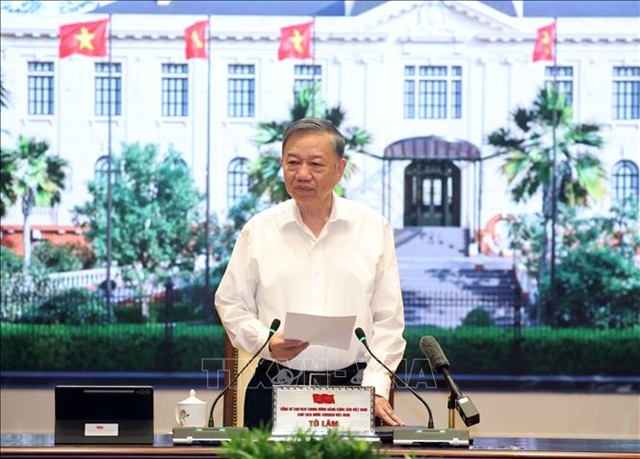
| Party General Secretary and President Tô Lâm chaired a working session with the Government’s Party Committee and relevant agencies on the implementation of social welfare policies, particularly those for vulnerable groups. — VNA/VNS Photo |
HÀ NỘI — General Secretary of the Communist Party of Việt Nam Central Committee and President Tô Lâm on Tuesday called for stronger and more effective social welfare policies to ensure that every Vietnamese citizen, regardless of where they live or their circumstances, is protected against major risks, has access to essential services and enjoys opportunities for development.
Speaking at a working session in Hà Nội with the Government’s Party Committee and relevant agencies on the implementation of social welfare policies, particularly those for vulnerable groups, General Secretary and President Lâm noted that under the Party’s leadership, the State's management and the joint efforts of society, social welfare work has achieved important results in recent years. However, policies supporting vulnerable groups still face shortcomings, requiring a shift in mindset, policy improvements and more decisive and effective implementation.
According to the top leader, by 2030, Việt Nam should basically establish a multi-layer, inclusive and digitalised social welfare system that guarantees minimum social protection for all citizens. By 2045, the system should approach the standards of developed, high-income countries, featuring quality services, sustainable financing, transparent governance and the capacity to respond rapidly to emerging risks.
Stressing that social welfare policies should ultimately be assessed by their benefits for individuals, the sustainability of families and the future of subsequent generations, he called for the principle of “leaving no one behind” to be translated into measurable and verifiable outcomes.
General Secretary and President Lâm said that no citizen should fall below the minimum living standard without being identified and supported; no child should drop out of school because of poverty; and no person with severe disabilities should be left without care. Families affected by natural disasters should also receive assistance without unnecessary delays, he noted.
To improve policy implementation, the General Secretary and President proposed establishing social welfare profiles and service focal points for citizens. He urged the Government to develop a national social welfare database interconnected with population, social insurance, tax, employment, healthcare, education, housing and disaster databases, with security, safety and privacy guaranteed.
It is necessary to expand social insurance coverage, develop an inclusive labour market, and complete flexible insurance packages in terms of contribution levels and periods and participation methods, with appropriate support for low-income workers. Employment services and vocational guidance should be strengthened for vulnerable groups, while livelihood models for households with older people or persons with disabilities should be piloted, including preferential loans to create jobs and raise incomes.
The State, local authorities and enterprises employing large numbers of workers should share responsibility for developing housing, schools, childcare facilities and social infrastructure, he stated, adding that particular attention should be paid to children living away from their parents, those cared for by grandparents and families with a lot of dependents.
The top leader also called for development of a care economy in response to population ageing, with a national strategy integrating healthcare, rehabilitation, social work and home- and community-based care. It is a must to study piloting long-term care insurance in selected localities, standardise care professions and adopt appropriate policies for social workers, nurses and home caregivers.
He further urged localities to strengthen primary healthcare, provide regular health check-ups and establish health monitoring records for older people at commune-level medical facilities. Equal development opportunities should be ensured for children and vulnerable groups, while persons with disabilities should have better access to public facilities, transport, education, healthcare and digital services.
Emphasising the need for stronger governance, financing and social oversight, General Secretary and President Lam proposed a national social welfare index to be published annually by locality and population group. The index should measure coverage, adequacy of benefits, exclusion rates, processing time, out-of-pocket costs, employment opportunities, accessibility for persons with disabilities and people's satisfaction.
He stressed that where eligible people are overlooked, cases are handled slowly or complaints remain unresolved, heads of agencies and localities must bear responsibility and provide explanations.
The top leader also noted that social welfare faces growing demands while resources remain limited and beneficiaries and risks continue to evolve. Therefore, it is a must to adopt a long-term vision, identify the right priorities and improve implementation capacity. The most important breakthrough, he said, is not merely increasing allowances but enhancing the State's ability to identify, listen to and support people in a timely manner, prevent risks and create conditions for citizens to improve their own lives.
Resources for social welfare come not only from the State budget but also from national solidarity, compassion, community responsibility and citizens' determination to become self-reliant and contribute to society, he added. — VNA/VNS
Politics & Law
 Politics & Law
 Politics & Law
 Politics & Law
 Politics & Law
 Politics & Law
 Politics & Law
 Politics & Law
 Politics & Law
 Politics & Law
 Politics & Law
 Politics & Law
 Politics & Law
 Politics & Law
 Politics & Law