 Politics & Law

AITO Looks Ahead to Europe, Building a Thriving Automotive Ecosystem
1.
 |
| Prime Minister Lê Minh Hưng and Russian President Vladimir Putin at the working lunch on the sidelines of the ASEAN–Russia Commemorative Summit in Kazan, Russia on Thursday. — VNA/VNS Photos Dương Giang |
KAZAN — ASEAN and Russia have agreed to strengthen connectivity between ASEAN and the Eurasian Economic Union (EAEU) as part of broader efforts to advance Eurasian integration and bolster regional economic resilience.
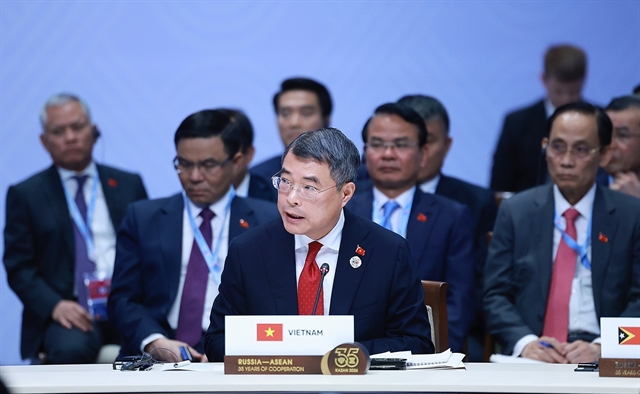
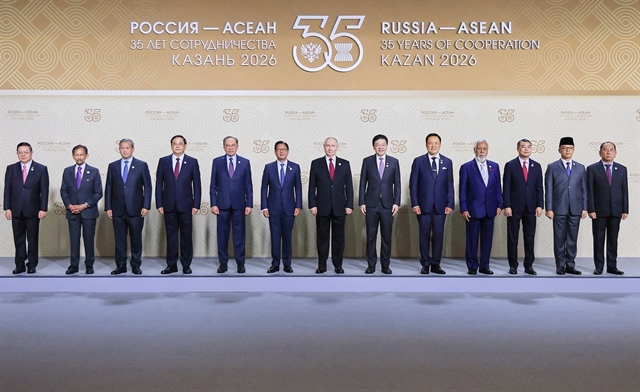
The agreement was reached during a working lunch on Thursday hosted by Russian President Vladimir Putin on the sidelines of the ASEAN–Russia Commemorative Summit marking the 35th anniversary of the two sides' relations.
Attending the event, Prime Minister Lê Minh Hưng joined other ASEAN leaders in discussions on Eurasian integration, with participants highlighting the growing importance of the Eurasian space as a global centre for strategic development and connectivity, stretching from Europe, Central Asia, Russia and the Caucasus to South Asia, East Asia and the Indo-Pacific.
Leaders noted that the vast region is home to 3.4 billion people, accounts for around 25 per cent of global GDP and more than 15 per cent of international trade. It also possesses over half of the world’s oil reserves, 60 per cent of global natural gas reserves, abundant strategic minerals, more than one-quarter of global agricultural land and significant logistics infrastructure potential.
Meanwhile, ASEAN posted its combined GDP reaching US$4 trillion in 2025, making it the world’s fifth-largest economy and placing it on track to become the fourth largest by 2030.
As a hub of regional trade and connectivity, ASEAN maintains extensive economic links with major partners, including China, India, Japan, the Republic of Korea, Australia and New Zealand. The bloc is also supported by key regional trade frameworks such as the Comprehensive and Progressive Agreement for Trans-Pacific Partnership (CPTPP) and the Regional Comprehensive Economic Partnership (RCEP).
ASEAN is currently accelerating the implementation of the ASEAN Power Grid to strengthen regional energy security. It has also recently concluded negotiations on the ASEAN Digital Economy Framework Agreement (DEFA), which aims to expand the region’s digital economy to $2 trillion by 2030 and establish ASEAN as one of the world's most dynamic digital economic centres.
 |
| ASEAN leaders and Russian President Vladimir Putin at the working lunch in Kazan on Thursday. |
ASEAN and Russian leaders affirmed that these favourable conditions demonstrate that Eurasian integration is a natural and inevitable trend for the two regions in the face of the rapid and complex changes in the geopolitical and geoeconomic landscape that have disrupted global trade and supply chains.
They identified enhanced connectivity between ASEAN, Russia’s Far East and Central Asia as a potential new growth driver for the wider Eurasian region.
In the economic and trade sphere, participants agreed to promote connectivity between ASEAN and EAEU, trade facilitation, customs cooperation, single-window mechanisms, e-commerce and business-to-business connectivity.
They also called for greater support for enterprises from both sides to integrate more deeply into regional and interregional supply chains, alongside increased investment in manufacturing, logistics and cross-border trade infrastructure.
Energy cooperation was highlighted as another key priority. Leaders recognised the Eurasian region’s strategic importance to global energy security and agreed to strengthen collaboration in oil and gas, liquefied natural gas (LNG), civilian nuclear energy, renewable energy and energy transition.
Regarding infrastructure and transport connectivity, they stressed the need to maximise the potential of strategic transport corridors linking Asia and Europe, including the International North–South Transport Corridor (INSTC), trans-Asian and Trans-Siberian railway networks, and the Northern Sea route. These initiatives are expected to shorten transit times, reduce logistics costs and enhance the resilience of regional supply chains. — VNA/VNS
Politics & Law
 Politics & Law
 Politics & Law
 Politics & Law
 Politics & Law
 Politics & Law
 Politics & Law
 Politics & Law
 Politics & Law
 Politics & Law
 Politics & Law
 Politics & Law
 Politics & Law
 Politics & Law
 Politics & Law




