 Politics & Law
Rural tourism needs to cash quantities over goods sold
1.
|
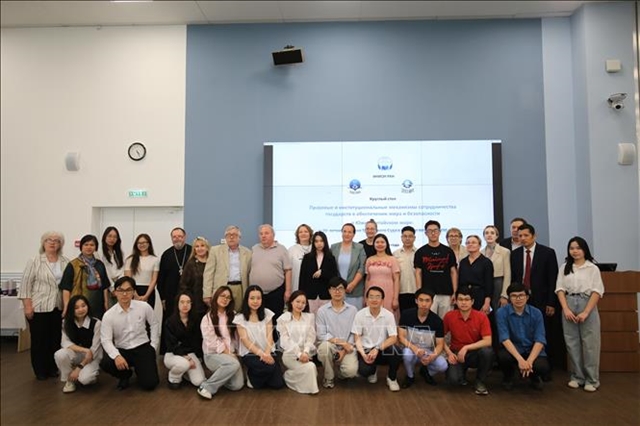
| Delegates pose for a group photo at the international roundtable in Russia on June 8. VNA/VNS Photo |
MOSCOW - Russian scholars called for stronger trust-building measures, enhanced regional cooperation and greater reliance on international law to address disputes in the East Sea (internationally known as the South China Sea) at an international roundtable in Russia on June 8.
The event, hosted by the Institute of Scientific Information on Social Sciences under the Russian Academy of Sciences (INION RAS), focused on legal and institutional mechanisms for governmental cooperation to ensure peace and security in the East Sea. It brought together leading researchers, international law experts and young researchers from Russia, Vietnam and several Southeast Asian countries. Participants presented 15 research papers providing academic perspective and comprehensive overview of developments in the East Sea over the past decade.
The presentations shared a common view that the East Sea remains a vital geostrategic area whose security, stability and freedom of navigation directly affect the global security architecture and international trade flows.
The scholars reaffirmed support for the peaceful settlement of disputes through diplomatic and legal processes, without the threat or use of force, in accordance with international law, particularly the 1982 United Nations Convention on the Law of the Sea (UNCLOS). They also emphasised the importance of maintaining peace and stability, freedom of navigation and overflight in the East Sea, and upholding the rule of law in the seas and oceans.
Addressing the role of UNCLOS 1982 in dispute settlement, the scholars noted that the Convention represents a universal, unified, and authoritative framework of international law that governs the jurisdiction, sovereign rights, and obligations of coastal states in a binding manner.
They also underscored the central role of ASEAN member states in regional affairs, noting that the bloc continues to play a key role in maintaining strategic balance, managing conflicts and promoting preventive diplomacy through sub-regional structures.
They urged relevant parties to accelerate efforts to transform the Declaration on the Conduct of Parties in the East Sea (DOC) into a meaningful, effective, and legally binding Code of Conduct in the East Sea (COC), consistent with the principles and provisions of UNCLOS 1982.
A joint recommendation adopted at the conference called on coastal states to consistently utilise the dispute-settlement mechanisms provided under UNCLOS 1982 as peaceful instruments for achieving convergence and delimiting maritime spaces.
In addition, the parties concerned should develop objective monitoring mechanisms and publicly report violations of the international legal order at sea, thereby creating effective deterrents against unilateral actions that undermine regional stability.
Delegates said that countries in the region should also promptly initiate joint governance models in areas such as the management of transboundary marine living resources, combating marine plastic pollution, maritime search and rescue (SAR), and collaborative oceanographic research, as a means of rebuilding strategic trust.
To strengthen trust-building efforts, they proposed establishing regular academic and research forums that would provide objective scientific analysis, help depoliticise existing disputes and generate practical recommendations for official diplomatic channels among countries.
Several speakers spoke highly of Việt Nam’s consistent efforts to seek peaceful solutions to the East Sea issue. Professor Irina Umnova, who chaired the roundtable, said Việt Nam has effectively utilised all bilateral and multilateral diplomatic channels to promote dialogue and consensus-building amid ongoing regional issues.
She also highlighted the political significance of the Vietnam–Russia Joint Statement issued during Russian President Vladimir Putin’s visit to Việt Nam in June 2024, to the East Sea issue, noting that the document reaffirmed the two countries’ support for maritime security, freedom of navigation and overflight, peaceful dispute settlement in accordance with international law, including UNCLOS 1982, and restraint in the use of force.
According to Umnova, both Việt Nam and Russia support the full implementation of the DOC and welcome efforts to conclude the effective and substantive COC. The two countries also share a commitment to strengthening ASEAN’s central role in the regional architecture and promoting the values and principles of the Treaty of Amity and Cooperation in Southeast Asia (TAC). VNA/VNS
Politics & Law
 Politics & Law
 Politics & Law
 Politics & Law
 Politics & Law
 Politics & Law
 Politics & Law
 Politics & Law
 Politics & Law
 Politics & Law
 Politics & Law
 Politics & Law
 Politics & Law
 Politics & Law
 Politics & Law