 Politics & Law
Việt Nam, Russia step up cooperation in criminal sentence enforcement
1.
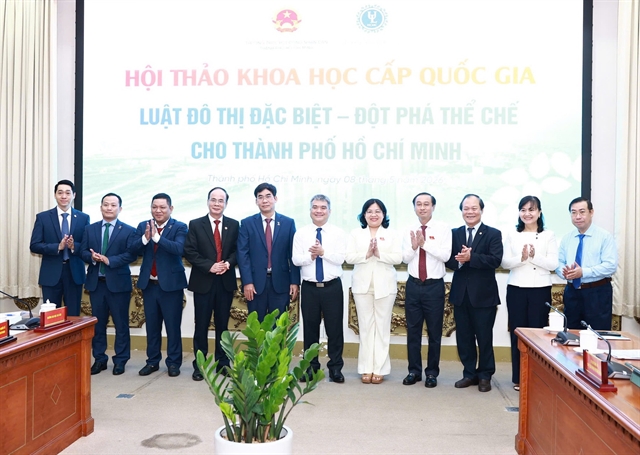 |
| Participants discuss breakthrough institutional proposals for the draft Special Urban Law at a workshop in HCM City on May 8. — VNA/VNS Photo |
HCM CITY — Direct election of the chairperson of the People’s Committee by residents was among the breakthrough proposals discussed at a scientific workshop on “special urban law" held in HCM City on Friday.
The workshop, titled "Special Urban Law – Institutional Breakthroughs for HCM City," was co-organised by the Standing Committee of the city People’s Council and the HCM City University of Law.
The event aimed to gather expert opinions to transform experimental mechanisms into a sustainable legal framework.
A highlight of the workshop was a presentation by Dr. Trần Thị Thu Hà and Associate Professor Dr. Vũ Văn Nhiêm from the HCM City University of Law.
They proposed a fundamental shift in how the head of the local executive branch is chosen.
Currently, the chairperson of the People’s Committee is elected by the People’s Council, usually from a single-candidate list.
The proponents argued that this process lacks political competitiveness and is no longer suitable for a "special urban area" that requires dynamic, decisive, and highly responsive leadership.
Under the proposal, the current indirect election process would be replaced by a direct vote, allowing city residents to personally elect the chairperson of the People’s Committee.
This shift aims to enhance the office's democratic legitimacy while fostering a deeper sense of accountability and responsiveness from the leader toward the electorate.
To ensure a healthy and competitive environment, the plan suggests increasing the number of candidates for the position, with all nominees undergoing rigorous vetting through consultative rounds conducted by the People’s Council.
"When directly elected, the head of the People’s Committee will undoubtedly feel a stronger obligation to the voters, thereby improving governance efficiency by responding faster to the people's needs," Hà said.
Nguyễn Trường Nhật Phượng, vice chairwoman of the city People’s Council, said while previous resolutions No. 54, 98, and 260 provided essential trial mechanisms, they were often limited by time and lacked synchronization with the general legal system.
"Moving from experimental resolutions to a sustainable law like the Special Urban Law is an urgent necessity to create a stable, flexible institutional framework for long-term development," she said.
The draft law aims to address several core areas.
It focuses on refining the current two-tier local government model to establish a more modern, streamlined, and effective governance structure.
It proposes granting the city greater autonomy over finance, budgeting, and staffing, guided by the principle of "local decision-making, local implementation, and local accountability."
It seeks to create robust legal corridors that unlock land and financial potential while actively encouraging private sector investment in essential sectors such as transport, healthcare, and education.
New breakthrough mechanisms will be established to attract top-tier scientists and experts, alongside legal protections for innovative officials who "dare to think and dare to do" for the common good.
The proposal for the special urban law has received high-level political backing.
At a recent meeting, Party General Secretary and State President Tô Lâm affirmed the support of the Politburo, the National Assembly, and the Government for the city's legislative efforts.
The city expects to complete the appraisal of the draft law by the end of September.
The National Assembly is slated to consider the Law on Special Urban Areas during its year-end session in 2026. — VNS
Politics & Law
 Politics & Law
 Politics & Law
 Politics & Law
 Politics & Law
 Politics & Law
 Politics & Law
 Politics & Law
 Politics & Law
 Politics & Law
 Politics & Law
 Politics & Law
 Politics & Law
 Politics & Law
 Politics & Law