 Politics & Law

Solcis launches open compliance layer for AI agents on NVIDIA OpenShell
1.
 |
| Raglai people in Bác Ái Tây Commune receive election information through social media platforms. — VNA/VNS Photos Nguyễn Thành |
KHÁNH HÒA — Authorities in the central coastal province of Khánh Hòa are rolling out a wide range of tailored communications for the election of deputies to the 16th National Assembly and to the People’s Councils at all levels for the 2026-2031 term, ensuring information reaches even the most remote and isolated communities.
The approach is designed to broaden public engagement, strengthen voters’ confidence and sense of civic responsibility, and help ensure that the major political event is conducted safely and in full compliance with the law.
In Bác Ái Tây Commune, a remote and sparsely populated area with 6,789 registered voters, more than 80 per cent of whom are Raglai people, five electoral units and nine polling stations have been established across villages, reflecting local demographic characteristics and facilitating voter participation.
Alongside preparing facilities and equipment, the commune has deployed multiple communications channels, including loudspeaker systems, mobile broadcasting units, posters and banners.
Election messaging has also been incorporated into village meetings, Party gatherings and activities run by mass organisations.
A door-to-door approach is being applied to ensure every resident fully understands the significance of the election, as well as their rights and obligations as voters.
Chairwoman of the local People’s Committee Nguyễn Thị Minh Nguyên said the commune has drawn up a detailed communications plan with specific milestones.
Given the large Raglai population, many of whom work far from home or spend nights in field huts during the farming season, village heads and election teams have been instructed to review each household and individual case.
The aim is to ensure that residents returning to their communities in the evenings are fully informed about the election timetable and encouraged to cast their ballots early and fully on March 15.
In Tà Lọt Village, which has 483 voters, 87.4 per cent of whom are from ethnic minority groups, communications efforts have also been intensified through appropriate and accessible formats.
Katơr Thị Hiệp, the village head, said the village is promoting the election through a variety of channels and languages.
It also makes use of social media platforms such as Facebook and Zalo, as well as infographics.
“The village management board works closely with youth union members to regularly share information and keep track of residents working away from home and elderly voters, so we can promptly encourage them to take part,” she said.
Katơr Thơm, a voter in the village, said the election is “a highly significant occasion” that allows citizens to choose representatives with the integrity and capability to reflect the people’s will and aspirations, contributing to local and national socio-economic development and safeguarding national defence and security.
In the coastal areas of the province, election communications have been adapted to reflect the reality of large numbers of residents working at sea for extended periods.
Out of 39,275 voters in Đông Hải Ward, 357 vessel owners and 623 crew members are regularly engaged in offshore fishing.
The ward’s Election Committee has worked with relevant agencies to step up outreach to boat owners and offshore fishermen, informing them of polling times and locations and their rights and obligations as voters.
Trần Ngọc Quang, Chairman of the Đông Hải People’s Committee, said the ward is encouraging fishermen to rearrange their schedules and return to port in time to vote.
Authorities are also reviewing voter lists and reminding vessel owners and captains to facilitate their crew members’ participation.
In the Trường Sa (Spratly) Special Administrative Zone, ballot boxes have been transported from the mainland to the islands by Brigade 146 of Naval Region 4 in coordination with the provincial Election Committee.
Preparations for polling day on the islands are now largely complete.
Voter meetings and election campaign conferences are being organised in line with statutory requirements.
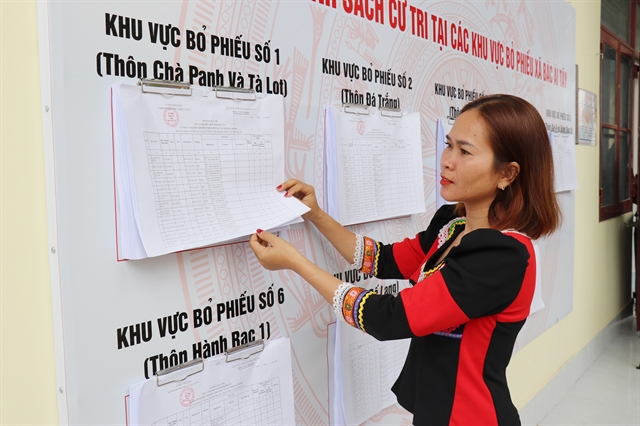 |
| A Raglai woman checks a voter list that is publicly posted at the People's Committee of Bắc Ái Tây Commune. |
Comprehensive preparations
The provincial Election Steering Committee has established inspection teams to review preparations at the local level, requiring authorities to ensure adequate facilities and to intensify communications efforts so that voters turn out in large numbers and comply with the election rules.
During on-site inspections, Nguyễn Khắc Hà, Deputy Secretary of the Provincial Party Committee and Chairman of the provincial branch of the Việt Nam Fatherland Front, urged localities and units to assign clear responsibilities, strengthen supervision and avoid complacency at any stage of the election process.
Communications work must be maintained consistently through official information channels and the Fatherland Front network and its affiliated organisations, enabling voters to clearly understand polling times and venues, as well as the action programmes of candidates, he said.
Special attention is being paid to outreach among fishermen, religious dignitaries and followers, as well as to enhanced communications in Raglai, Êđê and Chăm languages in ethnic community areas.
All 65 communes, wards and special administrative zones in the province have completed the compilation and public posting of voter lists and candidates’ summary biographies in accordance with the law, while continuing to review changes in voter information.
The provincial Department of Home Affairs has organised election training sessions both in person and online, focusing on voting procedures, ballot counting and the handling of contingencies.
Under current regulations, the province will elect 12 deputies to the 16th National Assembly across four constituencies, 67 deputies to the provincial People’s Council, and 1,392 deputies to commune-level People’s Councils.
Election boards have been established province-wide, with 1,123 polling stations approved, ready for the polling day on March 15. — VNS
Politics & Law
 Politics & Law
 Politics & Law
 Politics & Law
 Politics & Law
 Politics & Law
 Politics & Law
 Politics & Law
 Politics & Law
 Politics & Law
 Politics & Law
 Politics & Law
 Politics & Law
 Politics & Law
 Politics & Law