 Sci-Tech
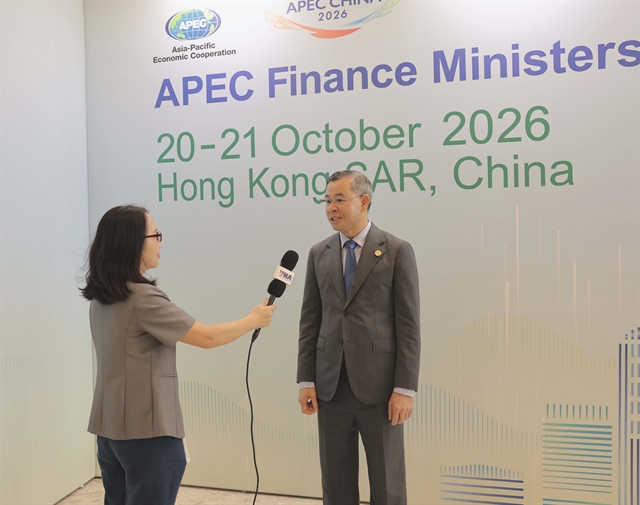
Việt Nam sets four priorities for APEC Finance Ministers’ Meeting in 2027
1.
 |
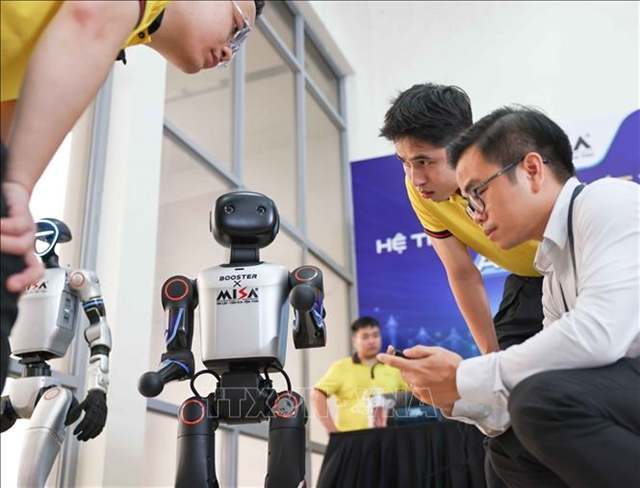
| A robot assisting healthcare checkup presented at the National Forum for the Development of Vietnamese Technology Enterprises 2025. — VNA/VNS Photo |
HÀ NỘI — Science, technology, innovation and digital transformation have been identified as the key drivers of Việt Nam’s rapid and sustainable development, according to documents approved by the 14th National Congress of the Communist Party of Việt Nam this week.
Developing and mastering strategic technologies is seen as a critical pillar for enhancing national autonomy, competitiveness and Việt Nam’s position in the global value chain.
Minister of Science and Technology Nguyễn Mạnh Hùng said innovation is the core mechanism for transforming knowledge and digital technology into productivity, added value and sustainable growth. While delivering a keynote speech at the congress, he emphasised that Việt Nam must rely on science, technology, innovation and digital transformation to move from middle-income to high-income status. These three drivers have been expanded and redefined by the Party through a new approach, creating broader development space and unlocking new resources for growth.
“With these three drivers, Việt Nam can achieve double-digit growth,” he said.
According to the minister, the Politburo’s Resolution No. 57, issued in December 2024, identifies science and technology, innovation and national digital transformation as top-priority breakthroughs and the main forces driving the rapid development of modern productive forces, the renewal of production relations, the modernisation of governance methods and the strengthening of national self-reliance.
He added that to ensure these areas truly become central growth drivers, the first task is to measure their contribution to GDP growth. From now to 2031, the priority order should be digital transformation, innovation and science and technology. In digital transformation, changing operational methods accounts for 70 per cent of the impact, while technology accounts for 30 per cent.
Nguyễn Xuân Thắng, chairman of the Central Theoretical Council and director of the Hồ Chí Minh National Academy of Politics, said only when science, technology, innovation and digital transformation are fully positioned as central drivers of the growth model can Việt Nam achieve breakthroughs in productivity, quality and competitiveness, laying a solid foundation for rapid and sustainable development in the new era.
He stressed the need to adapt to major global transformations such as digitalisation, green transition and energy transition, with a strong focus on science and technology, making these fields the main forces driving growth.
“Double-digit growth cannot rely solely on input-based resources or low-level comparative advantages such as labour, land and natural resources. These traditional drivers must be renewed through science, technology and innovation,” he said.
“Technology must be applied to new areas such as the digital economy, green economy and circular economy, as well as to semiconductor industries, artificial intelligence and cloud computing. These are the fields through which we can achieve growth consistent with our development goals.”
Deputy Minister of Science and Technology Phạm Đức Long said the congress has set a target for the digital economy to account for 30 per cent of GDP by 2030. Currently, the digital economy represents about 14 per cent of GDP, despite Việt Nam being among the fastest-growing digital economies in Southeast Asia and Asia.
Achieving this goal requires viewing the digital economy as a new mode of economic organisation and operation within a digital environment, he said.
“At present, science and technology, innovation and digital transformation are identified as driving forces. However, science and technology often take many years to generate value and economic impact. In this phase, we need to focus on innovation and digital transformation,” Long added.
Bùi Thanh Toàn, director of the Science and Technology Department of the Đắk Lắk Provincial Party Committee, said positioning science, technology, innovation and digital transformation at the centre of the development strategy provides a crucial foundation for localities to better exploit their potential and advantages, contributing to rapid and sustainable growth and improved economic competitiveness. He stressed the importance of prioritising investment in technology, strategic technologies and the completion of digital infrastructure from the central level down to provinces and localities.
 |
| Local residents in Khánh Hòa Province scan QR code to trace the origin of agricultural products. — VNA/VNS Photo |
Bùi Đức Giang, Secretary of the Phú Thọ Provincial Youth Union, said Vietnamese youth are facing unprecedented development opportunities as the country accelerates digital transformation, the advancement of science and technology, and deeper international integration.
“New fields such as the digital economy, artificial intelligence, green technology and innovative startups are opening up vast opportunities for young people to assert themselves and contribute to the nation,” he said.
He added that following the congress, youth representatives will develop plans and initiatives that align with the needs and aspirations of young people as part of their political mission.
11 strategic technology groups
The Government recently issued 11 groups of strategic technologies, aimed at rapid and sustainable development and consistent with global technological trends. The Ministry of Science and Technology serves as the focal agency for developing a unified strategic technology list.
The 11 strategic technology groups include: artificial intelligence, digital twins, virtual reality and augmented reality; cloud computing, quantum computing and big data; blockchain; next-generation mobile networks (5G and 6G); robotics and automation; semiconductor chips; advanced biomedical technologies; energy and advanced materials; rare earths, oceans and underground resources; cybersecurity; and aviation and space.
Building on this foundation, the Prime Minister has selected six strategic technology products for pioneering implementation: large language models and Vietnamese virtual assistants; edge-processing AI cameras; autonomous mobile robots; 5G mobile network systems and equipment; blockchain network infrastructure and application layers for traceability and tokenised assets; and unmanned aerial vehicles.
These are regarded as breakthrough spearheads with broad application potential and the capacity to form domestic high-tech industrial ecosystems.
The National Foundation for Science and Technology Development (NAFOSTED) has been also established to concentrate resources on key technologies with the potential to generate tangible results, products and impacts in line with national science, technology and innovation development orientations.
Đào Ngọc Chiến, director of NAFOSTED, said the foundation is an important financial instrument for implementing the strategic technology list.
“Based on orientations, lists and mechanisms issued by competent authorities, the foundation provides funding and support for science and technology tasks, including many basic and applied research projects directly linked to strategic technology sectors,” he said. — VNS
Sci-Tech
 Sci-Tech
 Sci-Tech
 Sci-Tech
 Sci-Tech
 Sci-Tech
 Sci-Tech
 Sci-Tech
 Sci-Tech
 Sci-Tech
 Sci-Tech
 Sci-Tech