SBV to curb property price inflation, enforce lending rate rules
1.
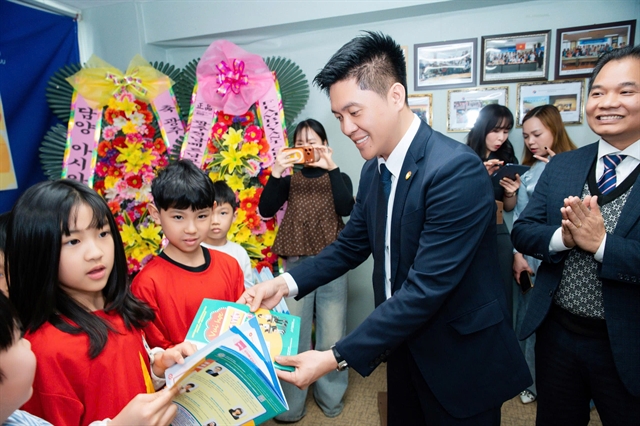 |
| General Secretary of the Global Network for Vietnamese Language and Culture Training, Nguyễn Duy Anh, presents learning materials for children at the inaugural ceremony of a Vietnamese langauge class in the Republic of Korea on April 12, 2026. |
Politburo Resolution No 23-NQ/TW issued on August 2, 2026 on overseas Vietnamese affairs sets out new requirements for strengthening community, preserving Vietnamese language and national cultural identity, and promoting the resources of overseas Vietnamese. Việt Nam News reporter Nguyễn Khánh Chi spoke to Nguyễn Duy Anh, Chairman of Vietnamese community in Fukuoka, Japan, member of the Vietnam Fatherland Front Central Committee and General Secretary of the Global Network for Vietnamese Language and Culture Training.
Resolution 23-NQ/TW, for the first time, explicitly defines the preservation and promotion of the Vietnamese language among the younger generation of overseas Vietnamese as a vital task. Based on the Network's practical activities, what do you consider the greatest significance of preserving the language in connecting young overseas Vietnamese with their roots?
As a person living and working abroad, I believe the greatest significance of preserving the Vietnamese language lies in maintaining the bond between generations and keeping open the path for the younger generation to return to their national roots.
A child who can still speak Vietnamese is able to converse with their grandparents and understand their mother’s lullabies and family stories. By understanding the language, they gain an extra doorway into the nation's history, culture, customs, literature and art, allowing them to understand more deeply where they come from.
From our practical experience in Japan, as well as our efforts to connect with Vietnamese communities across many countries, we have realised that Vietnamese is more than just a means of communication. It is a core component of cultural identity. For the second and third generations born abroad, this is even more significant because their living environment, education, and primary language are all those of their host country.
I strongly agree with how Resolution 23 places the preservation of the Vietnamese language within a broader vision: building an overseas Vietnamese community that remains closely attached to the homeland while integrating and contributing positively to their host societies.
We do not frame this as a choice between integration and maintaining identity. Our goal is to help young overseas Vietnamese become both exemplary citizens of the countries where they reside and individuals who understand, love, and take pride in their Vietnamese heritage. The Vietnamese language is one of the essential foundations for forging that connection.
Many young Vietnamese born and raised abroad use the language of their host country more than Vietnamese. What are the biggest obstacles making it difficult for the second and third generations to maintain the Vietnamese language, and what approach can help them learn it naturally, proactively, and sustainably?
First and foremost, we need to recognise this as a natural reality of the integration process, rather than simply viewing it as a case of the younger generation not wanting to learn Vietnamese.
A child born in Japan, South Korea, France or the United States spends the vast majority of their time at school and in social settings using the local language. Meanwhile, the time spent using Vietnamese is often limited to the family circle or a few hours of weekend classes.
Through my interactions with teachers and parents across many countries, we have identified three major challenges.
First is the lack of an environment for regular Vietnamese usage. Second, learning materials and teaching methods are not always suitable for children growing up in a multilingual environment. Third is the issue of motivation: if Vietnamese is seen only as a mandatory extra subject on the weekend, it is very difficult for them to sustain it over the long term.
In my view, we need to shift our mindset from teaching Vietnamese to creating an environment where children want to use Vietnamese.
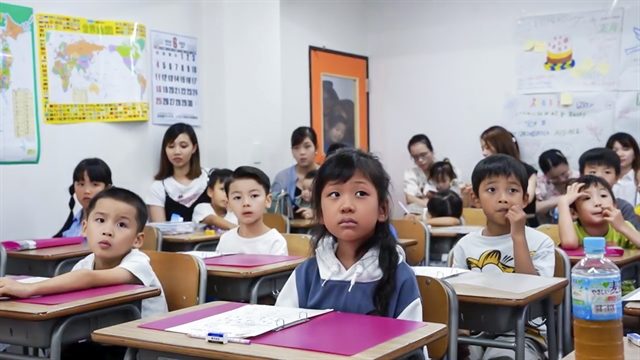 |
| A Vietnamese language class for Vietnamese born and raised in Fukuoka, Japan. Photos courtesy of Nguyễn Duy Anh |
Vietnamese needs to step outside the classroom. Children can learn through music, games, cuisine, the áo dài, family history, heritage tours, public speaking, making videos, or sharing stories about Việt Nam with their international friends.
In our Network’s activities, we always strive to combine language with cultural experiences. In forums designed for children and youth, they use Vietnamese to introduce their homeland, perform, tell stories and interact with one another. At that point, Vietnamese is no longer 'homework'. It becomes a tool for them to express themselves.
If we want a child to keep their Vietnamese, we must first give them a reason to love it and want to speak it. I believe this is a vital starting point.
How should the current system of learning materials and teaching methods change to better suit Vietnamese children growing up in multilingual environments?
We must first clearly recognise that Vietnamese children born and raised abroad have different linguistic characteristics than children studying within Việt Nam. Therefore, we cannot simply take a method or curriculum designed for domestic students and apply it directly overseas.
The Network has organised online training programmes for more than 500 participants across many countries, while also conducting in-person training sessions and seminars in Laos, Thailand, Taiwan (China), and the Republic of Korea. Through that, we have seen that the demand for a system of learning materials tailored specifically to multilingual children is immense.
I believe that moving forward, learning materials need to evolve in three directions.
First, they should be categorised by proficiency levels rather than just by age. There are 10-year-olds who are just starting to learn Vietnamese, while some younger children can already communicate quite well within their families.
Second, language learning must be intertwined with cultural learning. A vocabulary lesson could be paired with stories about Tết (Lunar New Year), the Mid-Autumn Festival, the áo dài, Vietnamese cuisine, scenic landmarks, or a historical figure. When children understand the cultural context of a word, they retain the language more naturally.
Third, there must be a strong shift toward digital materials and interactive methods. Alongside books, we need videos, audio, games, flashcards, apps, and short-form content that fits the consumption habits of today’s younger generation.
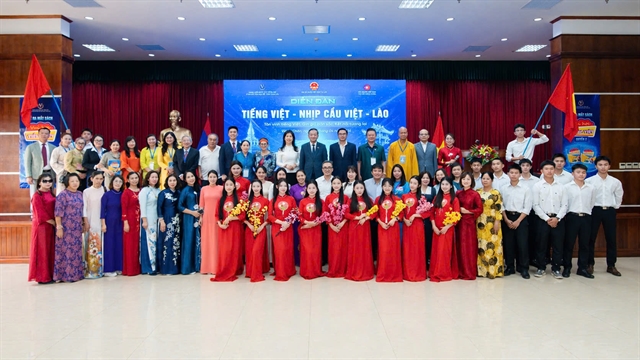 |
| A forum held by the Global Network for Vietnamese Language and Culture Training to promote the teaching and learning of Vietnamese language in Laos in 2026. |
Resolution 23 emphasises building a 'sustainable connecting ecosystem' for overseas Vietnamese. How do you envision a global network for teaching the language and preserving Vietnamese culture should be organised so that teachers, parents, associations, and the young people themselves can all become active participants in preserving the language?
The most important keyword here is 'ecosystem'. This means that no teacher, classroom or association should have to stand alone on the journey of preserving the Vietnamese language.
From our experience building the Network over the past year, we envision that this ecosystem requires the participation of at least four key stakeholders: domestic agencies and Vietnamese representative offices abroad; teachers and experts; community associations and families; and, most importantly, the younger generation of overseas Vietnamese.
Each stakeholder plays a distinct role. State agencies provide orientation, create mechanisms, and connect resources; experts and teachers develop professional expertise and learning materials; associations foster a community environment; and families maintain the daily use of Vietnamese. As for the youth, they should not be viewed merely as 'learning targets', but must become active subjects who create and spread the language.
We are proposing several specific initiatives. First is the creation of a 'Global Vietnamese Language Map', which will gradually link information about teachers, classes, centers, associations, and teaching resources across different regions. Our goal is simple: no matter where a Vietnamese family moves, they should be able to find a place where their child can continue learning the language.
Next is the development of a shared digital resource library, the maintenance of teacher training programmes, and the cultivation of 'Vietnamese nuclei' (core language advocates) within each community. VNS
 Opinion
 Opinion
 Opinion
.jpg) Opinion
Opinion
 Opinion
 Opinion
 Opinion
 Opinion
 Opinion
 Opinion
 Opinion
 Opinion
 Opinion
 Opinion