 Opinion

Top Vietnamese leader meets with Belgian Senate Speaker, House President
1.
|
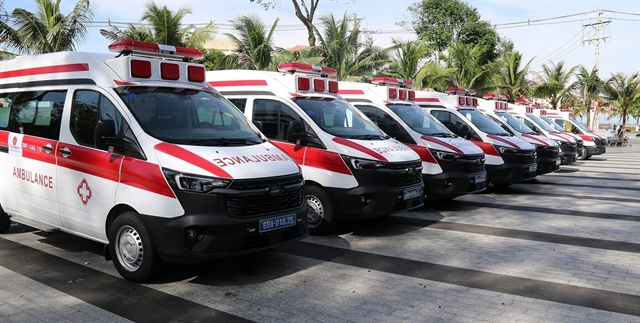
| Ambulances serving the Phú Quốc Pre-hospital Emergency Centre in An Giang Province. VNA/VNS Photo Lê Huy Hải |
The Government-approved Emergency Medical Services Development Project for 2026–2030, which took effect on August 10, marks a breakthrough in several aspects of the country’s pre-hospital emergency care system. Hà Anh Đức, Director of the Department of Medical Examination and Treatment under the Ministry of Health, spoke to Vietnam Plus about the sector’s plans to strengthen pre-hospital emergency services in the new period.
The Emergency Medical Services Development Project for 2026–2030 has recently been approved. Could you elaborate on its key new features?
First is a breakthrough in organisational structure. Previously, the healthcare system mainly focused on emergency care after patients arrived at medical facilities. Pre-hospital emergency care, or the stage before patients reach a healthcare facility, had not yet been organised in a systematic and comprehensive manner.
Second is the organisation of emergency call reception and dispatch. We have had numerous laws, decrees and circulars regulating the 115 emergency hotline. In practice, however, the hotline system has faced many shortcomings.
For example, emergency centres in Hà Nội, HCM City and many other localities receive hundreds or even thousands of calls every day. Up to 90 per cent of these calls are inappropriate or do not concern genuine emergencies. They are often not screened, callers are not properly guided, and the calls are not handled effectively. This means that dozens of call operators may be deployed, while much of their capacity is consumed by calls that do not require emergency services.
A key feature of the new project is the establishment of a single nationwide emergency number with local branches, combined with call screening and identification of callers’ phone numbers, addresses and locations. This will help identify calls for genuine emergencies and deal with nuisance calls, thereby improving the efficiency of pre-hospital emergency services.
A national-level call centre will receive emergency and life-threatening calls, with police and medical personnel directly handling them. The 34 centrally run cities and provinces will each have a local focal-point call centre to receive calls transferred from the national centre.

|
| Hà Anh Đức, Director of the Department of Medical Examination and Treatment under the Ministry of Health. VNA/VNS Photo |
Police and health authorities will jointly operate the emergency call system, enabling rapid and effective coordination in emergencies and other incidents at the scene.
For example, in traffic-related emergencies, ambulances can be promptly routed to avoid congestion. They will be given priority passage and directed along the shortest available route. The Ministry of Health is expected to issue a circular in October providing detailed guidance on financial mechanisms and equipment standards for ambulances and patient transport vehicles.
The project places strong emphasis on information technology and digital transformation, in line with Politburo Resolution No. 57 on breakthroughs in science, technology, innovation and national digital transformation. Could you elaborate on this?
The project makes extensive use of information technology, allowing emergency calls to be screened and processed and enabling immediate connections with medical facilities and specialists to support patients during transportation through video calls.
This will provide medical personnel with data to determine the nearest and most appropriate healthcare facility based on the patient’s condition. As a result, pre-hospital emergency services can significantly reduce response and treatment times, which is particularly important in time-sensitive emergencies such as strokes and cardiovascular events.
As planned, Việt Nam will develop a common digital platform for pre-hospital emergency services, together with a nationwide digital map of the emergency network. The locations of ambulances that are on standby or responding to calls will be displayed on the map, enabling dispatchers to identify and deploy the most suitable ambulance in the area.
The digital platform will also enable emergency calls to be screened and processed, while connecting patients with healthcare facilities and specialists who can provide remote support during transportation via video calls. Medical personnel will therefore have the necessary information to direct patients to the nearest facility best suited to their condition.
There are concerns that the number of ambulances in Việt Nam remains insufficient to meet demand. Could you provide an overview of the current situation?
In terms of infrastructure and equipment, Việt Nam currently has only 0.3 ambulances per 100,000 people, significantly below the World Health Organization's recommended ratio of one ambulance per 100,000 people.
The figure mainly covers ambulances operated by local 115 emergency centres, while hospital-based ambulances currently play only a limited role in the pre-hospital emergency network.
|
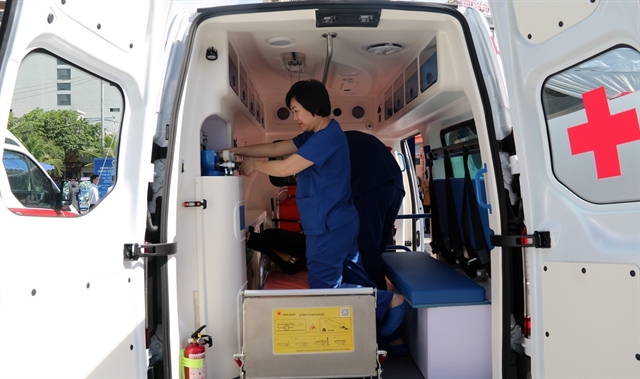
| An ambulance equipped with modern medical equipment for pre-hospital emergency care. VNA/VNS Photo Lê Huy Hải |
The pre-hospital emergency network will be strengthened by increasing the number of ambulances in localities, with the goal of ensuring at least one ambulance per 100,000 people. Việt Nam is estimated to need around 1,000 standard ambulances to achieve this target.
This will result in thousands of pre-hospital emergency points nationwide, with some locations equipped with multiple ambulances.
In addition to conventional road ambulances, other forms of emergency transport suited to local terrain and geography will be introduced. These could include emergency boats in river and waterway areas, with HCM City expected to pilot this model, as well as specialised vehicles suitable for mountainous and other difficult-to-access areas.
Alongside the expansion of the emergency network, communities will also be equipped with basic first-aid skills. In the coming years, the initial goal is to provide around 3 per cent of the population with basic first-aid knowledge and skills, including cardiopulmonary resuscitation (CPR) and chest compressions.
Where has the digital platform for managing pre-hospital emergency services been piloted in Vietnam?
The digital platform is now being piloted in Hải Phòng, covering various functions, from ambulance dispatch and GPS tracking to organising emergency teams and focal points. All of this information will be displayed on a digital map.
The map will track an ambulance throughout the entire emergency response process from the moment a call is received and the vehicle is dispatched, through its journey to the scene, arrival at the patient, transportation and treatment en route, to the handover of the patient to a healthcare facility.
The pre-hospital emergency platform is currently being piloted in Hải Phòng. Following evaluation, it will gradually be expanded nationwide, creating a digital map of Việt Nam’s pre-hospital emergency network.
Việt Nam will thus have a comprehensive digital health map featuring a dedicated pre-hospital emergency network, helping strengthen the safety and security of patients and the country.
Importantly, the pre-hospital emergency network will not distinguish between public and private resources. All qualified providers will be able to participate and will operate under the coordination of the emergency call centre.
As a result, Việt Nam will have thousands of pre-hospital emergency points nationwide, with multiple ambulances available at some locations. — VNS
Opinion
 Opinion
 Opinion
.jpg) Opinion
Opinion
 Opinion
 Opinion
 Opinion
 Opinion
 Opinion
 Opinion
 Opinion
 Opinion
 Opinion
 Opinion
 Opinion