 Opinion

Vietnamese Prime Minister meets Cambodian National Assembly President
1.
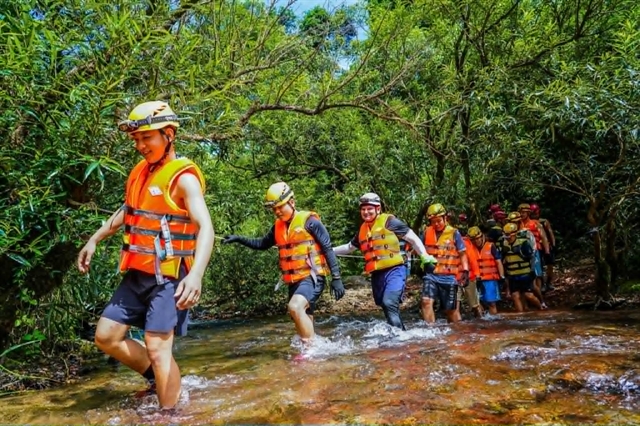 |
| Trekking in the primeval forest in Phong Nha-Kẻ Bàng National Park. — Photo courtesy of the Phong Nha - Kẻ Bàng Park |
Director of Phong Nha-Kẻ Bàng National Park, Phạm Hồng Thái, talks with Việt Nam News reporter Trần Như about potential, adventure tourism products and solutions to ensure safety and sustainable development for the park.
Phong Nha – Kẻ Bàng possesses a diversified ecosystem and unique grottos and is known as a famous destination for adventure tourism such as trekking, grotto exploration and primeval forest expeditions. Could you tell me about the potential for tourism development?
Phong Nha – Kẻ Bàng National Park, covering an area of 123,326ha, is the largest national park in Việt Nam. It boasts a pristine tropical forest ecosystem, rich biodiversity and many endemic and rare species.
Notably, the park contains a large-scale cave system with outstanding global geological and geomorphological value, estimated at over 1,000 caves, of which more than 440 have been surveyed.
This is an ideal condition for developing adventure tourism products such as trekking in forests, exploring caves or experiencing pristine nature.
In recent years, many adventure tours have been introduced and have gained international recognition, such as conquering tours of Sơn Đòong, the world’s largest cave, and the caves of Én, Va, Đại Ả, Over, Pygmy, Thoòng and Ba.
This affirms that developing adventure tourism is the right direction, suitable with trends of green and experiential tourism that are increasingly popular in the world.
We focus on quality, uniqueness and strict capacity control. Adventure tourism activities must be linked to the sustainable conservation of ecosystem values and biodiversity, while ensuring the safety of tourists.
Besides, we enhance capacity for guidance, rescue and relief operations, to develop the park into a high-quality adventure tourism destination of regional and international stature.
What is the most attractive aspect of adventure tourism in Phong Nha – Kẻ Bàng?
The core difference lies in the deep, authentic experience.
Sightseeing tourism usually stops at viewing the scenery, while adventure tourism in Phong Nha – Kẻ Bàng allows visitors to directly explore, conquer and immerse themselves in the pristine natural environment.
The appeal also comes from the uniqueness of the resources. The large cave system, special geological structures and almost intact primary forest create journeys that are hard to find elsewhere.
Visitors do not just participate in a trip but experience a true expedition, such as trekking through the forest, crossing streams, climbing and spending the night in caves.
Selectivity and control are also advantages.
Adventure tourism products are organised on an appropriate scale, with professional guides, ensuring safety and minimising environmental impact, creating an exclusive experience that mass tourism can hardly provide. The combination of unique resources, distinctive experiences, intense emotions and sustainable exploitation is what creates the unique appeal of adventure tourism in Phong Nha – Kẻ Bàng.
Where do the tourists come from and what is the scale and number of visitors at present?
Adventure tourists mainly come from European countries, the US, Canada and some Asian countries such as Japan, South Korea, Australia and India.
In recent years, the number of Vietnamese tourists, especially young people, has been increasing.
Due to the nature of adventure tourism, the number of visitors is strictly controlled to ensure safety and environmental preservation.
On average, the park welcomes thousands of visitors each year. In 2025 alone, the park attracted more than 16,000 participants in adventure tours, of which more than 12,000 were international visitors.
At present, there are 11 adventure tourism routes, all with controlled visitor numbers and visiting times.
The Sơn Đòong tour receives just 1,000 tourists a year and was fully booked through 2027.
The activities of forest trekking, climbing and cave exploration inherently involve risks. What does the park’s management board do to ensure safety for visitors?
Safety is always a top priority. All tours of forest trekking, climbing or cave exploration are carefully surveyed, assessed for risks and built with standard operating procedures and incident scenarios.
The tours have professional guides trained in tour leadership, first aid and rescue skills, fully equipped with protective gear, communication equipment and support systems. Before the trip, tourists must declare their health status, undergo physical fitness assessments, learn safety skills and follow instructions.
The management board maintains a standby emergency response plan, ensuring a rapid response in case of incidents.
It can be said that organising adventure tourism always prioritises safety above all else, while also being closely linked to resource protection and sustainable development.
What are the advantages and disadvantages of operating adventure tourism? What are the solutions for further developing the tourism product in the coming time?
The biggest advantage is the natural landscape, with a unique cave system and an immense primeval forest. In addition, the trend of experiential and exploratory tourism has become increasingly popular.
The difficulties are the high safety requirements, the need for professional human resources, large investment costs and the fact that the scale of tours is controlled to protect natural resources and the environment.
Besides, harsh weather conditions, distinct seasonality and the need to balance tourism development and conservation present significant challenges.
Some routes are located in border areas, requiring compliance with legal regulations for foreigners, which affects procedures for international visitors.
The management board is co-operating with capable businesses to organise tours, ensuring service and safety while local people participate as porters, guides and providers of accommodation and food.
Currently, there are more than 100 accommodation establishments, employing nearly 5,000 local workers, contributing to improved livelihoods and awareness of forest protection.
To develop adventure tourism in a professional, sustainable and internationally attractive manner, it is necessary to improve mechanisms, policies and safety standards; enhance product quality and human resources; strengthen cooperation with businesses and international organisations; invest in supporting service infrastructure; and link adventure tourism development with resource conservation and community livelihoods, ensuring exploitation within permissible limits and long-term sustainable development. — VNS
Opinion
 Opinion
 Opinion
 Opinion
 Opinion
 Opinion
 Opinion
 Opinion
 Opinion
 Opinion
 Opinion
 Opinion
 Opinion
 Opinion
 Opinion