 Opinion
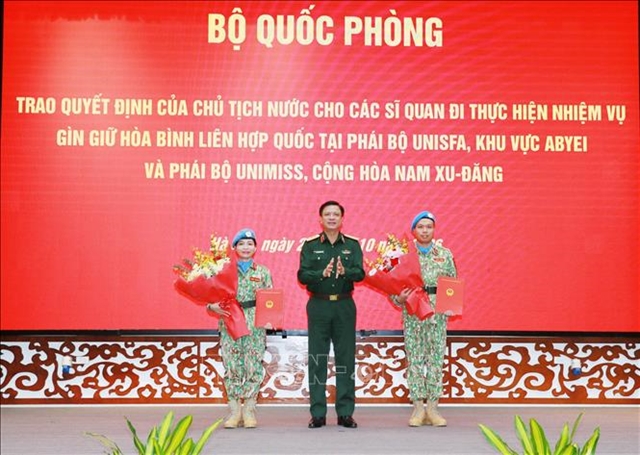
Việt Nam rotates two officers to UN peacekeeping missions in Abyei, South Sudan
1.

|
| Vice Chairman of the Việt Nam Association for the Conservation of Nature and Environment Trần Văn Miều. Photo nongnghiepvamoitruong.vn |
HÀ NỘI — Vice Chairman of the Việt Nam Association for the Conservation of Nature and Environment Trần Văn Miều has said that positioning environmental protection at the heart of the country’s development strategy in the years to come reflects an important shift in development thinking.
This is not only a necessary adjustment in response to increasingly severe environmental challenges, but also aligns with the global trend toward sustainable development adopted by many countries worldwide, he said.
Commenting on the draft documents for the 14th National Party Congress, Miều noted that the approach taken in the draft clearly emphasises sustainable development based on harmony among economic, social and environmental factors.
Development is no longer assessed solely by growth rates, but is closely linked to the quality of growth and improvements in people’s living standards, with human beings regarded as both the goal and the driving force of development.
Institutionalising environmental protection
According to Miều’s analysis, over nearly four decades of Đổi mới (Renewal), the Party’s thinking and policies on environmental protection and nature conservation have undergone positive, transformative changes. This transition has not been easy, but has been inevitable amid mounting challenges such as environmental pollution, natural resource depletion and climate change, which are increasingly affecting socio-economic life.
One of the most notable features of this process is the Party’s consistent and continuous leadership in the field. Through numerous important resolutions and directives, the Party has confirmed that environmental protection, climate change adaptation and biodiversity conservation are integral requirements of socio-economic development, which cannot be separated or treated as secondary concerns.
The principle of harmonious development between the economy, society and nature has been increasingly emphasised, gradually replacing the previous mindset of 'trading the environment for growth'.
On that basis, the State has progressively institutionalised the Party’s leadership through an increasingly comprehensive system of policies and laws. Miều pointed out that successive versions and amendments of the Law on Environmental Protection have established an important legal framework for environmental governance.
Beyond defining the responsibilities and obligations of organisations and individuals, the legal system has also introduced incentive and support mechanisms to encourage broad social participation in nature conservation, biodiversity protection and climate change response.
Another issue highlighted by Miều is that Party resolutions and current legislation have clearly institutionalised the role of the Việt Nam Fatherland Front, socio-political organisations and social and professional organisations in environmental protection.
Mobilising the participation of the entire political system and society as a whole has generated strong spillover effects, helping environmental policies and guidelines gradually translate into real-world practice, he said.
At the same time, the role of local communities has become increasingly evident. In both urban and rural areas, environmental protection has become an important component of building civilised cities and implementing the new-style rural development programme.
Communities are not only involved through concrete activities such as maintaining environmental hygiene and improving landscapes, but are also gradually developing the awareness that environmental protection is an inseparable part of everyday life.
According to Miều, the broad participation of all social strata from young people and workers to intellectuals, entrepreneurs and religious communities has helped form an important social foundation for environmental protection efforts.
Through various channels, values related to harmonious coexistence with nature, respect for living environments and protection of biodiversity have been increasingly disseminated, gradually enhancing awareness and individual responsibility for the shared environment.
Miều observed that the environmental protection mindset in Việt Nam has made clear progress, moving from awareness to action, and from policy orientations to institutional frameworks and practical implementation. This provides an important foundation for meeting increasingly demanding requirements for growth quality and sustainability in the next stage of development.
Environment as a foundation
From a strategic perspective, Miều highlighted a notable new point in the draft documents of the 14th National Party Congress: the identification of environmental protection as a foundation for the country’s sustainable development in the years to come.
Drawing on international experience, he noted that sustainable development is now widely understood to rest on three inseparable pillars. These pillars must be developed in harmony, as development that focuses solely on economic growth while neglecting social and environmental factors is unlikely to be sustainable in the long term. In this context, the environment is increasingly recognised as a fundamental element underpinning both economic development and social stability.
As international integration deepens, environmental standards, green development requirements, emissions reduction and product traceability are becoming mandatory conditions in many major markets. If products fail to meet these standards, access to international markets will be restricted, potentially undermining the competitiveness of the economy.
Environmental protection is thus not just a social responsibility, but also directly generates added value and competitive advantages for economic development.
Miều said that the environment plays a particularly important role in service sectors, especially tourism. A clean environment, well-preserved ecosystems and protected natural landscapes form the foundation for sustainable tourism development, enhancing service quality and the attractiveness of destinations.
This further underscores that viewing the environment as a foundation for development is not only about protection, but also about unlocking new opportunities for long-term growth. — VNS
Opinion
 Opinion
.jpg) Opinion
Opinion
 Opinion
 Opinion
 Opinion
 Opinion
.jpg) Opinion
Opinion
 Opinion
 Opinion
 Opinion
 Opinion
 Opinion
 Opinion
 Opinion