 Life & Style

Petrol retail prices revised down from 15:00 on October 15
1.
|
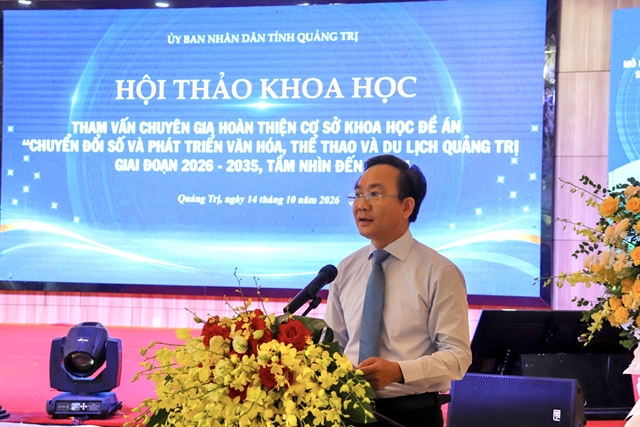
| Hoàng Xuân Tân, Vice Chairman of Quảng Trị Province's People’s Committee speaks at the workshop. — Photo chinhphu.vn |
QUẢNG TRỊ — Quảng Trị Province is seeking expert input to develop a digital transformation plan for culture, sports and tourism for 2026-2035, with a vision to 2045, focusing on preserving heritage and unlocking its value for sustainable development.
At a scientific workshop on Wednesday, Hoàng Xuân Tân, Vice Chairman of the provincial People’s Committee, said the province’s rich historical, cultural and natural resources provided an important foundation for socio-economic development.
These include revolutionary historical sites, Phong Nha-Kẻ Bàng National Park, a UNESCO World Heritage site, intangible cultural heritage and the distinctive traditions of ethnic communities.
As science and technology advance, the province needs to move beyond documenting and preserving heritage to making it more accessible and turning it into a driver of sustainable growth, Tan said. This requires improved management, effective data governance and mechanisms to balance heritage conservation with socio-economic development.
The proposed plan comprises 13 component projects and a separate science and technology task, to be implemented over 10 years. Tan stressed that it must be grounded in scientific research, supported by a clear legal framework and designed for practical implementation.
Key priorities include developing common criteria and encoding standards for heritage data, improving data classification and integration, and establishing technical standards for digitisation and data use. Experts also discussed the need for scientific accuracy when digitally reconstructing historical settings, events and figures, as well as transcription standards for ethnic minority languages and training for specialised personnel.
The plan also seeks to establish mechanisms for recognising and commercialising digital assets, assessing the contribution of digital cultural industries to local economic growth, and regulating access to and use of data, including data for artificial intelligence (AI) training. Mobilising private-sector funding and expanding international cooperation are also priorities.
The workshop’s recommendations will be reviewed to refine the plan before it is submitted to the relevant authorities for consideration and approval. — VNS
Life & Style
 Life & Style
 Life & Style
 Life & Style
 Life & Style
 Life & Style
 Life & Style
 Life & Style
 Life & Style
 Life & Style
 Life & Style
 Life & Style
 Life & Style
 Life & Style
 Life & Style