 Life & Style

Building stronger partnerships
1.
|
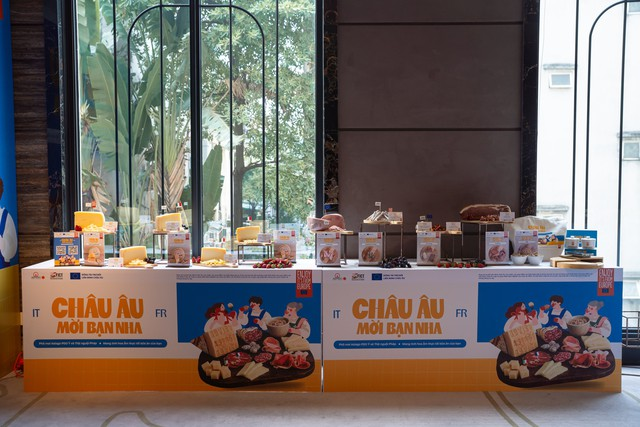
| A variety of Asiago PDO cheeses and traditional French cured meats are introduced to the public as one of the activities in the three-year campaign “Europe, Be My Guest” in Việt Nam. Photos courtesy of the organisers |
HÀ NỘI — The three-year campaign Europe, Be My Guest has widely introduced its products, specifically Italian Asiago PDO cheese and French charcuterie, to local customers in Việt Nam as part of an effort to highlight European culinary heritage—from origins and production processes to quality standards and sustainable development.
The campaign, scheduled from September 2025 to August 2028, is an EU-co-funded promotional initiative designed to bring premium European agricultural and food products to new Asian markets, including South Korea, Chinese Taipei, and Việt Nam, and to build long-term B2B partnerships with importers, retailers, and food service professionals.
The Italian Consortium for the Protection of Asiago Cheese and the Federation of Charcuterie and Delicatessen Companies (FICT) recently briefed attendees on the distinctive features of these two culinary traditions.
This activity was part of a broader programme aimed at raising awareness regarding food safety, traceability, authenticity, transparent labelling, animal welfare, and environmental protection, all of which are increasingly prioritised within European agricultural and food production systems.
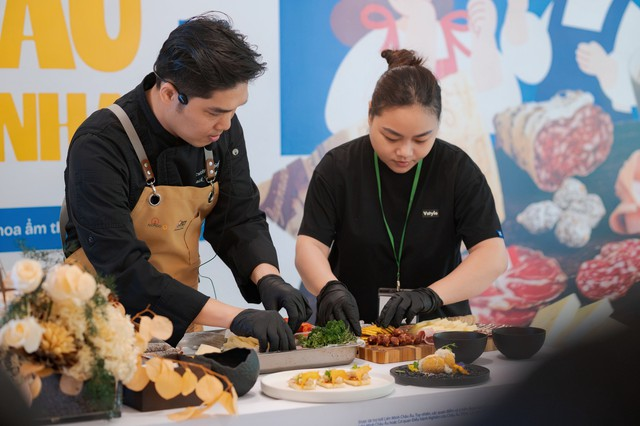
In its second year in Việt Nam, the campaign built upon the initiatives of its inaugural year, featuring a business-matching event in HCM City as well as workshops for chefs in both HCM City and Hà Nội.
|
| Chefs prepare dishes during a workshop in HCM City on October 29. |
The focus was on product introduction and building brand recognition before shifting towards the practical applications of European ingredients, creative cooking, and their role in the broader food service industry.
Activities included seminars for chefs and business networking sessions involving distributors, importers, retailers, and hospitality professionals.
Preserving value through origin and production methods
One of the highlights of the campaign is the EU’s quality certification system, which includes the Protected Designation of Origin (PDO) and Protected Geographical Indication (PGI) labels.
These certifications establish a link between a product and its specific geographical region, production methods, and traditional values preserved over generations.
In the case of Asiago cheese, the PDO certification requires the entire production process—from the sourcing of raw materials to processing and final product completion—to take place within a designated geographical area in accordance with strict standards.
Established in 1979, the Consortium is responsible for overseeing the production chain, safeguarding the designation of origin, and preventing brand counterfeiting.
Made from just three simple ingredients – milk, rennet, and salt – Asiago PDO comes in two main varieties: Aged Asiago PDO and Fresh Asiago PDO, each offering its own distinctive flavour profile and texture.
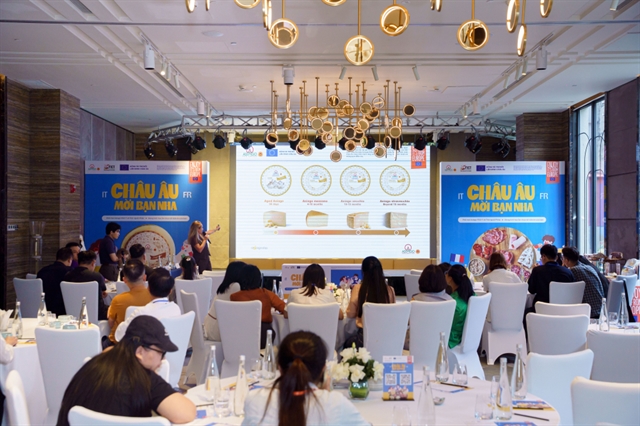
|
| Industry representatives engaged in active discussions at the business matching event. |
In France, FICT represents more than 310 businesses. The French charcuterie sector encompasses over 450 types of specialities, such as dry-cured ham, dried sausage, pâté, terrine, and rillettes.
The diversity of products is linked to the natural conditions and processing methods specific to each locality.
Quality, sustainable development priorities
Beyond flavour and variety, the value of these products also lies in how production is organised and how quality is controlled.
Protecting the origin of a product not only helps maintain its reputation but also contributes to preserving indigenous knowledge, traditional production methods, and the livelihoods of local communities.
Traceability is a fundamental requirement throughout the process. Every product must meet specific standards, ensuring transparency in production and providing clear information to consumers.
French charcuterie producers also undergo regular inspections and numerous quality checks each year.
Notably, the production philosophy behind these traditional products emphasises a deep respect for nature and the passage of time.
Asiago cheese is left to mature gradually in specialised cellars, while French ham undergoes a slow air-drying process under carefully controlled ventilation. Such methods demand rigorous oversight and expertise passed down through generations. — VNS
Life & Style
 Life & Style
 Life & Style
 Life & Style
 Life & Style
 Life & Style
 Life & Style
 Life & Style
 Life & Style
 Life & Style
 Life & Style
 Life & Style
 Life & Style
 Life & Style
 Life & Style