 Life & Style

HCM City to host international feed, livestock & meat industry expo
1.
|
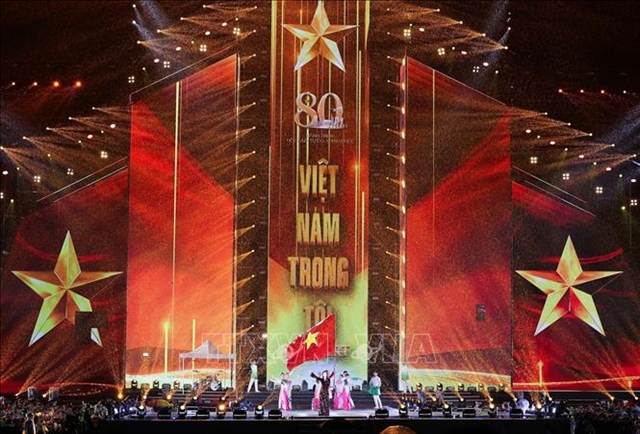
| A performance at the concert Việt Nam Trong Tôi (Việt Nam in Me). — VNA/VNS Photo Lê Đông |
HÀ NỘI — Amid the rapid growth of digital technology, the protection of intellectual property rights in the cultural sector not only safeguard the fairness for creators but also preserve the future of Việt Nam’s culture, according to experts.
Associate Prof. Dr. Bùi Hoài Sơn, full-time member of the National Assembly’s Committee for Cultural and Social Affairs, said copyright infringement in the digital environment has become a persistent problem in recent years. Films, music, television programmes, e-books, video games, journalistic works, images and creative data can now be copied, edited and redistributed within minutes. While copyright violations were once linked mainly to pirated discs or counterfeit books, infringements have shifted online with faster speed, wider scale and greater anonymity.
Cinema and music are among the hardest-hit sectors. Many Vietnamese films appear on illegal streaming websites immediately after release, while movie clips are secretly recorded in cinemas and uploaded to social media for views and advertising revenue. Such acts cause major financial losses for producers and undermine the professional development of Việt Nam’s film industry.
Watching pirated films has gradually become habitual for part of the public, inadvertently enabling illegal activities. A notable example is the film Bố Già (Godfather) by Trấn Thành. After being released on paid streaming platform Galaxy Play, the film was rapidly copied and distributed by illegal websites. Within 24 hours, Galaxy Play detected more than 10 infringing links from different domains.

|
| The poster of the film Bố Già (Godfather) by Trấn Thành. — Photo courtesy of HK Film |
The music industry is also facing serious copyright violations. Songs are frequently used in advertising videos, livestreams and performances without permission, while some organisers deliberately avoid paying royalties to cut costs. Many people still mistakenly believe that music uploaded online is “free” to use, despite substantial investment in time, intellect and financial resources required to produce valuable works.
In the digital environment, individuals and businesses need to fully understand the multiple layers of rights attached to musical works, including composers’ copyrights, recording rights, performers’ rights and commercial exploitation rights. The case of Mây Sài Gòn illustrates the issue. Although it obtained permission to organise performances, the company recorded, edited and uploaded music products to YouTube through BH Media without permission from the authors, exposing continuing gaps in copyright awareness.
Beyond cinema and music, publishing has also become a hotspot for violations. Pirated books and illegal e-book distribution remain widespread, with many bestselling titles converted into PDFs and shared online shortly after publication.
The causes of intellectual property violations stem from multiple factors, including limited public awareness and the persistent mentality of using content “for free”. Advertising and online traffic revenues also encourage individuals and organisations to exploit infringing content despite legal risks.
Enforcement efforts face major obstacles. Infringing websites can easily change domain names or place servers overseas to evade authorities, while penalties are often insufficient compared to the profits generated by violations. Coordination among regulators, technology platforms and copyright holders also remains inconsistent.
Trần Hoàng, Director of the Copyright Office of Việt Nam under the Ministry of Culture, Sports and Tourism, said digital technology and artificial intelligence are reshaping the global content ecosystem. In this new era, copyright has become not only a legal instrument but also essential infrastructure for the creative economy. He stressed that copyright protection must become more transparent, effective and adaptive to technological change, while international cooperation is essential to improving enforcement in cyberspace.
Managers also warned that intellectual property violations create a cultural environment lacking respect for creativity. When the “theft of intellectual labour” becomes widespread without strong condemnation, social ethical standards are undermined and respect for the law weakened.
To strengthen enforcement, the Government recently issued Official Dispatch No. 38/CD-TTg, launching a nationwide campaign to intensify inspections and tackle violations. The Copyright Office of Việt Nam also urged organisations and enterprises in cinema, music, publishing, journalism, television and video games to use licensed software and avoid illegal use of copyrighted works and recordings.
Notably, on May 16, the Ministry of Public Security initiated legal proceedings against five criminal cases involving seven defendants in the entertainment and digital media sectors. The move is regarded as the strongest crackdown so far on intellectual property violations in the music industry. Entities under investigation include BH Media, Lululola Entertainment, 1900 Group, Mây Sài Gòn and Giọng Ca Để Đời Centre over alleged copyright and related-rights infringements linked to music content uploaded to YouTube for commercial gain without permission or royalty payments. — VNA/VNS
Life & Style
 Life & Style
 Life & Style
 Life & Style
 Life & Style
 Life & Style
 Life & Style
 Life & Style
 Life & Style
 Life & Style
 Life & Style
 Life & Style
 Life & Style
 Life & Style
 Life & Style