 Life & Style

Rural tourism needs to cash quantities over goods sold
1.
|
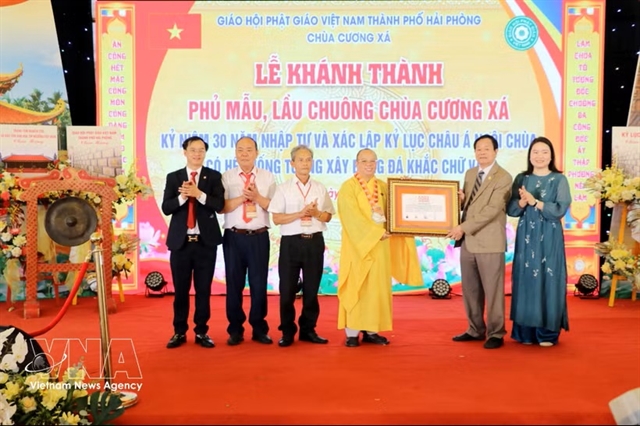
| The certificate recognising Cương Xá Pagoda as the temple with the largest system of stone walls engraved with the Buddhist swastika symbol is handed over to the pagoda's representatives at a ceremony held on May 3. — VNA/VNS Photo |
HẢI PHÒNG — Cương Xá Pagoda in Tân Hưng Ward of northern Hải Phòng City has been recognised as the temple with the largest system of stone walls engraved with the Buddhist swastika symbol in Asia by the Asia Book of Records.
Authorities, Buddhist dignitaries, followers, visitors and residents gathered at a ceremony held on May 3 to receive the certificate.
Also known as Quỳnh Khâu Tự (Jade Mound Pagoda), the site stands on elevated ground to the southwest of former Cương Xá Village, now part of Tân Hưng Ward.
According to stone inscriptions, the pagoda underwent its first major restoration during the reign of King Lê Thần Tông (1607–1662). Ravaged by wars and prolonged neglect, it fell into severe disrepair before being restored again in 1946, though without a resident abbot.
|
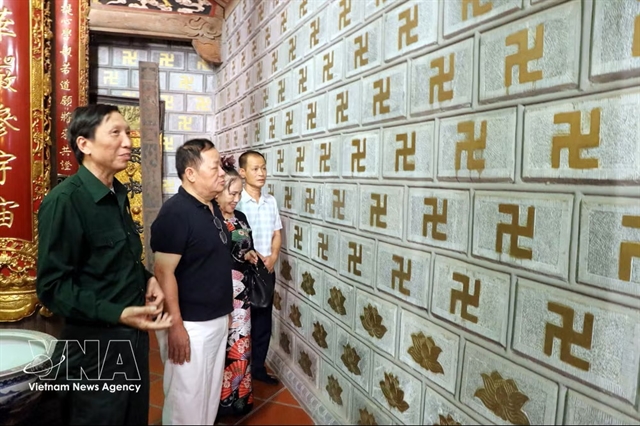
| Locals and tourists visit a stone wall engraved with the Buddhist swastika symbol at Cương Xá Pagoda. — VNA/VNS Photo |
A turning point came in 1996 when Venerable Thích Thanh Cường was appointed abbot. At the time, the pagoda consisted of only a modest front hall and a small rear sanctuary in deteriorated condition. Despite this, it preserved a number of valuable artefacts, including nine wooden statues, a grand bell dating back to the Lê Dynasty, ancient inscriptions, ancient couplets and a centuries-old tree.
Driven by a vision to fully revive the pagoda, the abbot initiated a comprehensive restoration project in 2009, with approval from local authorities. Excavation revealed ancient structural foundations and bricks dating back to the Eastern Han dynasty in China, approximately 2,000 years ago, affirming the site’s long-standing historical significance.
Following nearly seven years of reconstruction, the pagoda complex now spans 7,385 square metres. Notably, its distinctive stone wall system is built from green stone sourced from Nhồi Mountain in central Thanh Hóa Province. Each horizontal row comprises 108 blocks, each measuring 40cm in length, 30cm in width and 35cm in thickness, with an average weight of around 80kg.
The first three rows are intricately carved with lotus motifs while from the fourth row upward to the roofline, each stone is engraved with a gilded swastika symbol. In total, nearly 3,000 such symbols adorn the structure, creating a striking synthesis of architectural scale, sculptural craftsmanship and Buddhist symbolism.
Venerable Thích Thanh Cường said the original design envisioned a wooden structure. However, after visiting Angkor Wat in Cambodia, he drew inspiration from its monumental stone construction and decided to adopt a similar approach using smaller carved stone blocks. The construction process proved highly labour-intensive, with artisans hand-carving each stone on site and assembling only 10–15 blocks per day once upper layers required mechanical lifting.
The lotus carvings at the base symbolise purity and enlightenment, central to Buddhist philosophy, and lotus is also considered as Việt Nam's national flower. The swastika motifs above represent auspiciousness and form part of the 32 auspicious marks associated with Gautama Buddha, signifying wisdom, virtue and compassion attained through enlightenment.
Local authorities underscored their continued support for religious and cultural activities in accordance with the law. Chairman of the Tân Hưng Ward People’s Committee Vũ Công Thản expressed his hope that the pagoda’s new recognition will serve as a catalyst for linking with the local woodblock carving village to create a distinctive tourism offering.
Nguyễn Minh Xô, Standing Vice Chairman of the Hải Phòng Tourism Association, said the organisation will step up efforts to promote the pagoda’s unique cultural and architectural values to both domestic and international visitors.
In August 2015, the pagoda was recognised by VietKings as the first in Việt Nam to feature stone walls engraved with the swastika symbol. Following a rigorous independent evaluation process, the Asia record was officially approved on April 27 this year.
On the same day, the pagoda also inaugurated its Mother Goddess shrine and bell tower. — VNA/VNS
Life & Style
 Life & Style
 Life & Style
 Life & Style
 Life & Style
 Life & Style
 Life & Style
 Life & Style
 Life & Style
 Life & Style
 Life & Style
 Life & Style
 Life & Style
 Life & Style
 Life & Style