 Life & Style
HCM City records strongest quarterly growth in a decade
1.
 |
| Boats carry pilgrims during the Hương Pagoda Festival. — Photo nguoihanoi.vn |
HÀ NỘI — During spring festival season 2026, Hà Nội's major celebrations have aggressively adopted digital technology across management, organisation, communications and promotion, presenting a more orderly and civilised image for traditional events.
Civilised festivals through digitalisation
The 4km Yến Stream waterway leading pilgrims to the Hương Sơn Complex, home to the famed Hương Pagoda, has historically faced overloaded boats, missing life jackets and fare disputes.
In the Spring Festival 2026, however, the waterway presented a markedly different scene: passengers uniformly wearing orange life jackets in line with rules, boats strictly adhering to capacity limits, and no motorised vessels allowed. Drones periodically patrolled overhead, acting as 'electronic eyes' to monitor transport operations and support handling of violations.
To deliver a safe and orderly festival, the Hương Pagoda Festival organising board developed advance infrastructure and operational plans, integrating digital tools comprehensively. AI-powered camera systems now oversee high-traffic spots such as Hương Tích Cave, Thiên Trù Pagoda and cable car stations.
All 1,033 traditional boats, 2,636 rowboats and six electric boats have been registered, inspected and equipped with QR codes. Visitors or authorities can scan these codes to report irregularities involving boat operators directly to organisers, enabling rapid and transparent settlement.
At the Cổ Loa Festival in Đông Anh Commune's historic Cổ Loa Citadel area, numerous artifacts and items have been digitised. For 2026, digital platforms now include added interactive maps, information layers and media content, letting visitors access historical details instantly via mobile devices.
Festival grounds feature a Digital Heritage Space and Digital Traditional Festival zone with activities like 360-degree virtual reality tours, 3D hologram displays and augmented reality recreations of the Cổ Loa Festival. Attendees use VR headsets to tour the relic site, explore the legend of the magic crossbow, view digitised 3D artifacts and scan QR codes for details on history, architecture and documents.
 |
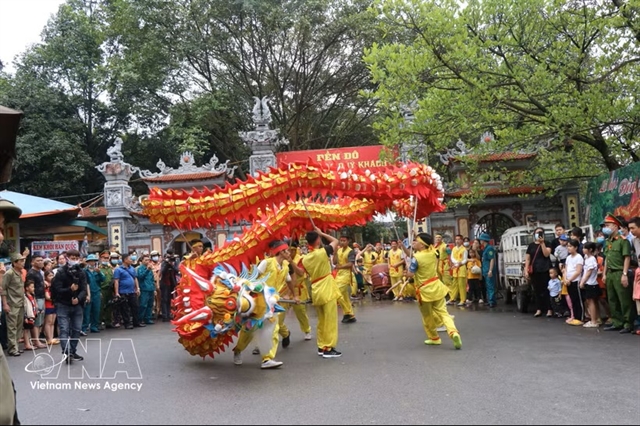
| At Cổ Loa Citadel, numerous artifacts and items have been digitised. — Photo suckhoeviet.org.vn |
Similar digital apps have been rolled out at other key Hà Nội festivals this season, including the Gióng Festival at Sóc Temple, the Hai Bà Trưng Temple Festival, and the Đống Đa Mound Festival. Prominent heritage sites such as the Temple of Literature, Tây Hồ Temple and Trấn Quốc Pagoda have also deployed digital monitoring, creating a refreshed image for traditional festivities. Incidents of jostling, disputes or traffic congestion have been promptly detected and responded through surveillance systems.
Shaping new-era festivals
Hà Nội hosts about 1,500 festivals of various scales. Recently, digital adoption focused mainly on promotion and communications, with management applications limited to select relic sites, such as Tây Hồ Temple's earlier use of surveillance cameras to curb social misconducts.
For the Spring Festival 2026, proven models like Tây Hồ Temple's have scaled across most major events. Localities introduced broader innovations, applying digital transformation to heritage promotion, civilised behaviour encouragement, security, order maintenance and environmental protection.
Assoc. Prof. Dr. Bùi Hoài Sơn, a full-time member of the National Assembly’s Committee for Culture and Social Affairs, stressed that technology should serve as a supportive instrument for better heritage management and preservation, rather than overshadowing essential traditional rituals. — VNA/VNS
Life & Style
 Life & Style
 Life & Style
 Life & Style
 Life & Style
 Life & Style
 Life & Style
 Life & Style
 Life & Style
 Life & Style
 Life & Style
 Life & Style
 Life & Style
 Life & Style
 Life & Style