 Economy


Việt Nam eye better result at Asian beach football tournament
1.
|
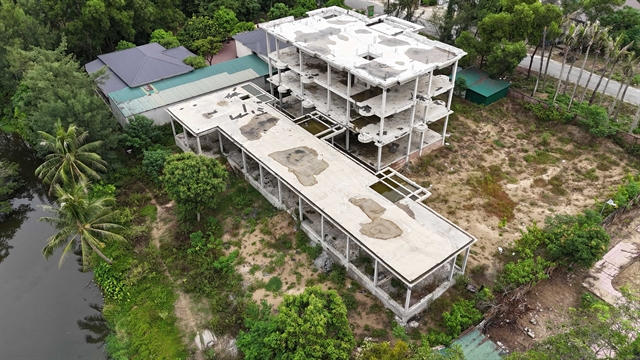
| A project left unfinished in Hà Tĩnh Province. A tax rate of 0.2 per cent is proposed to be imposed on land that is left unused or brought into use later than required. — VNA/VNS Photo Hữu Quyết |
HÀ NỘI — The Ministry of Finance has proposed a uniform tax rate of 0.2 per cent on land that is left unused, not put into use or brought into use later than required, nearly seven times the 0.03 per cent rate applied to residential land within prescribed limits.
The proposal is part of a draft law amending several provisions of the Law on Corporate Income Tax, the Law on Non-Agricultural Land Use Tax and Law on Personal Income Tax which the ministry has submitted to the Government for consideration.
Under the draft, the 0.2 per cent rate would be calculated based on land value and would not be subject to land use limits. The rate is the same as that currently applied to encroached or illegally occupied land.
The ministry said the proposal aims to carry out the Politburo’s Resolution 21-NQ/TW to improve the efficiency of land resource use.
Under the established regulations, non-agricultural land tax rates vary according to land use purposes and status.
Residential land within the prescribed limit is taxed at 0.03 per cent, while the portion exceeding the limit by no more than three times is subject to 0.07 per cent and the portion exceeding three times the limit to 0.15 per cent.
Non-agricultural land used for production and business is currently taxed at 0.03 per cent. Land used for purposes contrary to regulations is subject to 0.15 per cent, while encroached land is taxed at 0.2 per cent.
The ministry said that existing regulations do not specifically provide a tax rate for land left idle, land not put into use or land brought into use later than required, however.
Trương Bá Tuấn, deputy head of the ministry's Department for Management and Supervision of Tax, Fees and Charges Policies, said the proposed rate was intended to create stronger tax regulation for land that is left unused or brought into use late.
However, the draft does not yet establish definition and criteria for idle land. The criteria for land subject to the proposed tax regime will be based on land regulations instead.
Tuấn said the Government had assigned the Ministry of Agriculture and Environment to clarify the relevant concepts and criteria for idle land, land left unused and brought into use late, which would then provide the basis for applying the tax policy.
Clear criteria needed
|
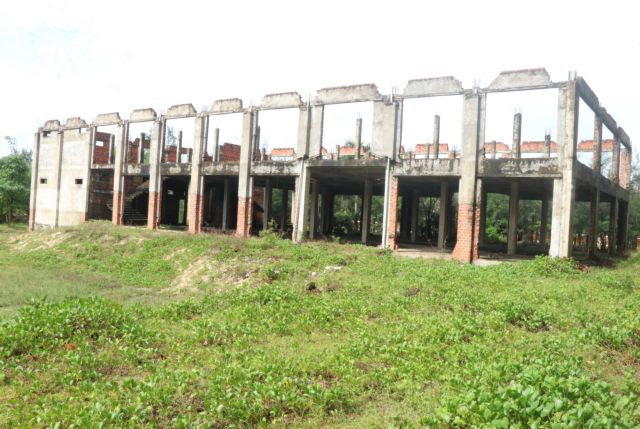
| A deserted project in Quảng Trị Province. — VNA/VNS Photo Nguyên Lý |
The proposal has attracted attention from land-owners and project developers, particularly those whose properties are affected by prolonged planning restrictions. Clear criteria will be needed to distinguish genuinely idle land from land that cannot be developed because of unresolved legal or administrative issues, experts said.
Nguyễn Duy Thành, general director of real estate services company Global Home, said the proposed tax rate of 0.2 per cent is a strong signal that authorities want to strengthen discipline in land use.
In the short and medium term, higher land-holding costs could encourage businesses and investors to accelerate projects, put land into use or transfer it to parties with genuine demand, which will potentially increase supply and reduce the waste of land resources, he said.
However, the effectiveness of the policy would depend largely on implementation and accurately identifying the land subject to the tax.
Thành said it is important to distinguish between deliberately holding land for speculation and projects delayed by objective factors such as planning adjustments, delays in land clearance, legal problems or prolonged administrative procedures.
He called for specific criteria covering project delays, investment progress, land use status and the causes of delays, as well as integrated land databases to ensure that land use status is determined based on data.
In practice, many businesses develop land portfolios in stages and choose appropriate timing for project implementation to ensure investment efficiency and balance supply and demand.
Thành said the policy should be assessed over the economy’s longer-term development cycle to strike a balance between curbing speculation and preventing wasteful land use, while supporting sustainable development of land resources.
A real estate legal expert said in the longer term, a progressive tax could be considered, with a grace period for land-owners to complete required procedures. If land remained unused, the tax could gradually increase, while prolonged violations could potentially lead to land recovery.
The draft law is expected to be submitted to the National Assembly for consideration and approval during its October session. — VNS
Economy
 Economy
 Economy
 Economy
 Economy
 Economy
 Economy
 Economy
 Economy
.jpeg) Economy
 Economy
 Economy
 Economy
 Economy
 Economy