 Economy


Ten Vietnamese talents to compete at Youth Olympic Games
1.
|
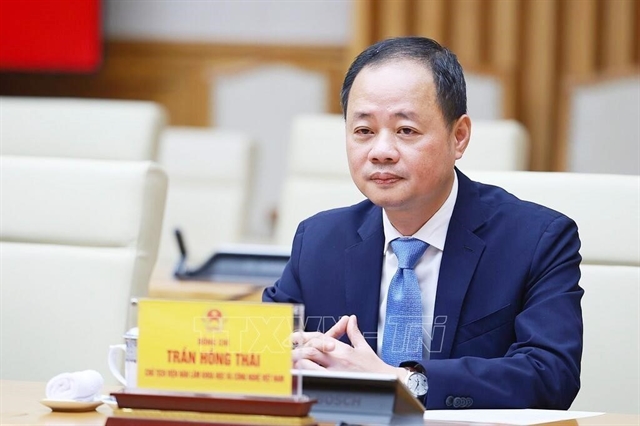
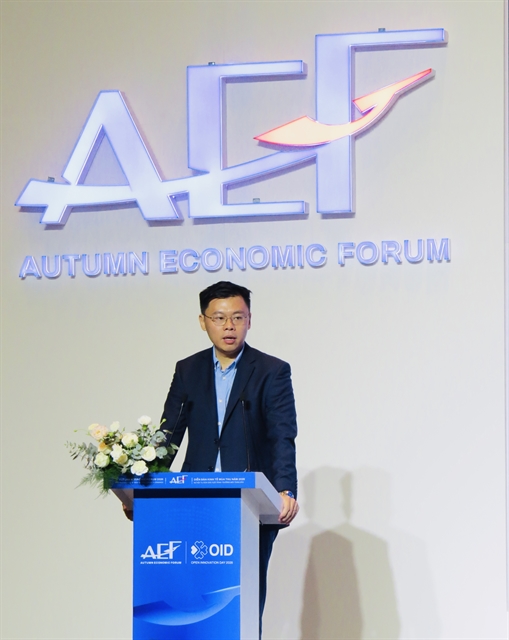
| Professor Trần Hồng Thái, President of the Vietnam Academy of Science and Technology (VAST) and Deputy Head of the Party Central Committee’s Policy and Strategy Commission. — VNA/VNS Photo |
Professor Trần Hồng Thái, President of the Vietnam Academy of Science and Technology (VAST) and Deputy Head of the Party Central Committee’s Policy and Strategy Commission, spoke to the Vietnam News Agency about how the academy approaches international cooperation on strategic technologies.
Việt Nam is stepping up international cooperation on strategic technologies. How does VAST see the role of that cooperation, which fields does it prioritise, and over what timeframe?
Việt Nam has identified ten groups of strategic technologies, and pursuing them requires far deeper international cooperation. Partnerships give us access to specialised knowledge, advanced infrastructure and substantial resources, and they help us narrow the technology gap. Acquiring technology, however, is not the end goal. What matters more is absorbing it, mastering it and continuing to develop it at home.
VAST draws on what each partner does best, whether that is basic research, core technologies, infrastructure, manufacturing, training or commercialisation. Rather than looking for a single partner to cover an entire field, we match particular capabilities to particular problems and stages of development, and connect them to the foundations Việt Nam already has. We are broadening our network of countries and international scientific organisations in order to reach the most relevant knowledge, experts and facilities, not to accumulate partners for their own sake.
Between now and 2030, our priority will be fields in which we already have a research base and established teams: biotechnology, advanced materials, energy, artificial intelligence, semiconductors, quantum technology, space technology, and marine and ocean sciences.
Within each field, Việt Nam should concentrate on the stages where it has an advantage or can genuinely create value. That means avoiding spreading investment too thinly, and accepting that we need not master an entire technology chain at once.
Over the longer term, cooperation must move beyond academic exchange toward joint technology development: shared research teams and laboratories, training, and the creation of intellectual property. At that point, international cooperation becomes a means of building self-reliance, a way for Việt Nam to turn its partners’ strengths into technological capacity of its own.
In this new phase, cooperation must therefore serve three goals at once: gaining access to advanced knowledge and technology; training Vietnamese experts; and gradually building technologies, know-how, data and intellectual property that Việt Nam can own outright or share with its partners.
For that reason, we do not judge a programme simply by the number of papers it produces or the technologies it transfers. The more important question is what Việt Nam has gained once the programme ends: how many more experts we have, which methods and stages of the technology we now command, and what scientific assets and intellectual property we have accumulated.
When choosing international partners, what carries the most weight: scientific capability, core technology, commercial potential, or the ability to help Việt Nam enter global value chains?
All four matter, but the choice of partner must begin with what Việt Nam needs to achieve in a given field. We first have to identify which links in the chain we are missing and which capabilities we need to add, and then look for the partner whose strengths fit best. For the academy, strength in science and core technology is essential but not sufficient. A partner with outstanding technology that only supplies equipment or hands over a finished process is not necessarily the right partner for our long-term goals.
What we value above all is a willingness to work alongside us: to define the problem together, conduct joint research, train our scientists, share infrastructure, develop the technology, and agree on fair terms for ownership of the resulting intellectual property. The criteria also shift as work moves through the development pipeline. At the fundamental research stage, we need to collaborate with leading institutes, universities and laboratories to gain access to new knowledge, expertise and major research facilities.
As work moves into technology development, we need partners with engineering, manufacturing and testing capabilities. And as a technology approaches the product stage, businesses, markets, standards and access to international value chains become increasingly important. Quantum technology is a good example. It is not a single technology but an entire ecosystem, extending from fundamental science, materials, photonics, devices and research infrastructure to computing, sensing and applications.
VAST is therefore not looking for one partner to deliver 'quantum technology' as a package. Instead, we work with different partners according to their particular strengths, and connect those capabilities with Vietnamese research groups in physics, materials science, mathematics and digital technology. The same approach can be applied to other strategic technologies, such as semiconductors, new energy and pharmaceuticals.
A single strategic technology may involve many partners, each contributing at a different point in the chain. For VAST, a strategic partner is not simply one with advanced technology, but one with the right capabilities and a genuine commitment to building long-term capacity with Việt Nam. The ultimate aim is not merely to bring technology into the country, but to enable Vietnamese scientists, technologies and products to play a deeper role in international research networks and global value chains.
Across AI, semiconductors, quantum technology, robotics, advanced materials, biotechnology, space and marine technology, where do you believe Việt Nam can move from learning and receiving to co-creating with international partners?
Co-creation does not mean that Việt Nam must immediately master an entire industry or match the capabilities of countries that started long before us. What matters is identifying the fields, and the links within them, where we have enough knowledge, data, scientific resources and research capacity to make a substantive contribution, and then working with partners to produce new knowledge, technologies or products.
For the academy, I see at least three avenues.
The first is to build on fields in which Việt Nam already has a strong research foundation, such as mathematics, physics, biology and marine science. In biotechnology, for instance, our advantage lies not only in the country’s rich biodiversity but also in the specimen collections, data, knowledge and research teams built up over many years.
The academy’s expertise extends from biodiversity, ecology and genetic resources to molecular biology and biotechnology. Marine science is similar: we have data, specimen collections, a deep understanding of the East Sea (internationally known as the South China Sea) and tropical marine ecosystems, and long-established research teams. These assets allow Việt Nam to enter partnerships not merely as a supplier of research material, but as a contributor of knowledge, data and expertise in producing new results.
The second lies in new fields emerging where the academy’s scientific strengths intersect with new technologies, notably the application of artificial intelligence across the sciences. The academy holds scientific datasets and deep expertise in biology, materials, marine science, the environment, Earth sciences and space science. Combining this specialised data and knowledge with AI could open new directions, from materials discovery and the analysis of genetic and biological data to the processing of marine data, satellite imagery, and environmental and disaster information. Here, the academy can contribute the scientific problems, the data and the domain expertise, while drawing on partners’ strengths in models, algorithms and advanced computing infrastructure.
The third covers technologies in which the gap with leading countries remains wide, but where the academy has the scientific basis to engage with selected links: advanced materials, semiconductors, quantum technology, hydrogen, and satellite and space technology.
In these areas, we need not begin with the goal of mastering the whole chain. We can start with materials, sensors, photonics, catalysts, membranes, or specific components and applications in which Vietnamese research groups are strong, then use cooperation to deepen our expertise, build capacity and gradually move into higher-value stages.
In our view, the question of what technology partners can transfer to Việt Nam remains important, but at this stage we must also answer another: what can Việt Nam contribute that would create new value alongside its partners? Once we are clear about our scientific assets, our strengths and the links we can contribute, we can move step by step from learning and receiving to becoming a genuine partner in joint research, joint development and co-creation. — VNS
Economy
 Economy
 Economy
 Economy
 Economy
 Economy
 Economy
 Economy
 Economy
.jpg) Economy
 Economy
 Economy
 Economy
 Economy
 Economy