 Economy


Five fishermen rescued after boat catches fire in Quảng Trị
1.
|
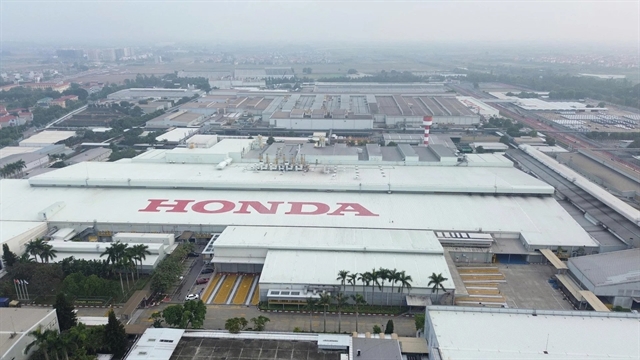
| A Honda Vietnam factory in Phú Thọ. — Photo vietnamfinance.vn |
HÀ NỘI — Japanese investment is helping drive green manufacturing and higher-value production in Việt Nam, as the country seeks to attract foreign capital that brings advanced technology, innovation and technology transfer, in line with a new policy direction under Resolution No 10-NQ/TW.
Japan has more than 5,800 active investment projects in Việt Nam, with total registered capital exceeding US$81 billion, according to the Vietnam Trade Promotion Agency under the Ministry of Industry and Trade.
Free trade agreements (FTAs) between the two countries and their regional partners have also improved market access through tariff reductions, rules of origin and trade facilitation, creating opportunities for businesses to deepen their participation in regional supply chains.
Major Japanese investors, including Honda, Panasonic, Kao and Sumitomo, have established and expanded manufacturing operations in the country, while new investment projects in industrial parks are supporting the shift towards more sustainable production.
One recent example is Japan's Oji Group, which has begun construction of a $110 million aseptic paper carton packaging factory under its Oji Liquid Pak (OLP) brand at Long Thành High-Tech Park in Đồng Nai Province.
Nguyễn Quốc An, deputy head of the Đồng Nai Industrial Parks and Economic Zones Management Board, said large-scale projects of this kind could strengthen local industrial capacity and increase Việt Nam's participation in regional supply chains.
The management board would continue to support the investor during project implementation, coordinate with relevant agencies and address emerging obstacles within its authority to help ensure the facility becomes operational in line with regulations, he said.
Kestutis Sliuzas, general director of Oji Liquid Pak, said manufacturers, including packaging producers, increasingly needed to combine operational efficiency, food safety and production flexibility with circular-economy principles.
The company's project combines packaging manufacturing for the food industry with research and development, technical services, and the installation and maintenance of Japanese machinery, he said.
Japanese investment in Việt Nam also extends beyond manufacturing to research and development in the natural sciences, machinery and equipment maintenance, and the import, export and distribution of goods in accordance with Vietnamese law, according to experts.
Tsuchibashi Akito, chairman of the Japanese Chamber of Commerce and Industry in Việt Nam, said Japanese companies continued to value Việt Nam's stability and development potential and intended to maintain long-term investment.
"We want to accompany Việt Nam in its industrial modernisation goals and achieve joint development through co-creation between Việt Nam and Japan," he said at a meeting in Huế on September.
Trần Việt Hà, deputy head of the Ho Chi Minh City Exporting Processing and Industrial Zones Authority, said the authority is seeking to accelerate project implementation by streamlining procedures related to planning and construction in order to facilitate foreign investors including those from Japan.
The authority also plans to move from handling administrative procedures on a case-by-case basis towards monitoring projects continuously, from investment preparation through to operation, Hà said.
Resolution No 10-NQ/TW, issued by the Politburo on June 8, 2026, on the development of the foreign-invested economy, sets out a policy shift towards attracting higher-quality foreign investment, particularly projects involving advanced technology, innovation, workforce development and technology transfer.
The policy direction reflects Việt Nam's ambition to move beyond labour-intensive assembly towards higher-value, technology-driven production, strengthening the role of foreign-invested enterprises in industrial upgrading and sustainable economic development. — VNS
Economy
 Economy
 Economy
 Economy
 Economy
 Economy
 Economy
 Economy
 Economy
 Economy
 Economy
 Economy
 Economy
 Economy
 Economy