 Economy



Play brings Vietnamese history, culture to international audiences
1.
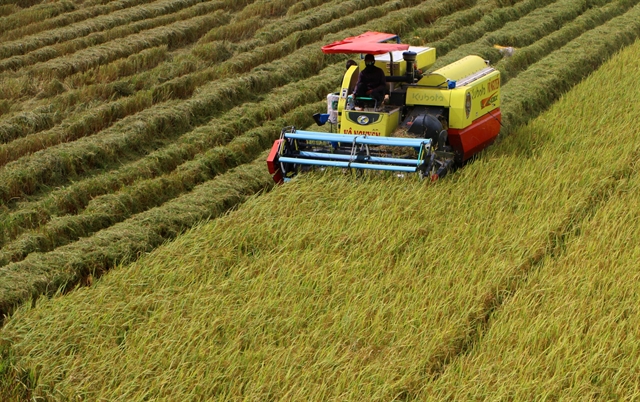 |
| Harvesting low-emission rice in Cần Thơ. It is necessary to develop standard criteria for assessing carbon-related projects and pilot financing models in areas such as low-emission rice cultivation, livestock farming with biogas, sustainable forestry, waste treatment and biomass energy. — VNA/VNS Photo Duy Khuong |
HÀ NỘI — Linking green credit with the carbon market is critical to mobilising finance for Việt Nam’s green transition. This alignment will help banks better evaluate emissions-reduction projects as the country drives toward its 2050 net-zero target.
Speaking at a conference organised by the Finance and Investment newspaper and the State Bank of Vietnam (SBV) in Hà Nội, SBV Deputy Governor Nguyễn Ngọc Cảnh said the carbon market can help turn verified emissions reductions into economic value, which will create additional revenue streams for businesses and ease pressure on bank lending.
He noted that an efficient carbon market is a powerful tool for businesses, capable of boosting cash flow, upgrading credit profiles, and ensuring exporters remain compliant with evolving environmental criteria.
The domestic carbon market began operating on June 29, 2026, with the pilot phase running through the end of 2028 and full mandatory operation scheduled to begin in 2029. The pilot phase covers more than 511 million tonnes of carbon dioxide equivalent in emissions allowances allocated to facilities in the power generation, steel and cement sectors for 2025-26.
Commercial banks can participate by providing settlement services, with state-owned lender BIDV serving as the sole settlement bank during the pilot phase.
Bùi Minh Giáp, chief economist at the Asian Development Bank in Việt Nam, estimated that the country would need about $368 billion in additional investment by 2040 for climate adaptation, resilience and emissions reduction, equivalent to 6.8 per cent of gross domestic product.
Of that amount, around $254 billion would be needed for adaptation and resilience, while $114 billion would be required for emissions reduction.
The revised eighth power development plan (PDP8) also estimates that $136 billion will be needed for investment in power generation and grid infrastructure between 2026 and 2030.
Giáp said near-term financing needs should be concentrated in clean power, electricity grids and energy efficiency, followed by industrial production, transport, agriculture and waste treatment.
The carbon market and green credit can effectively complement each other only if lenders have the capacity to assess green and transition activities, cash flows from carbon credits and individual projects’ debt-servicing capacity, he said.
Nguyễn Thị Thu Hà, director of Agribank's staff training school, said the key question is not whether banks should trade carbon credits directly, but how they could finance emissions-reduction activities and when carbon value will become sufficiently reliable to be factored into lending decisions.
She said financing needs arise before carbon credits are issued, as projects must go through preparation, investment, operation, measurement, reporting and verification, credit issuance, trading and settlement.
This process creates opportunities for banks to provide loans, bridge financing, cash-flow management, guarantees and blended financial solutions.
Agribank identified five roles for banks in the carbon market ecosystem, including financing emissions reduction activities, connecting stakeholders across the value chain, providing payment and cash-flow management services, mobilising climate finance, and supporting businesses and individuals in the green transition.
The bank called for clearer rules governing ownership of emissions reductions and carbon credits, the distribution of proceeds, collateral arrangements, accounting, taxation and foreign exchange transactions.
It also proposed developing standard criteria for assessing carbon-related projects and piloting financing models in areas where emissions reductions can be measured, such as low-emission rice cultivation, livestock farming with biogas, sustainable forestry, waste treatment and biomass energy.
Hà stressed that carbon market infrastructure would need reliable data and measurement, reporting and verification systems to reduce verification costs and improve confidence among lenders, project developers and credit buyers.
The SBV’s statistics showed that outstanding green credit reached more than VNĐ856 trillion (US$32.5 billion) at the end of June, up 9.87 per cent from the end of 2025. Green lending grew by more than 20 per cent annually on average between 2017 and 2025.
Agriculture, forestry, fisheries, and biodiversity conservation accounted for more than 31 per cent of green credit, while green energy accounted for nearly 28 per cent. — VNS
Economy
 Economy
 Economy
 Economy
 Economy
 Economy
 Economy
 Economy
 Economy
 Economy
 Economy
 Economy
 Economy
 Economy
 Economy