 Economy


Textile exports face dual challenges of sustaining orders and boosting efficiency amid growing competition
1.
|
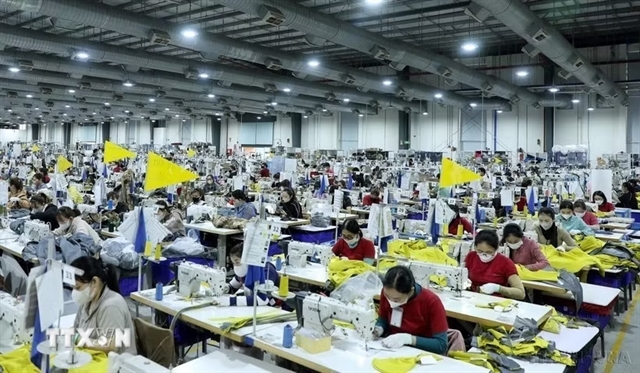
| Vietnamese textile manufacturers continue to navigate significant market uncertainties. — VNA/VNS Photo |
HÀ NỘI — Despite posting encouraging export figures, Vietnamese textile and garment enterprises continue to navigate unpredictable market variables.
In the year-end final stretch, the industry faces the dual challenge of maintaining order volumes while enhancing export efficiency amid intensifying international competition.
According to Trương Văn Cẩm, Vice Chairman of the Vietnam Textile and Apparel Association (VITAS), as global demand recovery remains uneven, input and logistics costs stay elevated. Meanwhile, price competition grows increasingly fierce, businesses urgently require a more predictable, stable, and favorable policy environment for export activities.
"In my view, management mindset must make a decisive shift from managing individual enterprises and single transactions to overseeing whole supply chains. A single export order can simultaneously involve yarn, weaving, dyeing, auxiliary materials, garment manufacturing, and logistics companies. Viewing these stages in isolation prevents policies from fully reflecting supply chain interconnections," Cẩm emphasised.
Statistical data shows that the textile and garment sector maintained its growth momentum in the first nine months of this year. The industry's total export turnover reached an estimated US$35.721 billion in the first nine months of this year, up 3.3 per cent year-on-year.
Garments remained the primary driver at an estimated $28.24 billion (up 2.2 per cent), followed by yarn and fiber exports at $3.6 billion (up 13.08 per cent), and non-woven fabrics at $610 million (up 7.77 per cent). Achieving this growth reflects persistent efforts by businesses amid volatile market conditions.
Industry experts note that despite positive nine-month performance this year, manufacturers remain exposed to significant market uncertainties, particularly trade policy adjustments and tariff barriers in major consumer markets.
In the US, Việt Nam's largest export market, domestic textile products currently face a 12.5 per cent tariff rate. This creates a significant disadvantage compared to several competing export nations that face a lower tariff rate of 10 per cent.
Furthermore, certain competitor countries may gain access to tariff-rate quota mechanisms with duties reduced to 0 per cent for products incorporating US-sourced input materials.
Entering the final months of the year, positive news emerged as major enterprises basically secured their order books. However, having secured orders does not mean businesses can breathe easy.
Cao Hữu Hiếu, general director of Vietnam National Textile and Garment Group (Vinatex), noted that export markets for Vinatex remain stable. The garment sector has basically secured orders through the fourth quarter of this year and select subsidiaries have already secured orders for early next year.
At Garment 10 Corporation - JSC, several EU clients have requested volume increases, and traditional buyers have proposed expanding order allocations for next year.
Bạch Thăng Long, deputy general director of Garment 10, cautiously remarked that these inquiries represented localised signals rather than a broader market trend. Garment 10 had secured production workloads through November 2026 and expected to maintain sufficient core orders through year-end.
Similarly, Vinatex Southern Corporation (VSC) has fully booked its order pipeline through the fourth quarter of this year. Nha Be Corporation and Hue Textile Garment JSC have likewise secured production schedules through the end of this year.
Hiếu added that despite Vinatex's positive financial performance, significant risks persisted for the group through the remainder of the year. Volatile cotton and fiber prices, fluctuating exchange rates, weakening demand in key US and EU markets, and mounting logistics and raw material costs continued to squeeze profit margins.
Concurrently, manufacturers face stringent rules of origin, trade defence regulations, and mounting competitive pressure from Bangladesh, China, and other manufacturing nations.
In the final stretch of the year, Vietnamese textile companies must focus not merely on securing additional orders, but on maximising efficiency per order.
To meet the full-year export target of $48 billion and contribute to broader national efforts toward double-digit economic growth, the industry must continue cutting costs, increasing added value, accelerating digital transformation and automation, and developing green supply chains. — VNS
Economy
 Economy
 Economy
 Economy
.jpeg) Economy
Economy
 Economy
 Economy
 Economy
 Rikkeisoft ký kết MOU với LAC.Co, LTD - thúc đẩy hợp tác kinh doanh toàn diện trong lĩnh vực an ninh mạng.jpg) Economy
Economy
 Economy
 Economy
 Economy
 Economy
 Economy
 Economy