 Economy


Top Vietnamese leader meets with Belgian Senate Speaker, House President
1.
|
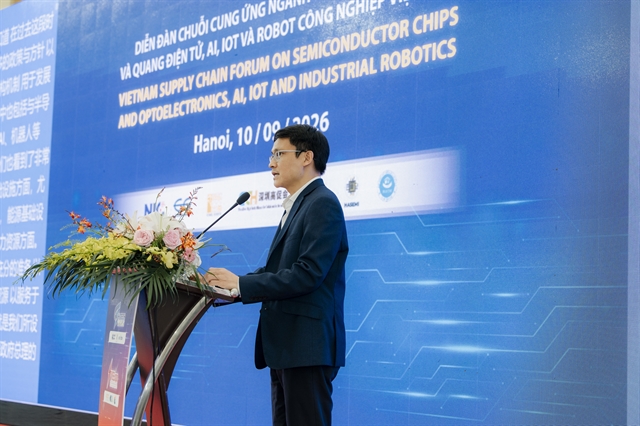
| National Innovation Centre's deputy director Võ Xuân Hoài speaks at the event. — Photo courtesy of NIC |
HÀ NỘI — The convergence of semiconductors, artificial intelligence (AI), optoelectronics, the Internet of Things (IoT) and industrial robotics is creating new opportunities for Việt Nam to strengthen its position in global technology value chains, speakers said at a forum in Hà Nội on September 10.
Held at the Vietnam Exposition Centre (VEC) in Đông Anh District as part of Vietnam Industry and Technology Week 2026, the event brought together policymakers, researchers, businesses and international partners. It was co-organised by the National Innovation Centre (NIC) under the Ministry of Finance and several domestic and international organisations.
Demand for semiconductors is being driven by AI, data centres, high-performance computing and connected systems. Automation is also expanding rapidly, with around 542,000 industrial robots installed globally in 2024. Asia accounted for 74 per cent of new installations, according to the International Federation of Robotics.
The developments are changing the nature of technology competition. Countries are increasingly competing not only in individual products but also in their ability to master and integrate different technologies and secure higher-value positions in global supply chains.
Việt Nam has a strong base for further development, including an established electronics manufacturing sector, the presence of major global technology groups and a young workforce. The country has also set a strategy for semiconductor industry development to 2030, with a vision to 2050.
The direction is consistent with Resolution No. 57-NQ/TW, issued by the Politburo on December 22, 2024, which identifies science and technology, innovation and national digital transformation as a major breakthrough for development. The resolution also highlights institutions, human resources, infrastructure, data and strategic technologies as key areas for Việt Nam to strengthen.
Võ Xuân Hoài, deputy director of NIC, said the convergence of semiconductors, optoelectronics, AI, IoT and industrial robotics was reshaping global technology value chains.
For Việt Nam, he said, the main gaps remained technological capabilities, specialised human resources and the ability of domestic companies to participate in higher-value stages of the chain.
The next step, Hoài said, is not simply to expand Việt Nam’s participation in supply chains, but to gradually strengthen its position in global technology value chains. This will require stronger investment in human resources, R&D capacity, infrastructure and shared platforms, while helping domestic businesses upgrade their technologies and improve their ability to transfer and commercialise research results.
From technology trends to practical cooperation
The forum covered semiconductor technology autonomy, AI applications, data security, investment promotion and the development of domestic supply chains for the semiconductor and electronics industries.
Nguyễn Hồng Duẩn, deputy director of the Institute of Professional Electronic Engineering under the Security Industry Department of the Ministry of Public Security, discussed potential security risks associated with emergency shut-off mechanisms in integrated circuits and the need to strengthen control over critical semiconductor technologies.
Mai Đình Ngọc, CEO of Media Group, examined the “One Person, AI Workforce, One Company” model and how the growing use of AI could change productivity and corporate structures.
Shang Kun, co-secretary-general of the Artificial Intelligence and Metaverse Industry Committee of the China Mobile Communications Association, discussed AI and the token economy, while Chử Hồng Bác, general director of procurement and business in Việt Nam at JD Industrial, spoke about investment promotion and links between Vietnamese companies and international technology suppliers.
Data governance was another focus. Kelly Pham, managing lawyer at VICI Vietnam Law Firm, discussed AI and data protection, focusing on legal compliance as businesses increasingly adopt AI.
Representatives of the Shenzhen Hi-Tech Association and Chinese technology companies also introduced technologies for semiconductor and electronics packaging and battery solutions.
NIC has been connecting technology companies, researchers, investors and experts to support semiconductor and AI development. Its activities include chip-design training, workforce development and links between businesses and supply chains.
The centre plans to focus more on practical cooperation, including high-tech workforce development, improving Vietnamese companies’ capabilities, linking R&D with production and markets, and promoting technology transfer and commercialisation. — BIZHUB/VNS
Economy
 Economy
 Economy
 Economy
 Economy
 Economy
 Economy
 Economy
 Economy
 Economy
.jpg) Economy
Economy
 Economy
 Economy
 Economy
 Economy