 Economy


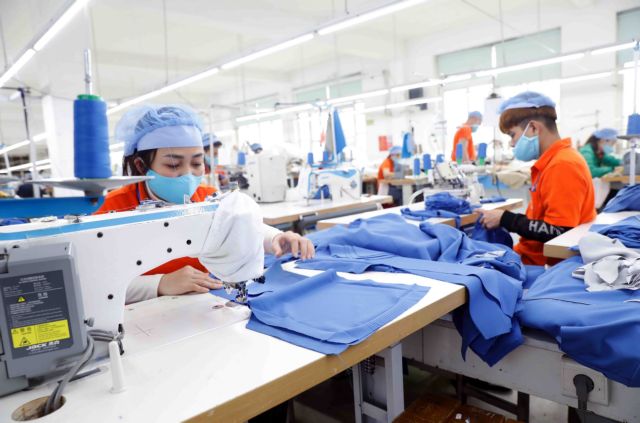
Data, AI boosting value in Việt Nam's textile and garment industry
1.

|
| Nguyễn Đức Huy, deputy director of C4IR, speaks at the forum on Việt Nam - ASEAN in global value chains in HCM City on August 21 in HCM City. — VNS Photo Hồng Linh |
HCM CITY — Việt Nam should move beyond low-cost manufacturing by fostering industrial clusters, developing infrastructure to improve connectivity and enhancing supply chain transparency to capture more value from regional networks, according to a forum on Việt Nam and ASEAN in global value chains held in HCM City.
The event was organised on August 21 by the HCM City Centre for the Fourth Industrial Revolution (HCMC C4IR), bringing together representatives from the World Economic Forum (WEF), the Organisation for Economic Co-operation and Development (OECD) and the Asian Development Bank (ADB), along with businesses and other organisations.
Vân Nguyễn, regional agenda lead at the WEF's Centre for Advanced Manufacturing and Supply Chains, said mounting pressures on global supply chains were triggering profound transformations and accelerating a rethink of how they are configured. These pressures include geopolitical tensions, technological developments, climate change and demographic shifts.
Amid shifting global value chains, ASEAN has an opportunity to position itself as a trusted manufacturing hub across increasingly fragmented markets, she added.
Its advantage lies in connecting the complementary capabilities of its member countries through regional value chains. Regional interoperability through digital standards, technology and talent collaboration can unlock greater scale, resilience and innovation, while attracting high-quality investment, retaining high-value-added activities and sustaining long-term growth.
Nguyễn Đức Huy, deputy director of HCMC C4IR, said that according to the World Bank's Việt Nam 2045 Report, the participation rate of domestic enterprises in global value chains fell from 35 per cent in 2009 to 18 per cent in 2023, representing a continuous decline over 14 years even as exports continued to rise.
This demonstrated that the country's challenge lay not in its export capacity, but in the position businesses occupied within value-creation networks.
Meanwhile, with a population of more than 700 million, ASEAN is one of the world's fastest-growing economic blocs. However, intra-bloc trade accounts for only about 22 per cent of the region's total trade, lower than the corresponding share in the European Union.
The main barriers no longer lie in tariffs, as the ASEAN Trade in Goods Agreement has eliminated up to 98.6 per cent of tariff lines, but in procedures, standards and systems that differ among countries.
These are the issues that the ASEAN Digital Economy Framework Agreement (DEFA), scheduled for completion in 2026, aims to address, creating opportunities for regional economies to jointly develop a framework connecting regional value chains, he added.
Anne-Katrin Pfister, policy lead for digital trade in Asia-Pacific at the WEF, said DEFA, the world's first region-wide digital economy agreement, sought to bring ASEAN's 11 national markets, including Việt Nam, closer to becoming a single, digitally connected regional market.
The agreement could unlock a US$1–2 trillion digital economy, while supporting the participation and growth of micro, small and medium-sized enterprises, developing interoperable digital infrastructure and strengthening ASEAN's role in shaping global digital rules.
DEFA proposes provisions in several areas to help ASEAN members facilitate digital trade, including cross-border e-commerce, payments and electronic invoicing, digital identification and authentication, online safety and cybersecurity, cross-border data flows and data protection, competition policy and emerging issues such as artificial intelligence.
However, she noted that implementation would face challenges due to uneven digital readiness, with significant gaps in infrastructure, skills and institutional capacity.
There are also differences among countries in regulatory frameworks governing data, privacy, cybersecurity, artificial intelligence, cloud computing and digital trade.
To implement DEFA, she suggested that governments prepare and align their domestic regulations and identify gaps between national rules and regional commitments.
Priorities should also include strengthening cross-border connectivity in payments and electronic invoicing, digitising end-to-end trade flows, enabling trusted data flows across value chains, designing systems for global interoperability, building interoperable supply chain infrastructure and developing a clear implementation roadmap. VNS
Economy
 Economy
 Economy
 Economy
 Economy
 Economy
 Economy
 Economy
 Economy
 Economy
 Economy
 Economy
 Economy
 Economy
 Economy




