 Economy

Việt Nam-Singapore digital ID link: a test for ASEAN interoperability
1.
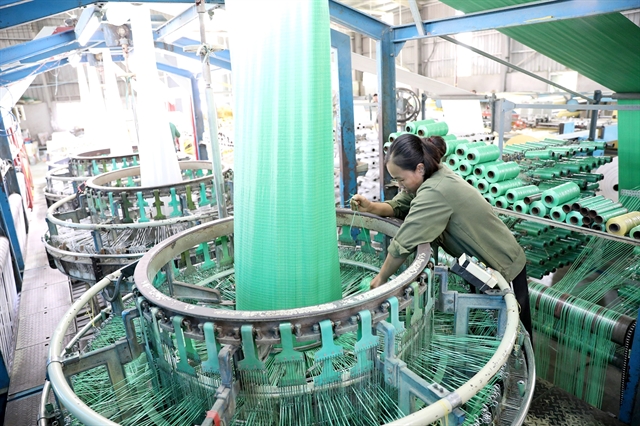 |
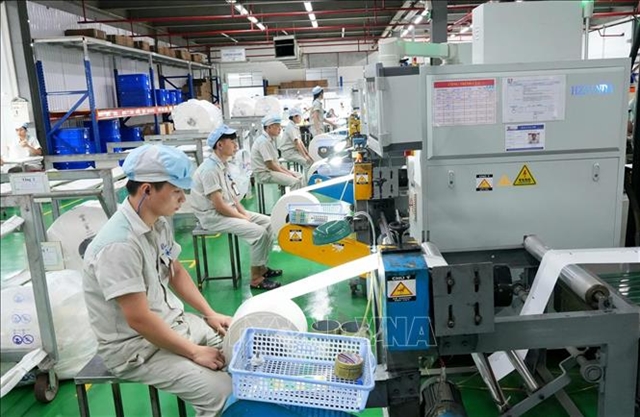
| Production at the Trường Thịnh Packaging Manufacturing Co Ltd in Ninh Bình Province. A more circular packaging industry is becoming increasingly important as environmental standards become increasingly important for access to global markets. — VNA/VNS Photo Đức Phương |
HÀ NỘI — As Europe tightens its packaging rules, Vietnamese exporters are facing a new reality: what wraps a product may matter almost as much as what is inside. The European Union's new requirements are forcing businesses to rethink packaging while opening the door to a more circular industry.
The EU's Packaging and Packaging Waste Regulation (PPWR) entered its general application phase on August 12, covering packaging placed on the EU market regardless of its material or country of origin.
For Vietnamese exporters, the rules mean that packaging can no longer simply be a protective layer around a product. Its design, recyclability, recycled content and chemical safety are increasingly becoming part of the conditions for selling products in the bloc.
The impact could extend across Việt Nam's major export sectors, including food, seafood, coffee, cashew, textiles, footwear, electronics, cosmetics, wood and other consumer goods.
"The new regulation affects the entire production and export chain, from design for recycling and the use of recycled materials to traceability and the control of substances of concern," said Nguyễn Thi, a lecturer at the Hà Nội University of Natural Resources and Environment.
The challenge comes as trade with the EU continues to expand. According to the Ministry of Industry and Trade, Vietnamese exports to the bloc exceeded US$56 billion in 2025, up 8.6 per cent from a year earlier, while exports reached $25.78 billion in the first five months of 2026, up 13.3 per cent year on year.
The PPWR introduces requirements covering food-contact packaging, sales packaging, grouped packaging and transport packaging.
From August 12, all packaging must comply with new limits on substances of concern, with particular attention to per- and polyfluoroalkyl substances in food-contact packaging.
This is particularly relevant to Vietnamese seafood exporters, which use food-contact packaging such as plastic trays, wrapping films and plastic bags. Companies will need to ensure that information on such content is available in the technical documentation for their packaging.
The PPWR establishes a phased transition, with technical requirements for recyclability and recycled content becoming progressively stricter over the coming years. From 2030, all packaging placed on the EU market will have to be designed to be recyclable.
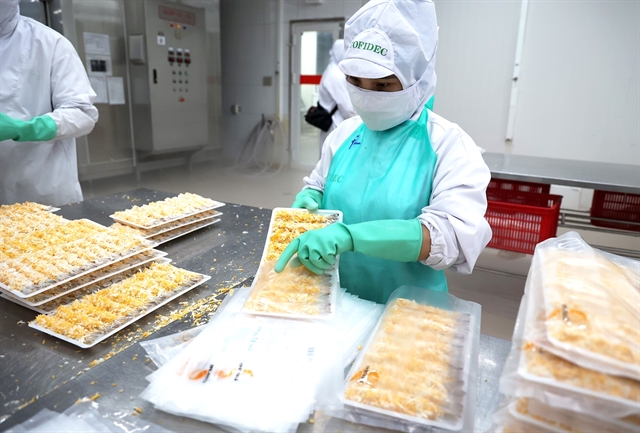 |
| A worker packs seafood products. The EU's new packaging rules could affect major export sectors, including food, seafood, coffee, cashew, textiles, footwear, electronics, cosmetics, wood and other consumer goods. — VNA/VNS Photo Hồng Đạt |
Food-contact plastic packaging will have to contain at least 30 per cent recycled plastic where PET is the main component and 10 per cent for packaging made from other plastics such as polypropylene and polyethylene. The requirements will rise to 65 per cent and 25 per cent by 2040, respectively.
The PPWR also seeks to reduce unnecessary packaging. By 2030, manufacturers and importers will have to ensure that the weight and volume of packaging are reduced to the minimum necessary to perform its intended function. For grouped, transport and e-commerce packaging, the proportion of empty space will be limited to 50 per cent.
Labelling requirements will also be introduced according to the PPWR's implementation timetable, with harmonised information on packaging materials intended to help consumers sort waste.
From cost to opportunity
The PPWR highlights a growing trend: to enter the EU market, goods will increasingly be judged not only by the product itself but by its entire life cycle, according to Thi.
The EU-Vietnam Free Trade Agreement has given many Vietnamese products tariff advantages, but as tariffs fall, the bloc is steadily raising standards on environmental protection, emissions, traceability, the circular economy and supply chain responsibility.
The Ministry of Industry and Trade has also said these green requirements are increasingly becoming an important condition for Vietnamese goods to maintain their foothold in the EU market as well as global markets.
Yet experts say the PPWR should not be viewed simply as another trade barrier but a wider shift in global trade in which environmental requirements are increasingly becoming conditions for market access.
Experts say that Vietnamese companies that invest early in recyclable packaging, recycled materials, traceability and circular production could gain an advantage not only in Europe but also in other developed markets with similar environmental requirements.
Meeting these standards could create opportunities for businesses to expand into other markets, said Sita Zimpel, a project director at GIZ Vietnam, adding that this could turn compliance spending into longer-term investment in production efficiency and product differentiation.
The changes could also reshape Việt Nam's packaging industry, forcing it to move towards a more circular model. Instead of producing packaging, using it and sending it to waste streams, companies would need to build stronger links among packaging manufacturers, waste collectors, recyclers and users of recycled materials.
Annie Trần, senior manager at Informa Markets Vietnam, said the packaging industry was at an important transition point towards a more circular model as environmental requirements increasingly became mandatory conditions in international trade.
Businesses should regard changes in materials, standardised design, greater recycling and circular supply chains as long-term development strategies rather than merely a way to comply with regulations, she said.
She stressed that this could create opportunities for investment in food-grade recycled plastics, recycling technology, testing and certification, waste sorting and collection, and new packaging materials.
However, Nguyễn Ngọc Sang, chairman of the Vietnam Packaging Association, said domestic packaging producers were of small and medium sizes with limited capacity for investment.
Policymaking should therefore provide an appropriate roadmap, particularly as Việt Nam still lacks specialised research centres for the packaging industry, he said.
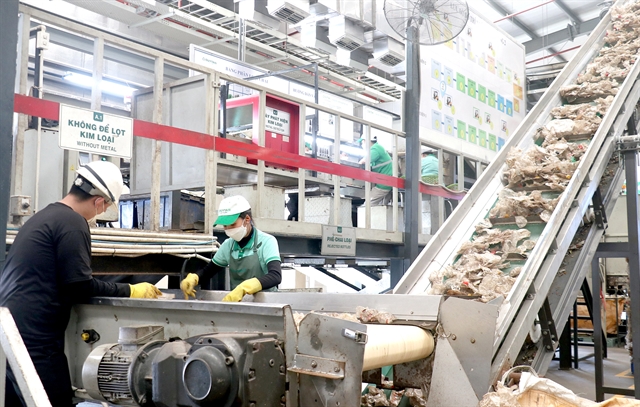 |
| The Duy Tân Plastic Recycling Plant in Tây Ninh Province. New packaging rules are reshaping Việt Nam's packaging industry. — VNA/VNS Photo Bùi Giang |
Major challenges
One of the biggest challenges for Vietnamese companies is likely to be the supply of recycled material that meets EU standards.
According to Thi, Việt Nam does not yet have a fully developed system of standards for food-grade recycled plastic, while domestic testing and certification capacity remains limited.
Food-grade recycled PET, or rPET, is particularly challenging because recycled material must meet stringent safety requirements before it can be used in packaging that comes into direct contact with food.
The problem starts with the quality of collected waste. Trần Đức, head of external affairs at Suntory PepsiCo Vietnam, said the quality of recovered plastic remained unstable because waste collection relies heavily on informal collectors.
For PET bottles, impurities can account for 40-70 per cent of recovered material depending on the batch, making bottle-to-bottle recycling more difficult and increasing production costs compared with virgin plastic.
That created a potential mismatch between the EU's growing demand for recycled materials and Việt Nam's ability to supply them at the required quality and cost, he said.
According to the Vietnam Association of Seafood Exporters and Producers, packaging commonly used in seafood exports, including plastic bags, trays, boxes, cardboard cartons, plastic pallets and wrapping films, falls within the scope of the PPWR.
Companies will therefore need to review their packaging systems, prepare documentation demonstrating compliance and keep pace with technical guidance from the EU.
Việt Nam is developing its own packaging regulatory framework through extended producer responsibility (EPR), recycling obligations, financial contributions for waste treatment and measures to reduce difficult-to-degrade plastic products.
Nguyễn Văn Phan from EPR Việt Nam Office under the Ministry of Agriculture and Environment, said the framework would not only improve the implementation of EPR in Việt Nam but also help businesses gradually meet increasingly stringent requirements in international markets, particularly the EU's new rules on packaging and the circular economy.
Experts say faster development of standards for food-grade recycled plastic, testing capacity, waste collection and sorting infrastructure and a reliable market for recycled materials will be critical to helping Vietnamese companies adapt.
The broader challenge is whether Việt Nam can build the industrial ecosystem needed to compete in a global economy where sustainability is becoming a condition of market access.
For exporters, early preparation will be equally important.
Companies would need to audit their existing packaging, identify materials and chemicals that may pose compliance risks, work with suppliers to develop recyclable alternatives and prepare technical documentation to ensure compliance, Thi said. — VNS
Economy
 Economy
 Economy
 Economy
 Economy
 Economy
 Economy
 Economy
 Economy
 Economy
 Economy
 Economy
 Economy
 Economy
 Economy