.jpg) Economy
Economy



Top Vietnamese leader highlights new horizon for Việt Nam–Denmark cooperation
1.
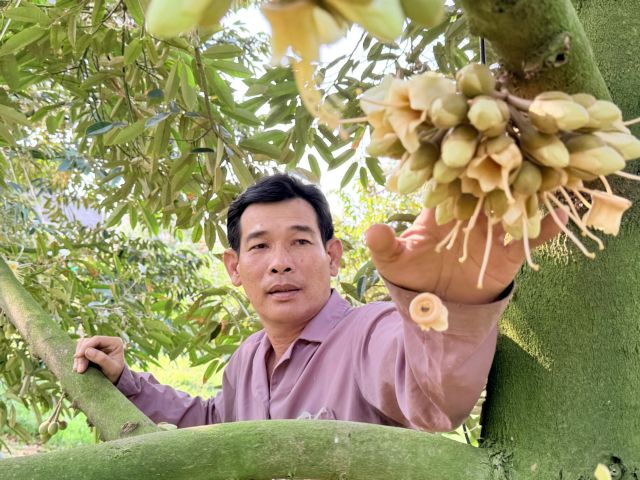 |
| Durian trees at the orchard in An Giang Province, begin flowering. The durian industry should focus on controlling quality throughout the supply chain to sustain export. — VNA/VNS Photo Thanh Sang |
HÀ NỘI — After years of rapid expansion, the durian industry needs to shift its focus from increasing output to improving quality, strengthening traceability, developing processing capability and building a more integrated supply chain to sustain export growth, a conference heard on August 20.
Durian cultivation has expanded sharply over the past decade, particularly in the last five years, said Nguyễn Quốc Mạnh, deputy director of the Plant Production and Protection Department under the Ministry of Agriculture and Environment.
He cited the ministry’s statistics that the durian-growing area rose from about 70,000ha in 2020 to around 195,000ha by the end of 2025, while output increased from 600,000 tonnes to 1.8 million tonnes and is expected to exceed 2 million tonnes this year.
The rapid growth has made durian one of Việt Nam's leading agricultural export products but has also exposed weaknesses in the management of growing areas, quality control, varieties, pest management and production organisation, Mạnh told the conference organised by the Tiền Phong (Vanguard) newspaper.
The industry should no longer pursue expansion, he said, warning that other countries are also rapidly expanding durian production, which will raise the risk of oversupply and intensifies competition if output continues to grow too quickly, he said.
Instead, the industry should focus on controlling quality throughout the supply chain, from varieties and cultivation practices to food safety, Mạnh said.
More than 90 per cent of Việt Nam's exported durian comes from the Ri6 and Dona varieties, highlighting the need to develop high-quality varieties suited to different markets and diversify the country's product offering.
Pesticide residues and pest risks should also be controlled at the production stage rather than detected only at harvest, packing or export, he added.
Nguyễn Đình Tùng, chairman and chief executive of Vina T&T Group, said the management on growing-area codes must be tightened.
Durian quality does not depend on the fruit alone but on the entire chain, including production, testing, logistics and customs clearance, he said.
Any disruption in testing, transport or border clearance can leave shipments delayed for extended periods, increasing costs and risks for exporters of fresh fruit, Tùng said, calling for incentives to further encourage investment in testing facilities, cold chains and deep processing.
According to Nguyễn Thanh Bình, president of the Vietnam Fruit and Vegetables Association, Việt Nam currently has 50 testing facilities recognised by China, but major producing regions such as the Central Highlands still face shortage of local testing facilities.
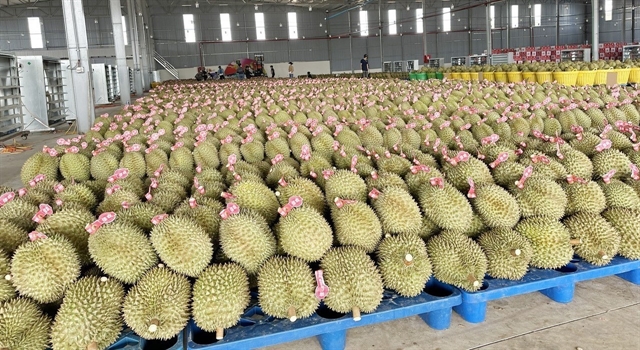 |
| Durian is labelled for export to China at a company in Đắk Lắk Province. Deep processing, particularly freezing technology, becomes essential to reduce the industry's dependence on fresh-fruit exports. — VNA/VNS Photo Kha Phạm |
Bình said that developing deep processing, particularly freezing technology, becomes essential to reduce the industry's dependence on fresh-fruit exports and allow producers to diversify into more markets.
Frozen durian products have already been exported to Europe, the United States and other markets, he said, adding that expanded cold-storage and processing capacity could give exporters greater flexibility over timing, destinations and sales channels.
Deputy Director of the Ministry of Industry and Trade’s Import-Export Department said that China remains by far Việt Nam's most important market for durian.
China imported about 1.07 million tonnes of durian in the first half of this year, with Thailand supplying more than 800,000 tonnes, almost four times that of Việt Nam, highlighting both the room for further growth.
However, the intense competition also requires Việt Nam to develop new destinations while building brands and gaining a better understanding of consumer demand, Hải said.
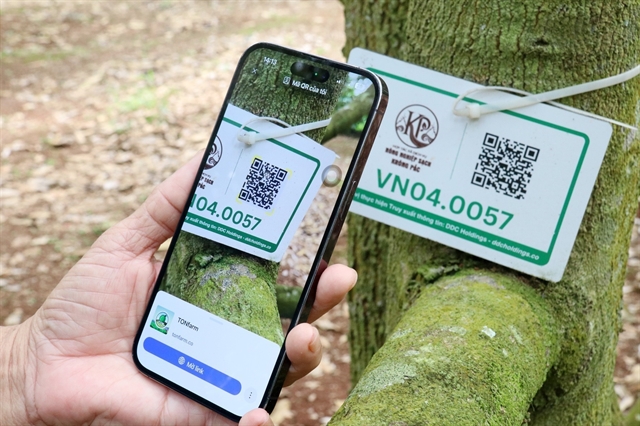
A credible traceability system capable of tracking products from growing areas through processing and packing to distribution will be crucial, he added.
Linkage among businesses, cooperatives and growers also need to be enhanced, as small and fragmented farms often struggle to independently meet requirements on volume, quality standards and traceability.
“Businesses should become more deeply involved in organising raw-material areas, guiding technical processes and connecting growers with markets, while local authorities should support supervision and the development of production areas that meet export standards,” Hải said.
“The longer-term challenge is to build an integrated ecosystem spanning varieties, growing areas, cultivation, testing, traceability, processing, logistics and markets rather than continuing to pursue acreage expansion.”
Such a shift could help Việt Nam's durian industry capture more value, strengthen competitiveness, and put exports on a more sustainable growth path.
The government has sought to address some bottlenecks through Resolution No. 36/2026/NQ-CP, which simplifies administrative procedures related to growing-area and packing-facility codes.
Under the new rules, there is no longer a minimum area requirement for obtaining a growing-area code, while intercropped crops on the same plot of land can also be granted codes.
On August 14, China's General Administration of Customs approved additional growing-area and packing-facility codes for Việt Nam. China has now granted Việt Nam a total of 567 codes, including 401 for growing areas and 166 for packing facilities.
Durian export value surged from US$177.7 million in 2021 to about $3.85 billion in 2025, accounting for roughly 45 per cent of the country's total fruit and vegetable export earnings.
In the first seven months of this year, Việt Nam exported about 493,000 tonnes of durian worth $1.8 billion, up 30 per cent from a year earlier, and is poised to exceed $4 billion this year.
Export markets have also expanded, with Vietnamese fresh durian now reaching more than 20 countries and territories. China accounts for around 90 per cent of Việt Nam’s durian exports.
India officially opened its market to fresh Vietnamese durian in July. Việt Nam is also negotiating market access with Australia, New Zealand and other destinations as it seeks to diversify export outlets beyond its traditional markets. — VNS
Economy
 Economy
 Economy
 Economy
 Economy
 Economy
 Economy
 Economy
 Economy
 Economy
 Economy
 Economy
 Economy
 Economy
 Economy