.jpg) Economy
Economy

Top Vietnamese leader highlights new horizon for Việt Nam–Denmark cooperation
1.
|
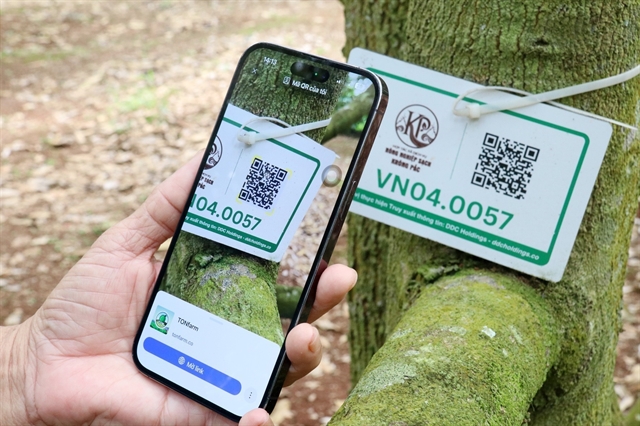
| A durian tree with a traceability code. Traceability should also be digitised so that every shipment can be tested and every product can be identified by its origin. — VNA/VNS Photo Hoài Thu |
HÀ NỘI — Việt Nam's durian industry needs to move beyond seasonal trading to build long-term supply chains linking growers, exporters, logistics providers, processors and distributors to secure sustainable growth in the Chinese market.
At a Việt Nam-China durian supply chain networking and trade event held in Đắk Lắk Province on Wednesday, experts said rising demand for high-quality fruit in China offered Việt Nam an opportunity to shift the durian industry from volume-driven growth to higher-value production.
Liu Xu, overseas market sales director at the Guangxi Supply and Marketing Cooperatives Union and representative of China Coop, said China is the world's largest durian-consuming market, with demand for high-quality products continuing to grow.
China Coop wants to build a bridge between Vietnamese growing areas and the Chinese market to help high-quality durians reach consumers faster with better quality and supply stability, he said.
“Cooperation should go beyond individual purchasing deals towards the development of a complete industry chain, with quality controlled at the source and more value retained by participants, particularly farmers,” Liu said.
China Coop plans to work with Vietnamese partners to standardise production, testing and traceability while developing pre-cooling, sorting and cold-chain systems to reduce losses and risks in cross-border trade, he noted, adding that quality must begin with good seedlings, suitable growing areas and proper production processes.
Lê Anh Trung, chairman of the Đắk Lắk Durian Association, said China is an important market for Vietnamese durian, but rapid growth alone cannot provide a lasting foundation for the industry.
"To move fast, we can rely on market opportunities, but to go far, we must rely on quality, reputation and the trust of our partners," he said.
Đắk Lắk Province is seeking to shift to production in line with market demand, said Trần Văn Thắng, the association’s deputy chairman. "If in the past we produced first and then looked for buyers, we now have to shift towards producing what the market needs," he said.
The province is seeking to establish direct links connecting growing areas with Vietnamese producers and exporters and distribution networks in China to establish a long-term value chain from plantation, processing, preservation, logistics, trade and technology, Thắng said.
International partners should play a greater role in providing information on consumer demand, quality standards and market trends to allow Vietnamese businesses, cooperatives and farmers to organise production meeting required standards, he added.
|
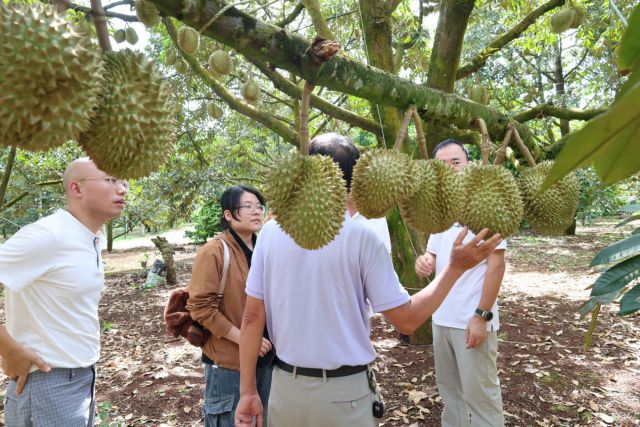
| Traders from China visit a durian farm in Đắk Lắk Province. — VNA/VNS Photo Kha Phạm |
According to Thắng, the association does not encourage growers to continue expanding cultivation areas. Instead, it urges farmers to increase value per hectare through better quality and higher-value products, he said.
He added that technology is also playing a larger role in producing, processing and improving quality control.
Zeng Xiao Yu from the China Certification and Inspection Group (CCIC) said Việt Nam's durian industry had an opportunity to move from simple commercial transactions towards cooperation to organise and upgrade the entire value chain.
Việt Nam needs to ensure a high-quality supply by optimising varieties, developing and applying standards, mobilising technical experts and strengthening digital monitoring, she said.
Cold-chain infrastructure should be developed to preserve durian freshness immediately after harvest. This should include cold storage facilities in growing areas, an uninterrupted cold chain during transportation and smart coordination mechanisms.
Traceability should also be digitised so that every shipment can be tested, and every product can be identified by its origin, Yu added.
She said that expanding distribution networks and building brands are also important, stressing that while distribution channels determine the ability to sell products, brands determine their value.
Yu urged Vietnamese businesses to combine direct distribution networks with online channels and strengthen marketing to improve the recognition of Vietnamese durian in the Chinese market.
Financial mechanisms such as order financing, warehouse receipt-based credit and risk management products could help ease capital pressure on farmers and businesses involved in cultivation, processing and distribution, while helping the supply chain respond to price volatility, she added.
The value ecosystem of the durian industry should be expanded through deeper processing, developing raw materials for the food industry and exploring agricultural tourism and other potential sectors.
CCIC also proposed developing a digital platform connecting growing areas, warehouses and markets, with data on soil, climate, pests and diseases, consumer demand, prices, orders, logistics and inventories.
She also noted that building one or two influential Vietnamese durian brands in the Chinese market would be an important step towards turning the country's advantages in growing areas and output into brand value and long-term competitiveness.
China is currently the main market for Đắk Lắk durian, accounting for about 70 per cent of the province's total output.
The province has 280 growing areas covering about 7,500ha and 41 fresh fruit packing facilities approved for export codes.
However, areas granted export codes currently cover only around 17-28 per cent of the durian area ready for harvest. A further 253 growing area codes covering about 6,532ha, along with 92 packing facilities, are awaiting approval from Chinese authorities. — VNS
Economy
 Economy
 Economy
 Economy
 Economy
 Economy
 Economy
 Economy
 Economy
 Economy
 Economy
 Economy
 Economy
 Economy
 Economy