 Economy

SBV to curb property price inflation, enforce lending rate rules
1.
|
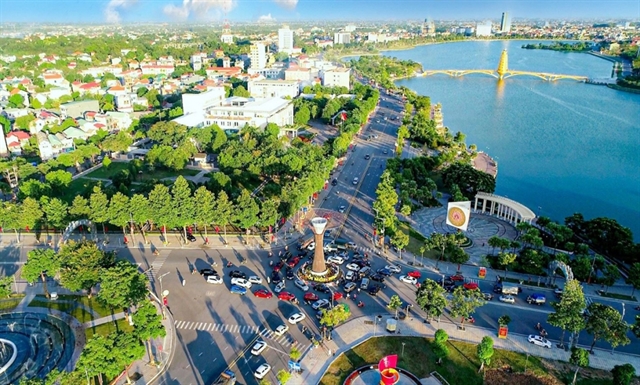
| A bird's eye view of Phú Thọ Province. The province has placed innovation and digital transformation at the centre of a new growth model. — VNA/VNS Photo |
Trần Như
PHÚ THỌ — The northern province of Phú Thọ has begun preparing its 2027 socio-economic development plan aiming to achieve double-digit economic growth by placing science, technology, innovation and digital transformation at the centre of a new growth model.
Chairman of the provincial People's Committee Trần Duy Đông asked local departments, agencies and authorities to ensure the draft plan is practical and capable of supporting the province's long-term development goals.
Phú Thọ must address longstanding internal constraints while implementing breakthrough measures to adapt to an increasingly uncertain economic environment to achieve double-digit growth in 2027, he said.
This year, the global economy continues to face mounting uncertainties. Conflict in the Middle East has triggered sharp volatility in energy markets, fuelling inflationary pressures. Climate change, natural disasters and food security challenges also remain significant risks.
However, rapid advances in science and technology, innovation and digital transformation continue to create new opportunities for local governments to accelerate development.
To prepare for the next development phase, Đông has asked for a comprehensive assessment of this year's economic and social performance to be conducted before setting targets and policy priorities for next year.
Evaluation will focus on the following key areas: maintaining macroeconomic stability while pursuing double-digit growth, improving the legal and regulatory framework, streamlining government administration, expanding decentralisation and strengthening anti-corruption efforts.
The province also plans to accelerate economic restructuring by improving productivity and competitiveness through technology adoption, innovation and digital transformation.
Priority will be given to strategic infrastructure projects, including transport links, digital infrastructure, telecommunications, energy facilities and urban development, while continuing to invest in education, skilled workers, environmental protection and climate resilience.
Đông said the province's 2027 socio-economic development plan should be based on a comprehensive assessment of its 2026 performance and realistic projections for both domestic and global economic conditions.
He said development policies should be innovative, practical and aligned with available resources, while giving local departments, agencies and authorities greater scope to take the initiative.
The 2027 plan will comprise three main components: overall development objectives, key socio-economic targets aligned with the national development strategy and specific tasks assigned to each sector and locality.
The draft plans are scheduled to be updated before November 5 for submission to the Ministry of Finance later this year.
Science and technology at the centre

|
| Workers at a Honda plant in Phú Thọ Province. The province's GRDP expanded by 10.18 per cent in the first half of this year, close to its full-year target of 10.2 per cent. — VNA/VNS Photo Trần Việt |
Phú Thọ Province said that science, technology, innovation and digital transformation have been identified as the main drivers of a new growth model to create a foundation for double-digit expansion.
The province has ranked among the three fastest-performing localities in carrying out the Politburo’s Resolution 57 on breakthroughs in science, technology, innovation and national digital transformation.
All communes and wards in Phú Thọ are now connected to broadband fibre-optic networks, while 4G coverage has reached 98 per cent of its area. Nearly 1,000 new 5G base stations have been installed since July 2025, expanding coverage across urban centres and industrial parks and eliminating remaining mobile signal blind spots.
Digital government platforms have also been deployed across provincial and communal authorities, with more than 98 per cent of administrative procedures processed online.
Electronic document handling among Party agencies exceeds 94 per cent, placing the province among the country's leading performers.
Of note, Phú Thọ has also introduced a real-time socio-economic management platform that integrates AI to analyse data, identify bottlenecks and provide early policy warnings to improve government decision-making.
According to Hoàng Mạnh Du, deputy director of the provincial Department of Science and Technology, the digital economy is becoming a major growth engine, accounting for an estimated 22.7 per cent of the province's gross regional domestic product (GRDP), the third-highest share nationwide.
The province is now home to around 600 digital technology enterprises. Electronics, computer and optical product manufacturing accounts for more than 38 per cent of total industrial output, while exports of digital industrial products exceed US$7 billion, he said.
To accelerate growth, Phú Thọ will focus on strengthening innovation ecosystems centred on businesses, expanding cooperation between government, universities and enterprises and accelerating digital transformation across all sectors, while promoting sustainable development and climate adaptation.
The province is also enhancing digital public services and integrated databases to simplify investment and business procedures, reduce administrative costs and improve transparency.
Following the recent administrative merger, Phú Thọ is also reviewing legal documents to establish a unified regulatory framework and create a more favourable investment environment.
Phú Thọ Province was formed from the merger of the former Phú Thọ with Hoà Bình and Vĩnh Phúc provinces. It has a total area of more than 9,300sq.m, ranking 15th nationwide, and a population of around four million, the country's 11th largest.
Its economy was valued at nearly $16 billion in 2025, accounting for 3.2 per cent of GDP and ranking sixth among Việt Nam's 34 provinces and cities.
In the first half of 2026, the province's GRDP expanded by 10.18 per cent, close to its full-year target of 10.2 per cent. Phú Thọ was one of nine localities nationwide to post double-digit growth, ranking seventh nationally.
Economic restructuring continued to improve the quality of growth and support fiscal revenues. Industrial production rose 25.1 per cent year-on-year, while retail sales of goods and consumer services increased 11.4 per cent.
Total import-export turnover reached $22.04 billion, up 10.9 per cent from a year earlier. Tourism revenue exceeded VNĐ10.7 trillion ($408 million), with the province welcoming nearly 10.54 million visitors, an increase of 13.3 per cent.
State budget revenue was estimated at more than VNĐ34.88 trillion, up 19.2 per cent year-on-year and equivalent to 60.1 per cent of the annual target.
Foreign direct investment reached more than $1.77 billion, almost five times higher than a year earlier and exceeding the full-year target by 10.2 per cent.
More than 2,800 new enterprises were established in the first six months of the year, up more than 29 per cent from the same period last year. Another 665 businesses resumed operations in the first half of 2026, bringing the total number of registered enterprises in the province to more than 41,300.
Early preparation of the 2027 development plan reflects the province's determination to strengthen its growth model and seize new opportunities through innovation and digital transformation, while also pursuing sustainable economic expansion. — VNS
Economy
 Economy
 Economy
 Economy
 Economy
 Economy
 Economy
.jpg) Economy
Economy
 Economy
 Economy
 Economy
 Economy
 Economy
 Economy
 Economy