 Economy



LANDMARK Launches ‘Destination CENTRAL’: A District-Wide Invitation to Explore the Dynamism, Luxury, and Soul of Central
1.
 |
| Farmers and a local official inspect turmeric quality ahead of harvest in Minh Ngọc Commune, Nghệ An Province. — VNA/VNS Photo Đức Thọ |
HÀ NỘI — Counterfeit products carrying the one commune one product (OCOP) label are increasingly appearing in traditional markets and on e-commerce platforms in Việt Nam, undermining consumer trust, harming legitimate producers, and weakening efforts to build strong agricultural brands.
From turmeric starch and lotus tea to herbal products, many items marketed as certified OCOP goods are being sold at unusually low prices despite unclear origins.
Producers in Nghệ An Province say fake packaging and copied labels are becoming more widespread, particularly on e-commerce platforms.
Phạm Kim Tiến, director of Sen Que Bac Cooperative in Kim Liên Commune, said the cooperative must comply with strict standards from raw material sourcing to packaging to obtain three- and four-star OCOP certification for products such as lotus-heart tea, lotus-scented rice tea and dried lotus seeds.
Each product must meet strict requirements on colour, fragrance and aftertaste while preserving the natural lotus aroma, making genuine products relatively expensive.
“However, fake OCOP-labelled lotus products are now widely sold online and around the Kim Liên relic site at prices sometimes only half as much as authentic goods,” Tiến said, adding that many consumers purchase cheaper items because they carry the OCOP logo only to lose trust in OCOP-certified goods when quality falls short, ultimately harming legitimate producers.
Consumers often struggle to distinguish between genuine and counterfeit products, especially when packaging closely imitates established brands.
Đoàn Thị Vân from the Xứ Nghệ Western Region Turmeric Starch Agricultural Cooperative said counterfeit turmeric starch products copy almost identical packaging designs, changing only contact details or addresses.
She warned that fake products are often mixed with cassava starch, colouring agents and impurities that may pose risks to consumer health.
According to producers, authentic OCOP turmeric starch requires costly filtering and cold-drying systems, resulting in retail prices of VNĐ400,000–600,000 (US$15–23) per kilogramme. Meanwhile, counterfeit products advertised online as 'Nghệ An turmeric starch' are sold for as little as VNĐ100,000–150,000 per kilogramme.
Market surveillance officials say the rapid growth of e-commerce has made counterfeit detection more difficult.
Phạm Khắc Huy, deputy chief of office at the Agency for Domestic Market Surveillance and Development under the Ministry of Industry and Trade, said it remains difficult for consumers to distinguish genuine products from fake ones without verification tools or traceability systems.
Authorities are stepping up inspections while accelerating the rollout of digital traceability systems.
Nguyễn Văn Hiệp from the Nghệ An Department of Industry and Trade said authorities are coordinating with market surveillance forces to inspect production and packaging facilities while encouraging OCOP producers to sell through reputable e-commerce platforms with stricter verification systems.
Provincial agricultural authorities are also promoting QR-code traceability systems linked to certified growing areas and production processes.
Officials say consumers should be able to scan a code to access detailed information on production locations, harvest dates and processing stages.
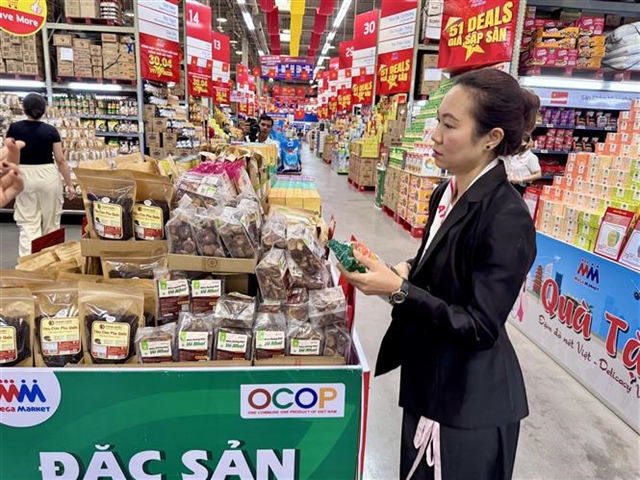 |
| Consumers browse OCOP products at a retail outlet in HCM City. — VNA/VNS Photo Hương Giang |
The Ministry of Agriculture and Environment has recently introduced new regulations governing the use of the national OCOP certification label, requiring products to maintain a minimum three-star OCOP rating, comply with food safety, labelling and environmental standards and undergo stricter post-certification inspections.
Under the new rules, products found misusing the OCOP label or failing to maintain quality standards may have their certification suspended or revoked.
Authorities are also promoting stricter traceability requirements, including standardised QR codes and clearer origin information for consumers.
Officials said the shift from pre-approval checks to stronger post-inspection oversight is aimed at protecting the credibility of the OCOP programme and preventing misuse of the national brand.
As of April 2026, Việt Nam had more than 20,000 OCOP products rated three stars or above, including 126 five-star products nationwide.
Experts said stronger enforcement, digital traceability and tougher penalties will be essential to prevent counterfeit OCOP goods from eroding consumer confidence and damaging the long-term development of Vietnamese agricultural products. — VNS
Economy
 Economy
 Economy
 Economy
 Economy
 Economy
 Economy
.jpg) Economy
Economy
 Economy
 Economy
 Economy
 Economy
 Economy
 Economy
 Economy