 Economy



Quy Nhơn Dialogue on Climate and Transition to provide platform for open discussion
1.
|
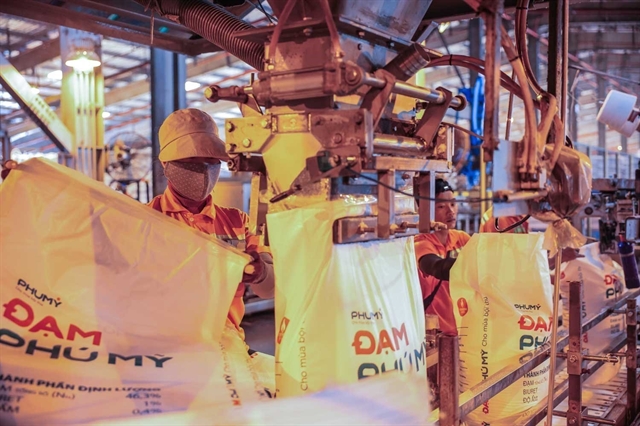
| PetroVietnam Fertiliser and Chemicals Corporation's packaging line for Phú Mỹ nitrogen fertiliser product. — VNA/VNS Photo |
HÀ NỘI — Since early March, fertiliser prices have risen, driven largely by the impact of tensions in the Middle East.
In response, domestic fertiliser producers have taken proactive steps to secure raw material supplies in an effort to stabilise prices.
The agricultural sector consumes about 10 million tonnes of fertiliser annually, mainly urea and phosphate fertiliser.
The country is largely self-sufficient in these two categories to meet domestic demand and remain relatively insulated from direct disruptions linked to Middle East conflicts.
However, other fertiliser types still depend on imports, exposing domestic prices to global market fluctuations. These products have already seen price increases and are forecast to rise by a further 5–15 per cent.
Compared to a month ago, prices of various inorganic fertilisers have surged sharply. According to Võ Văn Tươi, a farmer in Cần Thơ, the price of a bag of DAP fertiliser has climbed to VNĐ900,000 ($34), up significantly from VNĐ600,000 ($22.8) in late February.
With fertilisers accounting for 40–50 per cent of production costs, farmers are under mounting pressure, particularly as agricultural product prices have yet to rise in tandem with input costs.
Across the country, fertiliser prices have generally increased by 5–10 per cent, with some products rising by as much as 15–20 per cent or more.
In the Mekong Delta, DAP Hồng Hà is currently priced at VNĐ1.25-1.3 million per bag, while DAP Đình Vũ ranges from VNĐ840,000 to VNĐ870,000.
The urea prices range between VNĐ610,000-650,000 per bag for products from the PetroVietnam Ca Mau Fertiliser Joint Stock Company, while urea from the PetroVietnam Fertiliser and Chemicals Corporation (Phú Mỹ) is priced at around VNĐ610,000–630,000 per bag.
In central provinces, NPK fertilisers are priced between VNĐ700,000 and VNĐ980,000 per bag depending on type.
Phan Văn Tâm, deputy general director of Bình Điền Fertiliser Joint Stock Company, said the firm supplies around 750,000 tonnes of fertiliser annually. In light of developments in the Middle East, the company has stepped up production to ensure timely supply.
In the first three months of the year alone, it supplied about 230,000 tonnes of NPK fertiliser, a 10 per cent increase year-on-year. It plans to deliver an additional 220,000 tonnes in the remaining months.
Despite rising input costs, the company held prices steady until March 26 to support farmers, particularly in the Mekong Delta where rice prices remain subdued.
However, after the date, it was forced to increase the prices by 5–10 per cent depending on product type. Those are expected to continuously raise from April 6 as higher input cost developments.
Meanwhile, PetroVietnam Fertiliser and Chemicals Corporation (PVFCCo) has maintained stable operations, optimised distribution, and continued developing environmentally friendly products.
The company is also preparing to expand urea exports. In 2026, PVFCCo aims to produce around one million tonnes of fertiliser, with plants currently operating at 110-115 per cent capacity to ensure adequate domestic supply.
PVFCCo has prioritised product quality and strict distribution management to curb speculation and stockpiling. The company is also accelerating digital transformation across its supply chain to ensure timely delivery to agricultural regions.
Besides that, it is working with authorities and agricultural experts to guide farmers in efficient fertiliser use, helping reduce costs and environmental impacts.
The firm is also expanding its range of organic fertilisers, which are less exposed to market volatility and support sustainable farming practices.
To safeguard the market, PVFCCo has called for stronger inspection and enforcement to tackle counterfeit and substandard fertilisers, thereby protecting both farmers and producers.
|
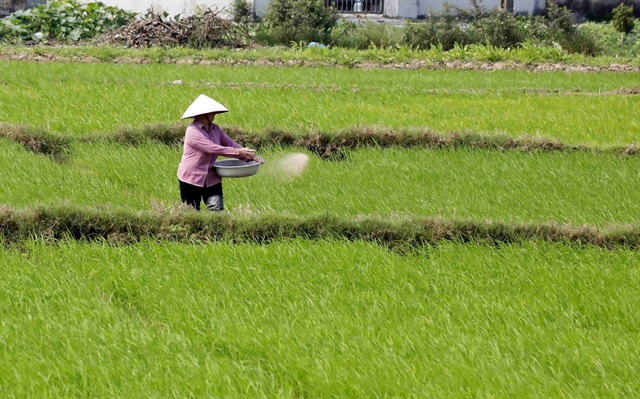
| A farmer in Ninh Bình Province fertilises her winter-spring rice crop. VNA/VNS Photo |
Nguyễn Viết Hiến, director of Ninh Bình Nitrogenous Fertiliser Plant, said that Việt Nam’s total urea production capacity stands at around 2.8 million tonnes per year, compared with domestic demand of roughly 2.1 million tonnes, leaving a surplus of about 700,000 tonnes for export.
His company alone exports around 150,000 tonnes, while supplying about 350,000 tonnes for the domestic market.
In the first quarter of 2026, the plant maintained urea prices at VNĐ14–14.5 million per tonne, largely unchanged from the final quarter of 2025.
However, global prices have surged sharply – from around $390-400 per tonne in February to nearly $800 at present.
Domestic prices have not fully adjusted to these increases due to market demand conditions and pricing mechanisms.
To capitalise on export opportunities, the plant has proposed reducing urea export tariffs to zero, sustaining production while continuing to meet domestic needs.
Meanwhile, Nguyễn Hoàng Trung, deputy general director of DAP–VINACHEM, highlighted that domestic demand for DAP fertiliser is about one million tonnes annually.
However, up to 80 per cent of production costs depend on imported raw materials from the Middle East, pushing costs up by about VNĐ1.97 million per tonne, or around 12 per cent.
Although the export prices are about VNĐ1.5 million per tonne higher than domestic prices, the company continues to prioritise the local market.
In the first quarter alone, it supplied 110,000 tonnes domestically, marking a 60 per cent year-on-year increase.
The company has proposed increasing apatite ore mining quotas to secure raw material supplies, alongside measures to stabilise the market and support farmers.
Market stabilisation
Huỳnh Tấn Đạt, director of the Plant Protection and Cultivation Department under the Ministry of Agriculture and Environment, stressed that ongoing geopolitical tensions in the Middle East are exerting direct pressure on global supply chains, driving up costs for raw materials and logistics and consequently pushing fertiliser prices higher.
To ensure stable agricultural production, maintain supply and limit input cost increases, the department has outlined several key measures.
These include balancing domestic supply and demand, maintaining stable production, maximising factory capacity, and ensuring transparency in market information to prevent speculation and artificial price distortions.
Enterprises are also urged to strengthen forecasting capabilities, closely monitor global market developments – particularly energy prices, logistics costs, and raw material supply – and adjust import and stockpiling strategies accordingly. Diversifying supply sources is seen as essential to reducing dependence on specific markets.
At the same time, businesses are encouraged to boost production, diversify products, and prioritise the domestic market, especially during peak demand periods such as the first quarter.
The department has pledged to work closely with businesses, monitor market developments, and advise the ministry and the Prime Minister on appropriate support policies.
It will also intensify market inspections, promote efficient fertiliser use and expand sustainable practices such as organic fertilisation.
The State agencies are further considering policies to reduce transport, energy and input costs, as well as proposals to increase domestic raw material extraction quotas.
Local authorities are being called upon to strengthen farmer education on efficient fertiliser use, while the agricultural sector promotes greater adoption of organic fertilisers and cost-saving application methods to reduce reliance on inorganic inputs during this period of volatility. — VNS
Economy
 Economy
 Economy
 Economy
 Economy
 Economy
 Economy
 Economy
 Economy
 Economy
 Economy
 Economy
 Economy
 Economy
 Economy