 Economy



Vietnamese Prime Minister meets Cambodian National Assembly President
1.
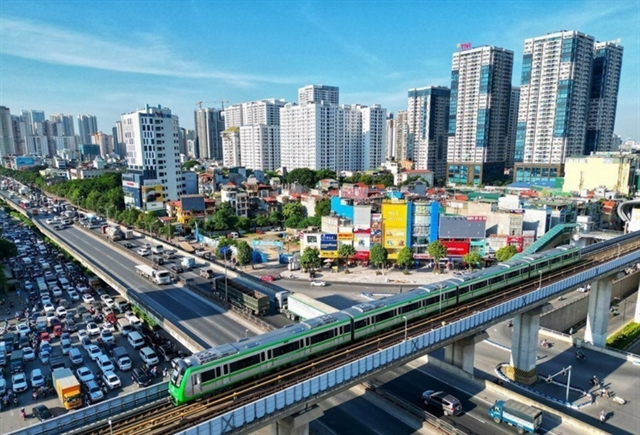 |
| A view of Hà Nội. The State Bank of Việt Nam has proposed allowing banks to extend credit beyond normal regulatory limits for major projects in Hà Nội to facilitate funding for large infrastructure developments in the capital city. — VNA/VNS Photo Tuấn Anh |
HÀ NỘI — The State Bank of Việt Nam has proposed allowing banks to extend credit beyond normal regulatory limits for major projects in Hà Nội to facilitate funding for large infrastructure developments in the capital city, while also ensuring the stability of the banking system.
The proposal is part of several amendments to Decision 09/2024/QĐ-TTg, which regulates the conditions, documentation and procedures for approving credit exposure that exceeds standard thresholds for credit institutions and foreign bank branches.
Under the draft, projects defined as large and important in the capital city as detailed under the National Assembly’s Resolution 258/2025/QH15 would be added to an eligibility list for loans beyond standard lending caps.
Specifically, the maximum credit exposure for a single borrower would not exceed 38 per cent of a bank’s owned capital, while lending to a borrower and related parties would be capped at 52 per cent of bank capital when financing large projects in the city.
The central bank also proposed limiting the total value of loans granted beyond normal limits by a bank to no more than four times its owned capital, including both approved loans and those under consideration.
The SBV said the thresholds were proposed based on financing projects requiring large capital, including the Sơn La and Lai Châu hydropower plants and several thermal power projects, and most recently Quảng Trạch 1.
At Quảng Trạch 1, Prime Minister Phạm Minh Chính approved lending beyond standard limits for Vietnam Electricity (EVN), at 38 per cent of a bank’s owned capital for a single borrower and 52 per cent for EVN and related parties.
In comparison, the lending cap in 2025 was 13 per cent of a bank’s owned capital for a single borrower and 21 per cent for a borrower and related parties, which would decline to 10 per cent and 15 per cent respectively by 2029, under the Law on Credit Institutions 2024.
The SBV said that setting clear ceilings would create a legal framework for financing large projects while helping control credit concentration risks within the banking system.
Given the large financing needs of infrastructure and energy projects, the SBV said banks could also arrange syndicated loans, allowing multiple lenders to jointly finance a project and share risks.
With the current capital levels of major banks, the proposed ratios could allow very large loans of up to trillions of Vietnamese đồng.
By the end of last year, Vietcombank and VietinBank reported owned capital of more than VNĐ222.7 trillion (US$8.5 billion) and nearly VNĐ229.2 trillion, respectively.
At those levels, the proposed caps would allow lending of around VNĐ87 trillion to a single borrower and about VNĐ119 trillion to a borrower and related parties.
The SBV noted that some major projects planned in Hà Nội are estimated to require total investment of about VNĐ300 trillion, with borrowing needs accounting for roughly 85 per cent, or VNĐ255 trillion.
The central bank said that higher lending caps and syndicated loans could enable the banking sector to mobilise sufficient capital for strategic infrastructure projects in the capital city. — VNS
Economy
 Economy
 Economy
 Economy
 Economy
 Economy
 Economy
 Economy
 Economy
 Economy
 Economy
 Economy
 Economy
 Economy
 Economy