 Economy



Top leader hails friendship association's role in nurturing Việt Nam–Denmark ties
1.
|
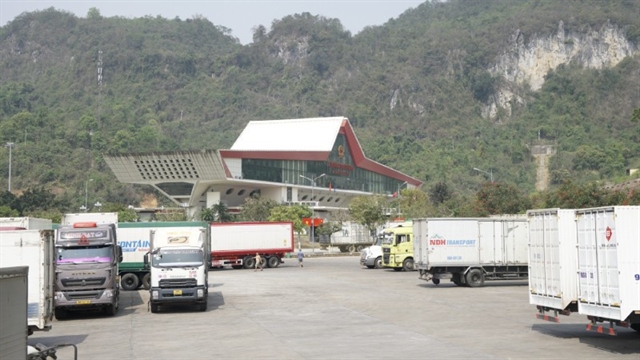
| Import and export vehicles at Hữu Nghị International Border Gate in the northern mountainous province of Lạng Sơn.— Illustrative Photo nhandan.vn |
HÀ NỘI — Prime Minister Phạm Minh Chính has told relevant ministries and agencies to urgently address difficulties and bottlenecks in the implementation of Government Decree No. 46/2026/NĐ-CP, which provides detailed guidance on a number of provisions and enforcement measures under the Law on Food Safety.
The order was issued in Official Dispatch No. 08/CĐ-TTg, signed by the Prime Minister on Tuesday, amid growing concerns over disruptions to food imports, exports and domestic supply chains following the decree’s entry into force.
Under the dispatch, the Ministry of Health, the Ministry of Agriculture and Environment, the Ministry of Industry and Trade, and other relevant bodies are required to urgently issue implementing guidelines for Decree 46, dated January 26, 2026, in line with their assigned functions and authorities.
They are also instructed to direct and supervise subordinate units and localities to ensure adequate facilities, manpower and equipment are in place to carry out inspections, with the aim of ensuring timely and smooth customs clearance and avoiding congestion or backlogs of imported and exported food products.
The ministry of health has been tasked with leading an inter-ministerial review of the decree’s provisions, working with the ministries of Agriculture and Environment, Industry and Trade, Justice and other agencies to assess implementation progress, identify obstacles and submit specific recommendations at the Government’s regular meeting, scheduled for Wednesday.
24/7 hotlines, round-the-clock clearance
The ministries of health, agriculture and environment, and industry and trade are also required to establish 24/7 hotlines, publicise the contact details through mass media, and assign staff to provide real-time guidance and handle emerging issues, particularly those related to new provisions under the decree.
Meanwhile, the Ministry of Finance has been told to direct the Customs Department to deploy round-the-clock staffing at border gates, closely coordinate with other competent forces, and swiftly clear congestion to ensure timely customs clearance.
The electronic customs clearance system must remain fully operational during this peak period.
Provincial and municipal authorities are required to immediately assign local agencies to conduct inspections on food safety and designate food testing facilities, ensuring sufficient testing capacity in accordance with Decree 46.
They are also authorised to adopt necessary measures to support businesses in completing inspection procedures and to expedite testing and clearance for goods currently backlogged.
Where documentation is complete and compliant with commitments, goods must be cleared immediately, with sampling and testing conducted in parallel or through post-clearance inspections at company warehouses.
The ministry of health is further tasked with submitting daily reports to the Prime Minister on the implementation of Decree 46 and proposing timely solutions to any emerging problems.
Logistics industry calls for delay until end of March
In a separate urgent submission to Deputy Prime Minister Lê Thành Long and relevant ministries, the Việt Nam Logistics Business Association has proposed suspending the application of Decree 46 and Resolution 66.13/2026/NQ-CP until March 31 to allow for a comprehensive review of the suitability of the new regulations.
The association said a temporary suspension would both enhance the effectiveness of State management and give the business community time to work alongside the Government to protect consumer health while maintaining economic stability.
The association said that the simultaneous implementation of the two instruments represents a profound legal transition, tightening responsibilities for food safety and quality management, standardising declaration and inspection procedures, and strengthening consumer protection.
However, it said the lack of synchronisation in implementation raises serious questions about balancing consumer protection with the normal functioning of the economy.
Four major challenges identified
The association outlined four key challenges in enforcing the new rules.
The first is severe congestion and disruption arising from the application of Decree 46 and Resolution 66.13.
The second is system-wide capacity constraints, with difficulties stemming not only from compliance requirements but from the ability of the entire system to absorb the changes within a very short timeframe.
The third is lack of transitional mechanisms and unified guidance, increasing the risk of supply chain and production disruptions.
The fourth is policy-level issues that cannot be resolved through individual business efforts alone.
The association previously warned of serious bottlenecks caused by inconsistencies in the rollout of the new regulations.
As of Monday, raw food materials used in domestic production by industries such as soft drinks, alcohol, beer and confectionery had been stalled, unable to clear customs since January 29.
The association attributed the situation to a fundamental regulatory shift.
Under Decree 15/2018/ND-CP, raw materials imported solely for export production or internal use - and not sold on the domestic market - were exempt from product self-declaration requirements.
Decree 46, however, removes this exemption, creating what the association described as a serious legal deadlock.
Businesses are now facing two unresolved scenarios: For raw materials subject to conformity declaration, there is no immediate legal basis for inspection authorities to accept and assess dossiers, as conformity declaration cannot be carried out instantly. For materials exempt from declaring applicable standards, authorities have yet to reach consensus on accepting product standard dossiers, with inspection bodies still recommending conformity declarations.
As a result, importers of raw materials for internal production are struggling to comply with the law due to regulatory gaps rather than any lack of compliance intent or capacity.
Testing capacity overwhelmed
The situation has been exacerbated by insufficient testing capacity.
Between last Friday and this Monday, key inspection bodies such as Quatest 3, the National Institute for Food Safety Testing, and Vinacontrol simultaneously announced they were suspending acceptance of new inspection dossiers.
The association said the number of items subject to mandatory testing has surged under Decree 46, while inspection procedures are new and agencies were unprepared, making congestion unavoidable.
Even where issues are resolved, businesses importing food raw materials for domestic consumption face lengthy timelines.
If goods are subject to Vietnamese technical regulations, conformity declaration alone takes up to 10 days, followed by an additional 3-11 working days for state inspection - a total of around 25 days, much of it immediately before the Tết (Lunar New Year), severely disrupting supply chains.
Risk of widespread port congestion
The association also warned of heightened risks for food products of animal and plant origin subject to quarantine.
While Decree 46 assigns combined responsibility for food safety inspection and quarantine, there is no unified guidance on whether samples taken for veterinary or plant quarantine can also be used for food safety testing.
This could result in duplicate sampling, higher costs and longer clearance times.
Risk management mechanisms between the two systems are also misaligned, with quarantine inspections applying risk-based sampling while food safety inspections require consecutive sampling under standard procedures.
Without transitional arrangements, all imports are effectively required to undergo standard inspection simultaneously, bringing import and supply chains to a standstill.
“In peak import periods such as the run-up to Tết, the risk of widespread port congestion is entirely real,” the association warned, noting the potential knock-on effects across ports and the national logistics system.
Looking ahead, the association forecasts that thousands of businesses and hundreds of thousands of products will need to transition to new declaration regimes within a limited timeframe, while certification bodies, laboratories and specialist personnel remain in short supply.
Testing requirements under standard and strict inspection methods are also expanding, driving up compliance costs for businesses.
The association also stressed that without timely policy-level adjustments, the pressure on both enterprises and the wider economy will continue to mount in the months ahead. — VNS
Economy
 Economy
 Economy
.jpg) Economy
Economy
 Economy
 Economy
 Economy
 Economy
 Economy
 Economy
 Economy
 Economy
 Economy
.jpg) Economy
Economy
 Economy