 Economy



Artisan family keeps Đông Hồ folk painting alive
1.
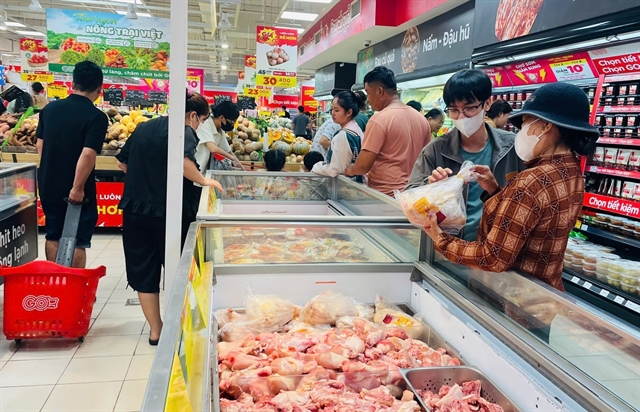 |
| Consumers shop at a supermarket in HCM City. Food supplies will be sufficient to meet the market demand for Tết. — VNA/VNS Photo Hương Giang |
HÀ NỘI — The Ministry of Agriculture and Environment said that there will be sufficient food supplies to meet demand during the upcoming Tết (Lunar New Year) holiday, with no shortages expected and prices forecast to remain broadly stable.
Phạm Kim Đăng, deputy director of the ministry’s Department of Livestock Production and Animal Health, said that demand for livestock products during Tết is expected to rise by 5-10 per cent compared to a normal month. Average monthly meat consumption in 2025 stood at around 350,000 – 450,000 tonnes, up 1.6 per cent from 2024.
Đăng said that Việt Nam has prepared nearly 8.7 million tonnes of meat, 21.4 billion eggs and 1.3 million tonnes of milk to date.
“Food supplies will be sufficient to meet the market demand for Tết,” Đăng stressed.
The fisheries sector is effectively implementing a strategy to reduce capture fishing while expanding aquaculture, contributing to overall growth and ensuring adequate seafood supplies for the domestic market, Director General of the ministry’s Department of Fisheries and Fisheries Surveillance Trần Đình Luân said.
According to the ministry, in 2026 the agricultural sector will continue to face significant challenges from climate change, resource depletion, environmental pollution and increasingly stringent international requirements on green growth and emissions reduction.
Ensuring food and foodstuff security remains a key priority, the ministry stressed, adding that the focus will be on strengthening resource management, protecting the environment and enhancing climate resilience to support sustainable agricultural development.
The ministry will implement coordinated solutions, including standardising raw material areas to meet market requirements, promoting deep processing, diversifying products, reducing logistics costs, improving market access and building a national brand for agricultural products.
In addition, efforts will be enhanced to advance the green transition, develop a circular economy and strengthen risk management for businesses and producers.
Pork prices rise, but supply stable
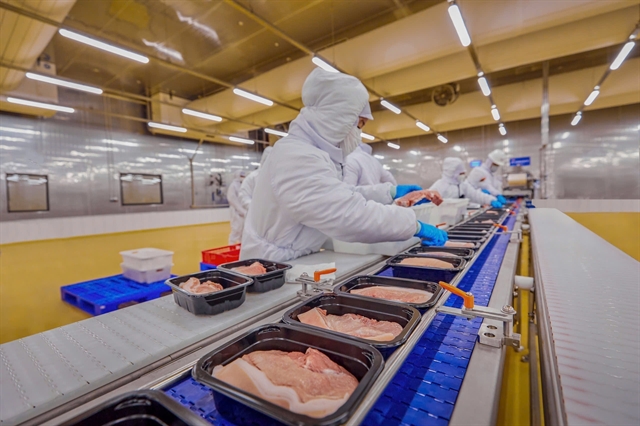 |
| Workers package pork products. Pork prices are increasing slightly, but no major disruptions are expected. — VNA/VNS Photo Hương Giang |
Live hog prices continued to rise in December 2025, surpassing VNĐ70,000 (US$2.70) per kg in several localities as demand rose ahead of Tết.
In northern Việt Nam, live hog prices increased from around VNĐ55,000 per kg at the end of November to VNĐ69,000 per kg by late December, with peaks of up to VNĐ71,000 per kg in some areas.
Prices in the central region and the Central Highlands rose sharply to around VNĐ66,000 per kg by the end of December, up about VNĐ14,000 per kg from a month earlier.
In the South, prices climbed from VNĐ55,000 per kg to around VNĐ65,000 per kg.
In early January 2026, live hog prices remained at around VNĐ66,000 per kg.
According to Đăng, recent increases in live hog prices reflect normal market movements and typical seasonal consumption increases, rather than supply shortages.
Efforts have been made to balance supply and demand during the Tết peak, he said, adding that live hog prices are currently hovering around VNĐ70,000 per kg and may rise further, but are expected to remain broadly stable.
Đăng said live hog prices are forecast to increase by 5-10 per cent but are unlikely to exceed VNĐ75,000 per kg, provided that disease prevention and control measures remain effective and no major disruptions occur.
After Tết, prices will gradually stablise, he said.
Deputy Minister of Agriculture and Environment Phùng Đức Tiến said no major pork disruptions or price spikes are anticipated.
The ministry’s statistics show that more than 1.2 million pigs were culled nationwide in the first 11 months of 2025 due to African swine fever, but detailed supply plans have been drawn up to meet strong year-end demand, particularly during Tết.
In addition, large volumes of imported meat are expected to help ease domestic supply pressures.
Data from the ministry reveals that Việt Nam spent an estimated $1.95 billion to import meat and edible animal by-products in 2025, up 11.6 per cent over 2024.
Key import products included buffalo meat, accounting for more than 31 per cent, pork at nearly 21.6 per cent, poultry meat at 18.1 per cent, beef at 13.7 per cent and edible by-products at 12.8 per cent.
India remained Việt Nam’s largest supplier of meat and meat products, accounting for nearly 18.9 per cent of total imports.
Other major suppliers included Russia, Brazil, the US and Australia.
Imports from Russia surged 70.1 per cent in volume and 72.3 per cent in value year on year, while shipments from Brazil rose 51.3 per cent in volume and 70.8 per cent in value. — VNS
Economy
 Economy
 Economy
 Economy
 Economy
 Economy
 Economy
 Economy
 Economy
 Economy
 Economy
 Economy
 Economy
 Economy
 Economy