Economy


Masan’s earnings more than double in Q3
1.
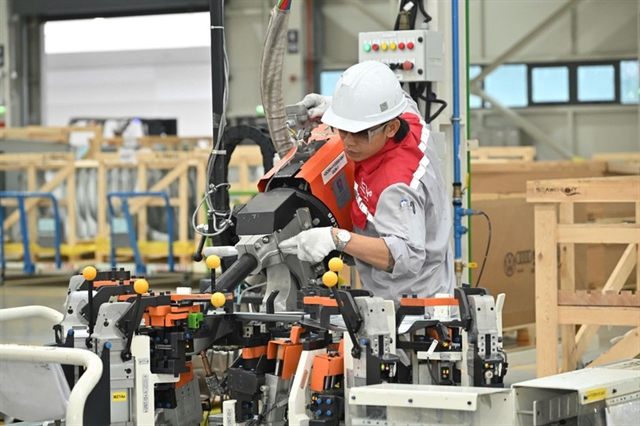 |
| Illustrative photo. Việt Nam's GDP expanded 7.9 per cent in the first nine months, well above the 6.8 per cent pace a year earlier. — VNA/VNS Photo |
HÀ NỘI — Country Director of the Asian Development Bank (ADB) in Việt Nam Shantanu Chakraborty provided a detailed analysis of Việt Nam’s economic performance in 2025 and its 2026 prospects in an interview recently granted to the Vietnam News Agency (VNA).
Chakraborty described Việt Nam's 2025 results as highly impressive despite global challenges. GDP expanded 7.9 per cent in the first nine months, well above the 6.8 per cent pace a year earlier, with quarterly acceleration. Inflation stayed contained at about 3.3 per cent, while credit growth surged to an estimated 18–19 per cent for the year, topping the 16 per cent target.
Trade and investment remained key drivers. Exports hit US$430 billion through the end of November, up 16.1 per cent year-on-year, while imports totalled $410 billion, up 18.4 per cent, yielding a $20.5 billion surplus. Realised foreign direct investment (FDI) climbed 8.9 per cent to $23.6 billion in the first 11 months. Domestic investment also hiked, backed by expanded fiscal policies for public investment and a real estate rebound. Services also gained from eased visa rules and major commemorative events.
Still, Chakraborty highlighted vulnerabilities. Natural disasters, including storms and floods, inflicted roughly $4 billion in losses, or nearly 0.8 per cent of GDP. Heavy dependence on international trade and foreign investment inflows exposes the economy to external shocks, especially geopolitical tensions and uncertainties in global trade policies.
Fast credit expansion has raised liquidity strains and funding costs, and the FTSE emerging-market upgrade notwithstanding, the stock market saw persistent foreign selling amid peer competition, compounded by the depreciation of the Vietnamese đồng against the US dollar.
Looking ahead, he advised Việt Nam to accelerate its capital market development to ease pressure on bank credit, while bolstering foreign exchange reserves as a shield against external shocks.
Chakraborty pointed out three key opportunities that Việt Nam could capitalise on. First, ongoing structural reforms stand out as a powerful catalyst. By improving the business environment, fine-tuning the institutional apparatus, and facilitating smoother market operations, Việt Nam can boost labour productivity and unlock the momentum needed for fast and sustainable growth.
Second, Việt Nam's digital transformation paired with its young, tech-savvy workforce represents a golden ticket. This demographic edge positions the country to supercharge sectors like digital services, fintech, e-commerce, and smart logistics. Relentless upskilling and cultivating a vibrant innovation ecosystem will pivot toward a high value-added, knowledge-driven economy.
Third, amid global supply chain reshuffling, Việt Nam is ideally placed to attract quality FDI in electronics, high-tech manufacturing, and green industries, tied to investments in renewable energy and climate-resilient infrastructure.
However, the road ahead is not without challenges, he warned. Externally, a potential global slowdown, escalating economic and geopolitical tensions, and disruptions to supply chains could weaken demand in major markets, directly affecting Việt Nam’s exports. Domestically, mounting pressures around structural reforms, infrastructure buildup, especially green projects, and private sector expansion demand bold and decisive actions; otherwise, Việt Nam’s ability to fully seize these opportunities could be constrained.
On ambitions for 10 per cent average annual GDP growth during 2026–2030 en route to high-income status by 2045, Chakraborty called them vital as a policy compass.
Near-term, ramping up public investment will spur growth, but success hinges on rigorous project vetting and swift rollout to maximise returns and safeguard fiscal health. Monetary policy must flexibly balance growth support with price stability, alongside better financial markets for capital flow optimisation. All of this require tight coordination to fuel economic expansion, curb inflation, and fortify the overall financial system.
Over the longer horizon, quality infrastructure spending will help lure private and foreign capital, supercharging Việt Nam's competitiveness. Investments in clean energy infrastructure and power grid upgrades will not only support Việt Nam’s net-zero commitments but also unlock more efficient green financing flows.
However, it should be stressed that fiscal stimulus measures or monetary easing will only truly drive sustainable economic growth if paired with tangible improvements in business environment and greater regulatory transparency. Việt Nam must also double down on innovation by developing a dynamic sci-tech market, encouraging entrepreneurship, and accelerating digital transformation, he said.
Finally, another critical factor is heavy investment in workforce, with training in digital, technical, and green skills. At the same time, stronger social security system will build resilience and drive inclusive growth. Improving labour productivity is the core element to successfully transform the country’s growth model, he added. — VNA/VNS
Economy
 Economy
 Economy
 Economy
.jpg) Economy
Economy
.jpg) Economy
Economy
 Economy
 Economy
 Economy
 Economy
 Economy
 Economy
 Economy
 Economy