 Economy



AIMCONNECT 2026 Held in Singapore, Bringing Global Automotive Leaders Together to Explore the Future of AI, Trust and Connected Mobility
1.
|
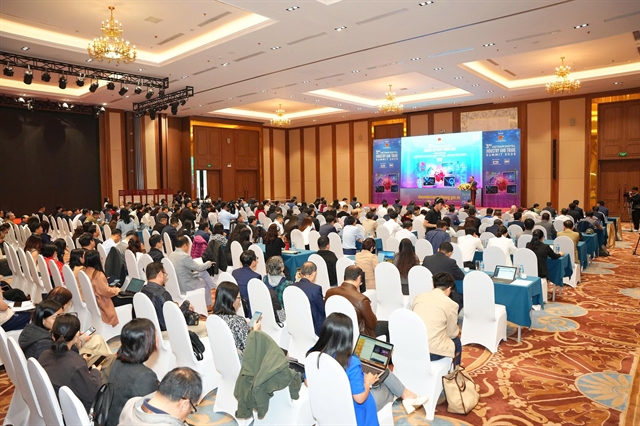
| Scene of the summit. — VNS Photo |
HÀ NỘI — Global economic growth is being sustained, primarily driven by services, digital consumption and innovation, with Việt Nam’s digital economy clearly improving and emerging as a new pillar to boost productivity, expand markets and enhance the economy’s resilience.
Retail e-commerce is forecast to surpass US$25 billion and remains a main pillar of the Internet economy, Deputy Minister of Industry and Trade Nguyễn Sinh Nhật Tân said at the third Việt Nam Digital Industry and Trade Summit 2025 in Hà Nội on Wednesday.
The summit was organised by the Việt Nam E-commerce and Digital Economy Agency (iDEA) under the Ministry of Industry and Trade (MoIT) at a crucial time when the Vietnamese economy is accelerating technology adoption and green growth, compelling the industry and trade sector to intensify innovation, modernise value chains and enhance its competitiveness amidst deepening international integration.
The Deputy Minister emphasised the industry and trade sector has pushed digital transformation across three main pillars: digital government, digital economy of the industry and trade sector and data infrastructure.
However, the sector this year needs to innovate more strongly and comprehensively to leverage opportunities from dual transformation – digital transformation (DX) and green transformation (GX).
To realise this goal and propose policies, models and solutions to promote effective and sustainable development of e-commerce and the digital economy, Deputy Minister Tân suggested discussions to focus on three major areas.
(1) New technology trends such as artificial intelligence (AI), the Internet of Things (IoT), big data and cloud computing, along with their application potential in digital government, smart manufacturing, smart energy and e-commerce.
(2) Solutions for developing a green, sustainable, safe e-commerce market; strengthening management of cross-border e-commerce; promoting regional linkages; and supporting consumption of local products on digital platforms.
(3) Models and solutions for developing the digital economy of the industry and trade sector at the local level, particularly for small and household businesses, key forces in the market’s digital transformation.
Finally, the Deputy Minister expressed a desire for contributions from agencies, organisations and businesses to help MoIT continue to perfect the legal framework, database, support mechanisms and programmes to promote e-commerce, digital economy and digital transformation of the industry and trade sector toward a green, sustainable and innovative direction.
Reporting on the orientation for digital transformation of the industry and trade sector in 2026, Hoàng Ninh, iDEA deputy director, affirmed that digital transformation continued to be identified as a strategic task, closely linked to green transformation and sustainable development, and remained a vital driver for comprehensive restructuring of the entire industry and trade sector until 2030.
The three pillars of digital government, digital economy and digital society would continue to be implemented consistently to ensure effective execution and broader impact of digital transformation across the whole sector, Ninh said.
In developing the digital economy, he stated that e-commerce remained a major growth driver with a B2C scale of about $25 billion last month, accounting for 10 per cent of total retail sales of goods and consumer services.
Digital transformation in industry, smart manufacturing, recorded many positive signs, with the IIP index increasing by 8.4 per cent, the highest level in five years.
About 90 per cent of processing-manufacturing enterprises have partially implemented digital solutions. Thirty-five per cent use robots and sensors in production and 10–12 per cent have achieved Smart Factory 3.0 level.
Furthermore, the energy sector continues its strong shift with the application of smart metering, real-time operational data, AI load forecasting, EMS systems in businesses, along with expansion of renewable energy models.
Ninh also emphasised that Việt Nam’s digital economy is projected to reach $39 billion this year, continuing to be among the fastest-growing in the region.
Over 40 AI startups have attracted $123 million in private capital, 81 per cent of users interact with AI daily and 96 per cent express trust in AI agents.
Based on these results, Ninh believes that 2026 will be the time for the industry and trade sector to create strategic breakthroughs, including standardising the national e-commerce data, expanding the smart factory model to generations 3.0–4.0 and rolling out smart energy metering and management nationwide. — VNS
Economy
 Economy
 Economy
 Economy
 Economy
 Economy
 Economy
 Economy
 Economy
 Economy
 Economy
 Economy
 Economy
 Economy
 Economy