 World
World

Swiss President Guy Parmelin arrives in Hà Nội, beginning official visit to Việt Nam
1.
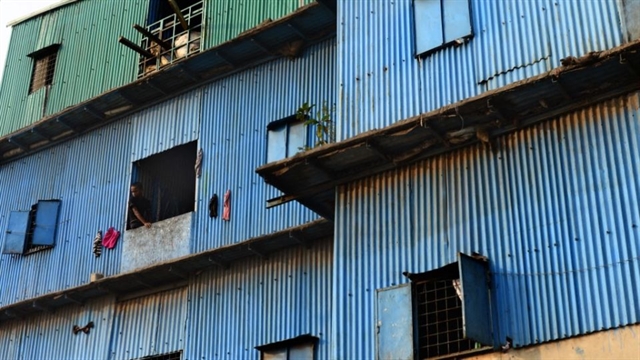 |
| A Bangladeshi youth looks on from a slum house near the Buriganga river in Dhaka on December 23, 2015. About a third of the 140 million people living in Bangladesh live in poverty. — AFP/VNA Photo |
DHAKA — Nearly three in four families who lost their homes to climate disasters and now live in the slums of Satkhira town are severely food insecure, according to a new study.
The survey, conducted throughout last August, covered families displaced by cyclones, floods and riverbank erosion who took shelter in the town’s slums. It found that 74.9 per cent of the surveyed families were severely food insecure, according to a press release.
KHANI Bangladesh, a nongovernmental organisation, carried out the research.
The study mentioned that only 7.5 per cent of these families are covered by government social safety net programmes.
Five years after the adoption of the National Strategy on the Management of Disaster and Climate-Induced Internal Displacement 2021, its commitments have yet to reach the lives of these displaced families, it said.
On the occasion of the International Day for Disaster Risk Reduction, the findings of the research “Displaced, Denied” by KHANI Bangladesh and PRAAN were presented at a multi-stakeholder dialogue in Satkhira, organised by the Food Security Network–KHANI Bangladesh, KHANI member SoDESH Satkhira and the Participatory Research and Action Network (PRAAN).
The research report was presented at the dialogue by Umme Salma, programme coordinator of PRAAN.
The research collected data on 1,341 members of 358 families across 35 settlements of Satkhira municipality. Around 7,573 such families live in 47 informal settlements of the municipality, a large share of whom have been displaced from various areas, including Shyamnagar and Assasuni.
According to the research findings, in 95.5 per cent of the surveyed families, at least one member skipped meals, and in 52.2 per cent of families, someone went an entire day without eating.
To obtain food, 57.3 per cent of families sold productive assets or essential household items, and 96.9 per cent of families depend partly or entirely on saline and iron-contaminated water from shallow tube wells.
In the past month, waterborne diseases occurred in half of the families, it added.
Some 59 per cent of families living informally on government land have faced eviction or the threat of eviction.
In the last 12 months, 79.1 per cent of families received no government or non-government assistance, and 92.7 per cent of families do not know where to lodge a complaint if they are denied assistance or need it.
Some 33.2 per cent of those aged 6 to 18 are not enrolled in school; 30 per cent of them are engaged in child labour, the study found.
Sheikh Moinul Islam Moin, deputy commissioner of Satkhira, said that in the slums, there is no space to grow vegetables, no water and no facilities for a decent life.
He said that if the needs of each slum could be identified through resource mapping in collaboration with the municipality, everyone concerned could share the responsibility.
He remarked that the municipality has not yet been formally given responsibility for the slums, so there is now an opportunity to redefine its role. — THE DAILY STAR/ANN
World
 World
World
 World
World
 World
World
 World
World
 World
World
 World
World
 World
World
 World
World
 World
World
 World
World
 World
World
 World
World
 World
World
 World
World