 Society

Wuzhen Summit Puts Spotlight on Tongxiang’s Expanding AI Industry
1.
|
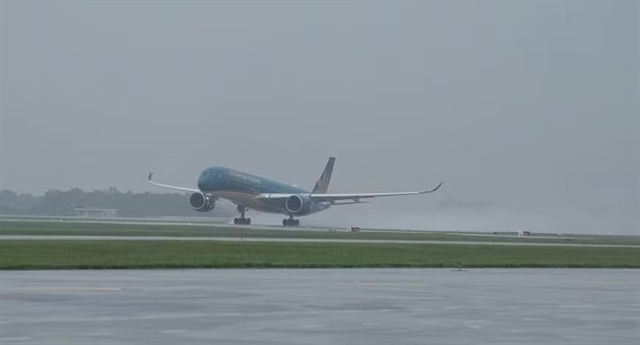
| An aircraft lands amid rainy and stormy weather conditions. VNA/VNS Photo |
HÀ NỘI — The Vietnam Air Traffic Management Corporation (VATM) has activated emergency response plans for its subordinate units as a tropical depression in the East Sea (internationally known as the South China Sea) develops in a complex manner and could intensify into a typhoon affecting flight operations.
According to meteorological agencies, the system may strengthen into a typhoon and affect a number of sectors under the jurisdiction of the Hà Nội Area Control Centre (Hà Nội ACC) and the HCM City Area Control Centre (HCM City ACC), as well as flight operations at several airports in northern Việt Nam.
Due to the influence of the inter-tropical convergence zone combined with south-westerly monsoon winds, from the afternoon of August 20 to August 22, convective clouds, thunderstorms and accompanying dangerous weather phenomena are likely to occur in sectors two and three, and subsequently in the southern area of sector one under the jurisdiction of Hà Nội ACC.
The Aviation Meteorological Centre has assessed that a number of northern airports – including Cát Bi, Vân Đồn, Nội Bài, Thọ Xuân, and Vinh – may be affected by rain showers, thunderstorms, gusts and reduced visibility in the coming days.
Air traffic control facilities are continuing to closely monitor weather developments and update forecast and warning bulletins in order to deploy appropriate air traffic management measures and ensure flight safety.
VATM's Steering Committee for Natural Disaster Prevention, Control and Search and Rescue has required all agencies and units to continue monitoring and tracking developments of the tropical depression or typhoon, to activate response plans in line with regulations, to assign specific responsibilities, and to organise round-the-clock duty forces.
Units are to deploy synchronised natural disaster prevention and control measures in accordance with the "four on-the-spot" principle, while inspecting, reviewing and implementing safety measures for facilities, stations, equipment and technical installations.
Units must secure and fasten structures and equipment in accordance with approved plans to minimise potential losses from natural disasters.
The Aviation Meteorological Centre is to continue closely monitoring weather developments and provide timely and accurate forecast and warning bulletins to air traffic control facilities and users, particularly regarding dangerous weather phenomena such as thunderstorms, lightning, heavy rain and strong gusts.
The Northern Air Traffic Management Company, the Central Air Traffic Management Company and the Southern Air Traffic Management Company are to co-ordinate closely with relevant units to ensure that air traffic control facilities maintain safe operations and strictly comply with regulations and directives on air traffic management in adverse weather conditions. Units are to prepare contingency plans for flights to avoid dangerous weather, reroute flights or divert to alternate airports when necessary.
The Air Traffic Flow Management Centre is to closely monitor flight activity on relevant airways and develop air traffic flow management plans, co-ordinating with relevant units to reduce congestion and holding at areas and airports likely to be affected by adverse weather.
Units are to continue inspecting communications systems and technical equipment to ensure that air traffic control operations are maintained safely and without interruption.
The Aeronautical Information Centre is ordered to follow developments closely and co-ordinate with relevant agencies and units to issue aeronautical information notices in line with actual conditions as they unfold.
VATM has said it is committed to ensuring the safety, efficiency and continuity of flight operations while minimising the impact of natural disasters on operations and facilities providing air navigation services.
Alongside its air traffic management responsibilities, VATM continues to concentrate resources on implementing its investment programme to upgrade infrastructure and technical equipment in accordance with this year's roadmap. — VNS
Society
 Society
 Society
 Society
 Society
 Society
 Society
 Society
.png) Society
Society
 Society
 Society
 Society
 Society
 Society
 Society
.jpg)