 Society

AIMCONNECT 2026 Held in Singapore, Bringing Global Automotive Leaders Together to Explore the Future of AI, Trust and Connected Mobility
1.
|
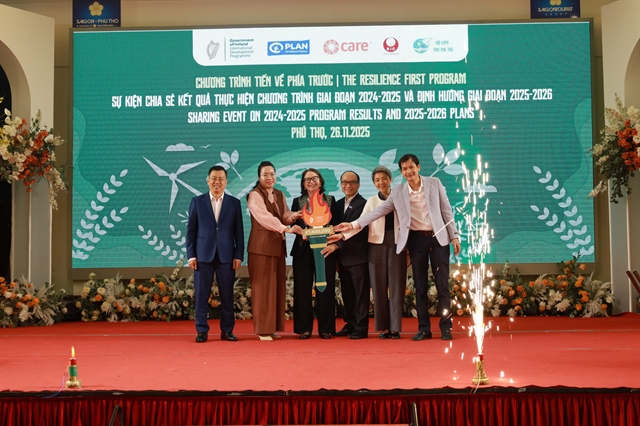
| Irish Aid in Việt Nam has committed €1.4 million (US$1.62 million) to the Resilience First programme to strengthen climate resilience and empower ethnic minority women in 13 communes across Tuyên Quang, Quảng Trị, and Phú Thọ provinces. — Photo courtesy of CARE Vietnam |
HCM CITY — The Resilience First programme, implemented by Plan International Vietnam, CARE International in Vietnam, and the Centre for Research on Initiatives of Community Development, has announced a substantial commitment of €1.4 million (US$1.62 million) in funding from Irish Aid in Việt Nam.
The announcement followed a planning event in Phú Thọ Province, where partners finalised the programme’s implementation plan for the next 12 months, targeting 13 communes across Tuyên Quang, Quảng Trị, and Phú Thọ provinces.
Deirdre Ní Fhallúin, Ambassador of Ireland to Việt Nam, said Ireland was proud to continue to support the programme.
“This €1.4 million commitment reflects our dedication to safeguarding vulnerable communities against climate change and empowering ethnic minority women as leaders in their own development,” she noted.
The renewed funding will strengthen local authorities’ capacity, support poor and ethnic minority communities in mountainous areas, and enhance resilience to both immediate and long-term climate impacts.
Ngô Công Chính, programme director of Plan International Vietnam, highlighted that strong collaboration among partners had improved the adaptive capacity of over 26,000 people and scaled up women-led, climate-resilient livelihood models. He added that the next phase would bring climate-smart initiatives to more communities.
During 2024–2025, the programme delivered significant community-led results. Under the commune-level climate change adaptation component, officials in 15 communes were trained in vulnerability analysis and developing climate response plans. More than 140 community activities benefited 1,747 people, including 732 women, through training, equipment provision, drills, and public awareness campaigns on climate change and waste management.
Under the infrastructure and capacity-building pillar, 31 micro-projects, including bridges, roads, water facilities, revetments, and reinforced disaster shelters, were completed, with 24 fully managed by communities. Nearly 12,000 residents, mostly ethnic minorities, now benefit from improved mobility, safe shelters, water and irrigation security, and expanded electricity access. A further 247 people received training in project planning and implementation, building long-term technical capacity within communities.
The programme also strengthened climate-resilient schools, assessing 32 schools and implementing plans for disaster preparedness and climate adaptation.
Women’s empowerment and climate-adaptive livelihoods were central to the programme. Over 1,400 participants, mostly women, received training in adaptive farming and resource management. More than 64 per cent of women applied new resilience techniques, 36 per cent reported increased income, and nearly 87 per cent said they now participate confidently in household and community decision-making.
“Empowering women is an investment in community resilience. When women are equipped with knowledge and resources, they become the most powerful agents for driving local climate change adaptation solutions, ensuring communities not only survive but also thrive," said CARE Vietnam Country Director Lê Kim Dung.
Mao Quốc Toản, deputy director of Tuyên Quang’s Department of Foreign Affairs, praised the programme’s community-based approach, noting that officials were better trained, schools safer, and women’s groups more confident in economic activity. He added that the new funding is expected to "bring meaningful improvements, especially to highland communes that still face many difficulties." — VNS
Society
 Society
 Society
 Society
 Society
 Society
 Society
 Society
 Society
 Society
 Society
 Society
 Society
 Society
 Society