 Politics & Law

Lotte, Phát Đạt combine strengths in Thu Thiem project
1.
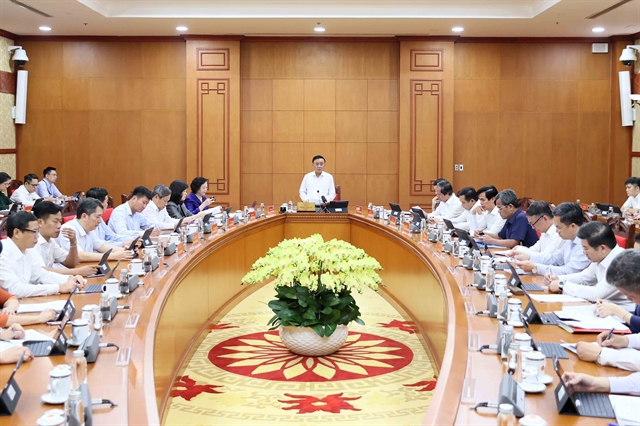 |
| Trần Cẩm Tú, a Politburo member and permanent member of the party’s Secretariat, chairs the meeting on the one-year implementation of Resolution 72 on Thursday. — VNA/VNS Photo |
HÀ NỘI — A senior Communist Party official urged the government on Thursday to end shortages of medicines, vaccines and medical supplies and to overhaul how public hospitals are financed, saying a year-old health resolution must deliver tangible results for the public.
Trần Cẩm Tú, a Politburo member and permanent member of the party’s Secretariat, chaired a meeting with the government to review the first year of Resolution 72, a Politburo blueprint setting out breakthrough measures to protect and improve public health.
Health Minister Đào Hồng Lan, whose ministry leads implementation, told the meeting that the resolution had quickly taken hold, changing attitudes and drawing in resources across the political system.
Tú praised the health ministry and local authorities for their initiative and said early results were encouraging, with real progress on every target. But he said party leaders, including General Secretary and President Tô Lâm, had demanded an end to the pattern of sound policies poorly carried out.
The public must be able to see and monitor the changes, he said, and concrete benefits for ordinary people would be the measure of success.
On shortages, he told the health ministry to issue a full set of circulars in the fourth quarter covering cost and technical norms, the grouping of tender packages and price frameworks for medical services.
He also told the ministry to scrap the 'ask-give' approval system and overlapping rules that leave hospitals hesitant.
The finance ministry was ordered to urgently finalise mechanisms for national centralised procurement and drug price negotiations, and to issue transparent guidance on how public hospitals set aside and use their development funds.
The senior party official also called for a comprehensive revision of hospital financial autonomy, ending 'half-baked' autonomy and the practice of forcing lower-level hospitals to cover running costs before they are ready, which he said risks pushing them to squeeze patients for revenue or overuse services.
Under the resolution, facilities that provide welfare and basic care should be funded by the state, with high autonomy reserved for those that qualify, he said. The state budget should also pay for infrastructure, major equipment and disease prevention.
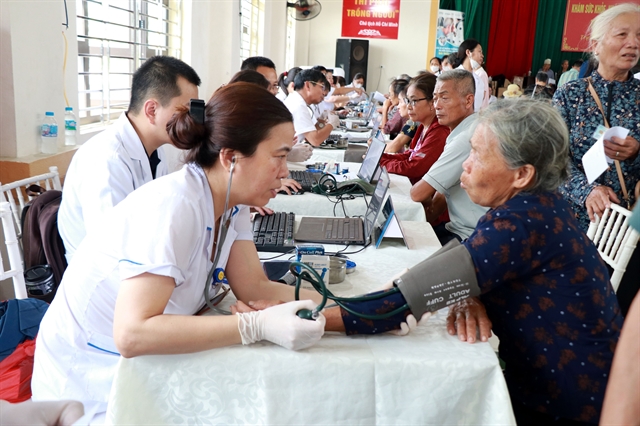 |
| Older residents receive free health checkups at a hospital in the northern province of Ninh Bình under Resolution 72. — VNA/VNS Photo |
He urged a shift from treating illness to managing health over a lifetime, with health goals written into the economic and social development plans of every ministry, province and city.
Provincial and city authorities must commit at least 30 per cent of local health budgets to preventive medicine and primary care, as the resolution requires, and report any difficulties to the central leadership for support, he said.
Tú also asked the health ministry and local authorities to review how commune-level health stations are organised, staffed, equipped and financed, deciding what must be fixed immediately and what can follow a timetable. He called for incentives to recruit, train, rotate and retain staff, especially in remote and disadvantaged areas.
On the health workforce, Tú said resources should first go to the 2026-2035 national target programme on health care, population and development, with a focus on preventive medicine and primary care.
Once rules on salaries and special occupational allowances for health workers are finalised, he said, they must be enforced strictly this year to attract and keep staff.
The resolution entitles residents to at least one free checkup or screening a year from 2026. The Secretariat member said localities should complete checkups for remaining residents in the final months of the year, striving to reach 100 per cent.
He praised some localities for lining up donors to supply basic medicines to people seeking care, calling the approach effective and worth replicating.
Warning that delays in digitisation would waste resources, Tú asked the health ministry to lead the building of a national health database that connects smoothly with other national databases, and to invest in IT infrastructure at primary care facilities to roll out electronic medical records, health books and prescriptions.
The health ministry should also work with the Ministry of Public Security to put electronic health books on the VNeID digital identity app for all residents before June 30, 2027.
"Going to the doctor should require nothing more than a citizen ID card, with no paper books and no unnecessary repeat tests," he said.
By year-end, all qualifying hospitals must link test and imaging results across facilities, the senior party official said, adding that hospitals must not be allowed to deliberately repeat tests to charge patients without legitimate medical grounds. — VNS
Politics & Law
 Politics & Law
 Politics & Law
 Politics & Law
 Politics & Law
 Politics & Law
 Politics & Law
 Politics & Law
 Politics & Law
 Politics & Law
 Politics & Law
 Politics & Law
 Politics & Law
 Politics & Law
 Politics & Law