 Politics & Law
Businesses urged to redesign work around people as AI reshapes jobs
1.
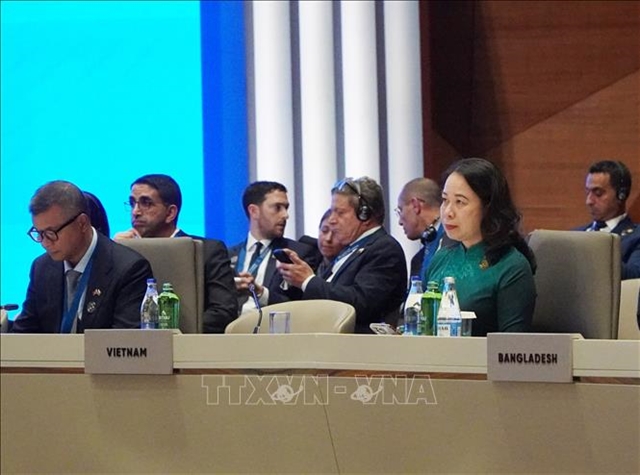 |
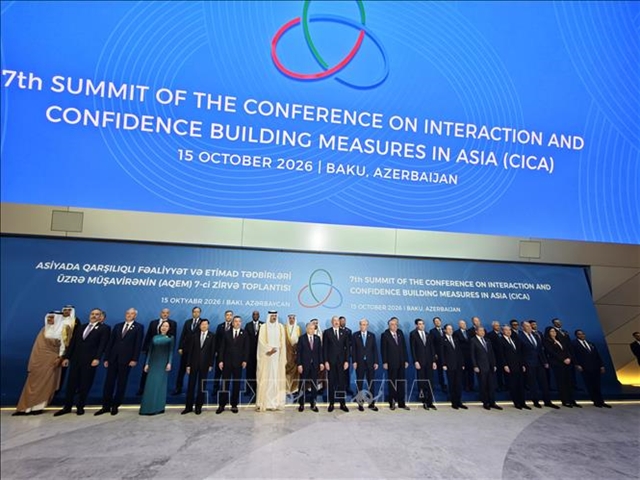
| Vice President Võ Thị Ánh Xuân delivered a keynote address at the 7th Summit of the Conference on Interaction and Confidence Building Measures in Asia in Baku, Azerbaijan on Thursday. — VNA/VNS Photo |
BAKU — Vietnamese Vice President Võ Thị Ánh Xuân delivered a keynote address at the 7th Summit of the Conference on Interaction and Confidence Building Measures in Asia (CICA) in Baku, Azerbaijan on Thursday.
Xuân praised CICA’s more than three decades of progress in fostering dialogue, mutual understanding and trust among members, and safeguarding peace, stability and cooperation across Asia.
With the global and regional landscape shifting profoundly, she said CICA must keep reforming to sharpen its effectiveness and drive substantive cooperation, a resolve reaffirmed in the key documents adopted at the summit.
She said the summit’s theme, “Stronger CICA: Connectivity, Digitalisation and Sustainable Growth in Asia,” gives the bloc a practical direction: fair and transparent connectivity that aligns interests, inclusive digitalisation that widens opportunities, and shared development gains that deliver common prosperity.
The Vice President set out three priorities for CICA. First, she called for respect for and consistent adherence to international law as the foundation of stronger trust, urging members to uphold multilateralism and the central role of the United Nations (UN). CICA should cooperate and settle differences under the UN Charter and fundamental principles of international law, including respect for independence, sovereignty and territorial integrity; non-interference in internal affairs; no use or threat to use force; and peaceful settlement of disputes. Việt Nam urges countries to settle regional conflicts and disputes by peaceful means and in line with international law, she said.
Second, she pushed for tighter coordination to make cooperation against common challenges more effective. She urged more information sharing, open communication channels and joint efforts to head off and respond to risks, particularly in political and military affairs, cybersecurity, energy security, water security, climate change and natural disasters. She also proposed broader coordination among CICA, the Association of Southeast Asian Nations (ASEAN) and other regional mechanisms, along with stronger links among Southeast Asia, Central Asia and the wider Eurasian space.
Third, economic, technological and cultural ties should be tighter to build momentum for sustainable development. She pressed for deeper connectivity in infrastructure, transport and supply chains, and stronger cooperation in education - training, science - technology, innovation, digital transformation, green transition and artificial intelligence. She also expected wider access to finance, credit, funding and humanitarian aid to narrow development gaps and open opportunities for countries in difficulty. Cultural cooperation and people-to-people exchanges should be reinforced too, turning diversity into a resource for cooperation and sustainable development.
Xuân highlighted Việt Nam’s gains after 40 years of Đổi Mới (Renewal), saying that the country has built a solid foundation for its next phase, targeting status as a developing country with modern industry and upper-middle income by 2030, and a developed, high-income country by 2045.
Việt Nam is ready to share its experience and work with CICA members on areas of common interest, and will keep building trust through concrete, practical action toward a peaceful, connected and prosperous Asia, she said.
Meeting Uzbek President Shavkat Mirziyoyev the same day, Xuân relayed greetings from General Secretary of the Communist Party of Việt Nam Central Committee and President Tô Lâm and an invitation to Mirziyoyev to make an official visit to Việt Nam at an early date. She welcomed the progress in bilateral ties in recent years.
Mirziyoyev sent regards to the Vietnamese Party and State leader, recalled a positive impression from their May 2025 meeting, and praised Việt Nam’s development gains.
Uzbekistan places particular importance on ties with Việt Nam and hopes to establish a direct air route soon to give bilateral connectivity a breakthrough, he said.
Meeting CICA Secretary-General Kairat Sarybay, Xuân congratulated him on the summit’s success and commended his efforts to strengthen the CICA Secretariat and elevate the organisation’s role in confidence-building and regional dialogue.
Việt Nam always attaches importance to CICA and is committed to taking part actively and responsibly and contributing in practical ways, she said. She announced a voluntary contribution of US$20,000 to the Secretariat as a show of that commitment.
On the occasion, the Vice President gave Sarybay a miniature model of the Đông Sơn bronze drum, a symbol of Vietnamese culture, as a message of solidarity to the Secretariat in Astana, Kazakhstan.
The two sides agreed to take steps to make cooperation more effective and strengthen CICA’s institutional framework to deliver substantive results. They also pledged to roll out regional connectivity directions and initiatives, focusing on Việt Nam’s strategic role as a bridge between CICA and ASEAN.
On October 14, her first day in Baku, Xuân also met leaders of Laos, Cambodia, Kyrgyzstan, Kazakhstan, Belarus, Israel and Sri Lanka.
The leaders sent greetings to General Secretary and President Lam, Prime Minister Lê Minh Hưng, National Assembly President Trần Thanh Mẫn and other Vietnamese leaders. They congratulated Việt Nam on its recent achievements and said they want to deepen bilateral relations.
Conveying greetings from General Secretary and President Lâm and other leaders, Xuân said Việt Nam values friendship and substantive cooperation with each country. She also discussed ways to boost cooperation in areas where both sides have strengths.
The summit drew nine heads of state and government, one top legislator, one Vice President, one Deputy PM and nine ministers from 32 member and observer countries, plus representatives of five international and regional organisations.
CICA was founded in 1992 on the initiative of then-Kazakh President Nursultan Nazarbayev to coordinate efforts on major Asian issues and build cooperation among members in security, economic and financial affairs, sustainable development, environment, health, energy, information technology, humanitarian affairs, counterterrorism and the fight against transnational crime. It is an intergovernmental forum for dialogue, consultation and confidence-building that adopts decisions and measures on Asian security issues by consensus. CICA now has 29 member states, 14 observer states and six partner organisations. Việt Nam has been a member since 2010. — VNA/VNS
Politics & Law
 Politics & Law
 Politics & Law
 Politics & Law
 Politics & Law
 Politics & Law
 Politics & Law
 Politics & Law
 Politics & Law
 Politics & Law
 Politics & Law
 Politics & Law
 Politics & Law
 Politics & Law
 Politics & Law